We always say that a few days are not enough for Napoli, and that a month would not be enough for its surroundings. Volcanoes, islands, cities buried by Vesuvius, coastlines plunging into the sea and a cuisine that on its own justifies the trip. In this guide we line up everything we have written about the city and its province, to help you build the trip that suits you best.
Naples: where to start
If it is your first time, start with what to see in Naples, devoted to monuments and squares, and 5 must-see places in Naples, our selection for those short on time. For the great museums there is what to visit in Naples, while things to do in Naples gathers the experiences not to miss, from an espresso at the bar counter to the funicular up to the Vomero.
Already decided how many days to stay? We have prepared two day-by-day itineraries, Naples in 2 days and Naples in 3 days, plus a route entirely devoted to Caravaggio, the Baroque and contemporary art in an art weekend in Naples. To walk with a common thread, read the most famous streets of Naples.
The historic centre and its churches
The historic centre of Naples has been a UNESCO World Heritage Site since 1995 and still preserves the street grid of the Greek city. We describe its most famous axis in Spaccanapoli, Palazzo del Plebiscito and the Royal Palace. Along Spaccanapoli you will come across the church of the Gesù Nuovo, with its diamond-point façade, and the Santa Chiara complex and its majolica cloister, commissioned by Roberto d'Angiò (Robert of Anjou) and Queen Sancia.
A few steps away is the Cappella Sansevero: we explain how to plan your visit in visiting Naples: discover the Cappella Sansevero and tell you about its masterpiece, the sculpture by Giuseppe Sanmartino, in the Veiled Christ in Naples. Heading up towards Via dei Tribunali you pass through San Gregorio Armeno, the street of nativity scenes, which fills with visitors every Christmas; the art of the figurine makers is described in the Neapolitan nativity scene.
On the decumano maggiore, the main ancient street, you will find San Lorenzo Maggiore and its excavations, where you walk through the old Roman market, and Santa Maria delle Anime del Purgatorio ad Arco, with its hypogeum devoted to the anime pezzentelle, the forgotten souls of the poor. A little further on stands Naples Cathedral, which holds the relics of the patron saint and whose most heartfelt feast is described in the miracle of San Gennaro. For all the other churches, from Angevin Gothic to Baroque, there is the churches and basilicas of Naples.
Royal Naples: castles, theatres and galleries
The Naples of kings is concentrated between Piazza del Plebiscito and the port. the Teatro di San Carlo, opened in 1737, is the oldest opera house in the world still in operation. Opposite it rises the great glass-and-iron roof of the Galleria Umberto I and Via Toledo, where the shopping street begins. Towards the sea soar the towers of the Maschio Angioino, built by the Angevins from 1279.
On the seafront, the castle on the islet of Megaride has a story all of its own: you will find it in the legend of Castel dell'Ovo. And if you want to know where the city's name comes from, read the legend of the siren Parthenope: the myth of the birth of Naples. Up on the hill, meanwhile, Castel Sant'Elmo and the Certosa di San Martino await, with one of the finest views over the gulf, and inside them the Museo del Novecento at Castel Sant'Elmo.
Museums, underground Naples and the Rione Sanità
Two museums alone are worth the trip: the National Archaeological Museum of Naples (MANN), with the Farnese collection and the treasures of Pompei and Ercolano, and the Museo e Real Bosco di Capodimonte, the royal palace built by Carlo di Borbone (Charles of Bourbon) for the works he inherited from his mother Elisabetta Farnese.
Beneath the streets lies another city, which we describe in visiting Napoli Sotterranea (underground Naples). In the Rione Sanità district you can visit the Catacombs of San Gennaro and the Catacombs of San Gaudioso, and not far away is the old ossuary to which we devoted the Fontanelle Cemetery: between beliefs and truth. For street art, from huge portraits to the murals of the Quartieri Spagnoli, read the murals of Naples.
The sea in Naples and the Posillipo coast
Naples is a city of the sea. On the Posillipo hill, among submerged Roman villas and protected waters, Marechiaro and the Gaiola Underwater Park await. To help you choose where to swim in the city and the province, we have gathered our favourite spots in the beaches of Naples and its surroundings.
Travelling with little ones? You will find ideas in having fun with kids in Naples, including the historic Fuorigrotta amusement park described in Edenlandia in Naples. And in San Giovanni a Teduccio, on the border with Portici, there is a museum loved by adults and children alike: the Pietrarsa Railway Museum, housed in the workshops founded by Ferdinando II di Borbone in 1840, a stone's throw from the route of Italy's first railway, the Napoli-Portici line of 1839.
Vesuvius, the buried cities and the Miglio d'Oro
The volcano that dominates the gulf, 1,281 metres high, last erupted in 1944: its whole story is in Vesuvius: its history. The eruption of AD 79 buried the Roman towns of the area, and the archaeological sites of Pompeii, Herculaneum and Torre Annunziata have been UNESCO World Heritage since 1997. Start with Herculaneum and Pompeii: what to see and add the excavations of Oplontis, with the great villa attributed to Poppaea.
At the foot of the volcano, between Naples, Portici, Herculaneum and Torre del Greco, the 18th-century nobility built dozens of summer residences: we describe them in the Miglio d'Oro: the luxury and elegance of its 18th-century villas.
The Campi Flegrei
West of the city stretches the caldera of the Campi Flegrei (Phlegraean Fields), a land of craters, lakes and ancient myths. Our general guide is a trip to the Campi Flegrei. In Pozzuoli you will find the Flavian Amphitheatre and Rione Terra in Pozzuoli, the third-largest Roman amphitheatre in Italy. In Bacoli you can visit the Archaeological Park of Baia, with its baths and sunken city, and a little further north the oldest Greek colony on the Italian mainland, described in the archaeological site of Cuma, with the Antro della Sibilla (Cave of the Sibyl).
The islands of the gulf
Ferries and hydrofoils leave the port of Naples for all three islands. For Capri, start with the island of Capri: what to see and do, then go deeper with the Blue Grotto and the residences of Emperor Tiberius described in Villa Jovis and Villa Damecuta; the latter lies within Anacapri.
Ischia is the largest island in the gulf: the guide is the island of Ischia: what to do and see, and its symbol, the fortress linked to the shore by a bridge, is in the Aragonese Castle and the Sea Museum of Ischia. We cover its hot springs in spa tourism in Campania: Ischia and other thermal baths. The smallest and most colourful is Procida: read the island of Procida: what to do and see and Corricella on Procida, the fishing village of pastel houses.
Sorrento and the peninsula
On the southern side of the gulf, Sorrento is the gateway to the peninsula: start with Sorrento: what to see and go further with the ancient walls of Sorrento. Continuing towards Punta Campanella, in the municipality of Massa Lubrense, you reach one of the most beautiful inlets in Campania, the Bay of Ieranto. Along the way, in Gragnano, you can discover the pasta-making tradition described in Pasta di Gragnano IGP.
What to eat: dishes, pastries and coffee
Neapolitan cuisine deserves a trip of its own. Start with what to eat in Naples and typical Neapolitan dishes, then move on to the icons: Neapolitan pizza, whose art has been UNESCO Intangible Cultural Heritage since 2017, Neapolitan ragù and genovese, the two Sunday sauces, and the pastries, namely the Neapolitan sfogliatella, the Neapolitan babà and the Neapolitan pastiera. Finish with Neapolitan coffee and the caffè sospeso.
Traditions and popular culture
To understand Naples you need to know its traditions. We have gathered the most famous in famous Neapolitan traditions. The city's emblematic mask is the star of Pulcinella, and the link between dreams and lottery numbers is explained in the Neapolitan Smorfia.
The wines of the province
The volcanic soils of Vesuvius, the Campi Flegrei and the islands produce wines of great character. The overall map is in the wines of Naples. We have described the appellations one by one: Vesuvio DOC, Campi Flegrei DOC, Ischia DOC, Capri DOC and Penisola Sorrentina DOC, along with the geographical indications Catalanesca del Monte Somma IGT, Pompeiano IGT and Epomeo IGT.
Getting there and when to go
Naples is served by Capodichino airport and Napoli Centrale station, with high-speed trains. For the Vesuvius area and Sorrento use the Circumvesuviana; for the Campi Flegrei, the Cumana and the Circumflegrea. The islands can be reached from the Molo Beverello and Calata Porta di Massa ports and, for Ischia and Procida, from Pozzuoli too. Always check timetables and tickets on the official websites before you go.
Spring and early autumn are our favourite seasons: mild weather, the sea already (or still) pleasant and fewer crowds. Summer is for the islands and beaches, winter for the museums and the nativity scenes of San Gregorio Armeno.
Nearby
If you want to continue your trip around Campania, we recommend our other provincial guides: Caserta and its surroundings, with the Reggia, San Leucio and the villages of the Caserta area, and Salerno and its surroundings, for the Amalfi Coast, Paestum and the Cilento. From Naples, meanwhile, don't miss the National Archaeological Museum of Naples (MANN) and Herculaneum and Pompeii: what to see.
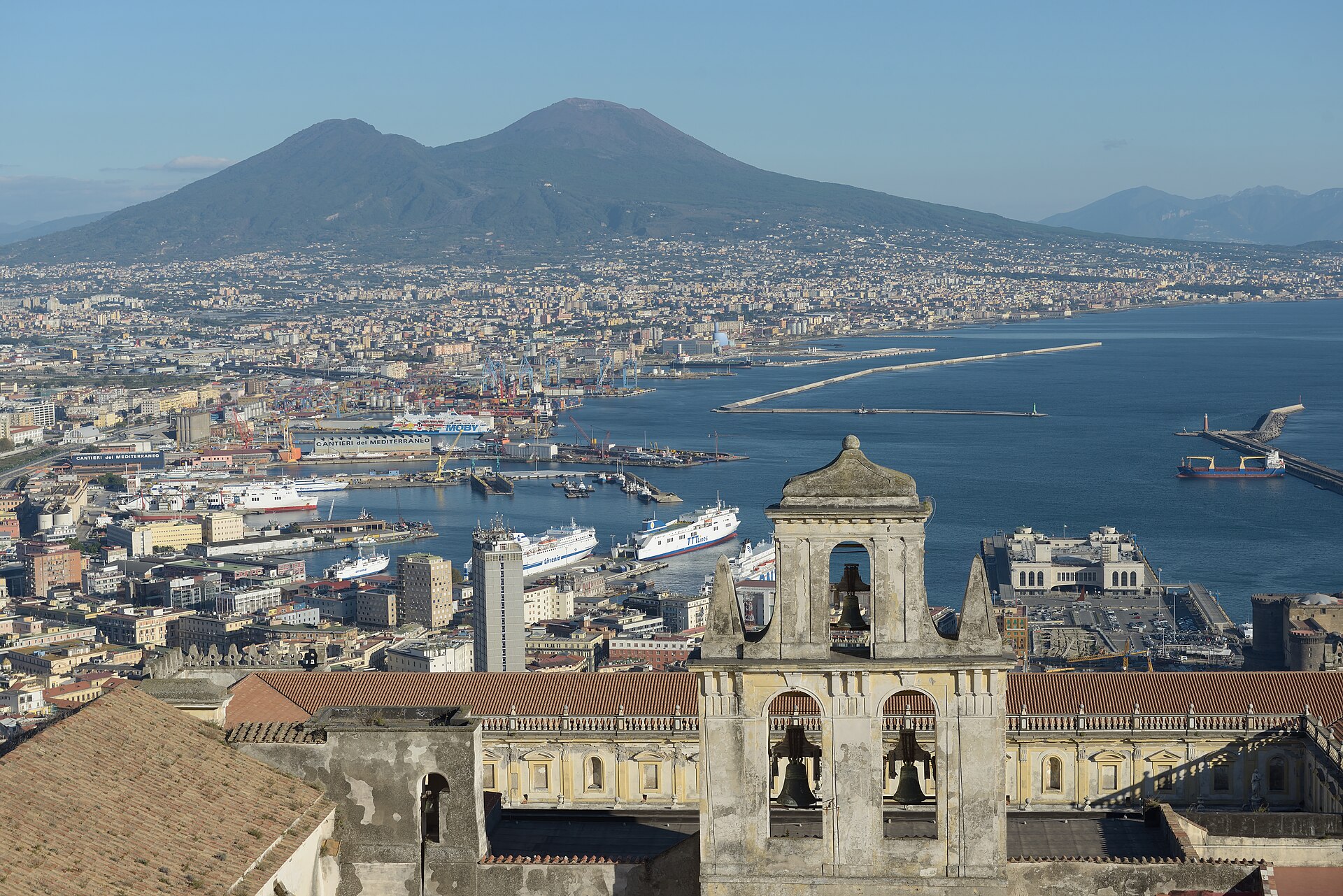
Top photo (Napoli): This Photo was taken by Wolfgang Moroder. Feel free to use my photos, but please mention me as the author and send me a message. This image is not in the public domain. Please respect the copyright protection. It may only be used according to the rules mentioned here. This specifically excludes use in social media, if applicable terms of the licenses listed here not appropriate. Please do not upload an updated image here without consultation with the Author. The author would like to make corrections only at his own source. This ensures that the changes are preserved.Please if you think that any changes should be required, please inform the author.Otherwise you can upload a new image with a new name. Please use one of the templates derivative or extract., CC BY-SA 3.0, via Wikimedia Commons.