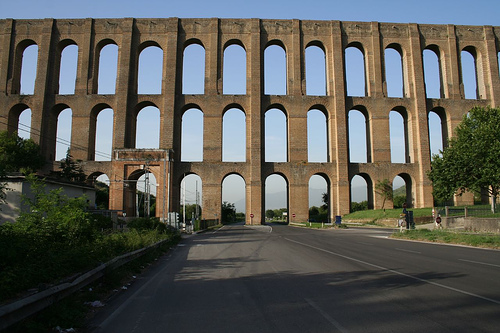
After seeing the fountains of the Royal Palace, we wondered where all that water came from. We found the answer just a few kilometres away, in a valley between the hills, where three tiers of tuff arches cross the landscape like a Roman aqueduct. These are the Ponti della Valle, and we can assure you that they make quite an impression in person.
A work built for the Royal Palace
The Carolino Aqueduct takes its name from Charles of Bourbon, who commissioned it, and is the work of Luigi Vanvitelli, the same architect who designed the Royal Palace. It was built to feed the water features of the royal park, the Great Waterfall and the San Leucio complex, as well as to meet the needs of the town.
Work began in March 1753 and the aqueduct was inaugurated on 7 May 1762: nine years for a project that still seems impressive to us today. Since 1997 it has been a UNESCO World Heritage Site, together with the Royal Palace and the Belvedere of San Leucio.
Thirty-eight kilometres from Mount Taburno to Caserta
The water is collected at the Fizzo springs, at the foot of the Taburno massif, in the municipality of Bucciano, in the province of Benevento. From there the channel runs for about 38 kilometres to Mount Briano, behind the Royal Palace, where the water pours into the park’s waterfall.
What surprised us is that almost the entire route is underground: the aqueduct runs through tunnels following a gradient calculated with great precision, and only surfaces where it has to cross the valleys. The most spectacular point is precisely the one at Valle di Maddaloni.
The Ponti della Valle
At Valle di Maddaloni the aqueduct crosses the valley on the great viaduct of the Ponti della Valle: 529 metres long and 55.8 metres high at its highest point. It is built of tuff and rises on three tiers of arches stacked one above the other, modelled on the great Roman aqueducts that Vanvitelli knew well.
Standing beneath the arches we grasped its proportions: the lower arches are massive, the upper ones lighter and more numerous, and the whole has a regular rhythm that is best appreciated from a few hundred metres away. We recommend looking at them both up close and from a distance, to take in the full view.
An eighteenth-century engineering masterpiece
To build the aqueduct, Vanvitelli had to solve very practical problems: keeping a constant gradient over dozens of kilometres, tunnelling through mountains and crossing valleys without losing height. The Ponti della Valle are the most visible solution to this work, but the real achievement is the whole system, which carried water by gravity right into the heart of the royal park.
Visiting them after the Royal Palace helps you understand that Charles of Bourbon’s residence was not just a palace, but a great project of territorial transformation, which also included the silk colony and the hunting estates.
How to get there and when to go
The Ponti della Valle are a few kilometres from the Royal Palace, between Maddaloni and Valle di Maddaloni, and are easy to reach by car. The viaduct can be viewed freely from the outside, from the open square at its foot. From time to time the Royal Palace of Caserta, which manages the site, organises guided tours and special openings, including evening ones: check times, bookings and tickets on the official website before you set off.
In our opinion the best light is in the late afternoon, when the tuff takes on a warm colour. Avoid the muggiest summer days if you want to walk around the area.
In the surroundings
Heading back towards Caserta, complete the water trail with The Royal Gardens of Caserta and The English Garden of the Royal Palace of Caserta. The aqueduct also supplied the San Leucio colony: we tell you about it in The Silk Museum of San Leucio. For a medieval break there is Casertavecchia, and to plan the rest of your trip start from Caserta and its surroundings.
Top photo (Valle di Maddaloni): Original uploader was Istvánka at hu.wikipedia, CC BY-SA 3.0, via Wikimedia Commons.
Read also: The English Garden of the Royal Palace of Caserta