When the ferry approaches Marina Grande and we see the white houses climbing up the rock, every time we think that Capri is even more beautiful than we remembered. It is a small island but full of things to see, divided between two municipalities, Capri and Anacapri. Here is what not to miss and how to plan your day so you can enjoy it even in the busiest months.
An island unlike the others
Unlike Ischia and Procida, which are volcanic in origin, Capri is an island of limestone, once joined to the Sorrento peninsula. This is what gives it its caves, sheer cliffs and famous sea stacks. The vegetation is typically Mediterranean, and the island is home to rare species such as the famous blue lizard.
The Piazzetta and the Certosa di San Giacomo
From the harbour, take the funicular up to the Piazzetta, whose official name is Piazza Umberto I. It is the heart of island life, with its clock tower and lanes branching off all around. We recommend going at sunset, when the light changes and the square fills up.
Heading south you reach the Certosa di San Giacomo, a charterhouse founded in 1371 by Count Giacomo Arcucci on land donated by Queen Giovanna I d'Angiò (Joanna I of Anjou). It is the oldest monastery on the island: among its cloisters, cells and gardens there is a deep sense of calm. Inside is also a museum devoted to the German painter Karl Wilhelm Diefenbach, who lived and died on Capri.
The Faraglioni, Marina Piccola and Via Krupp
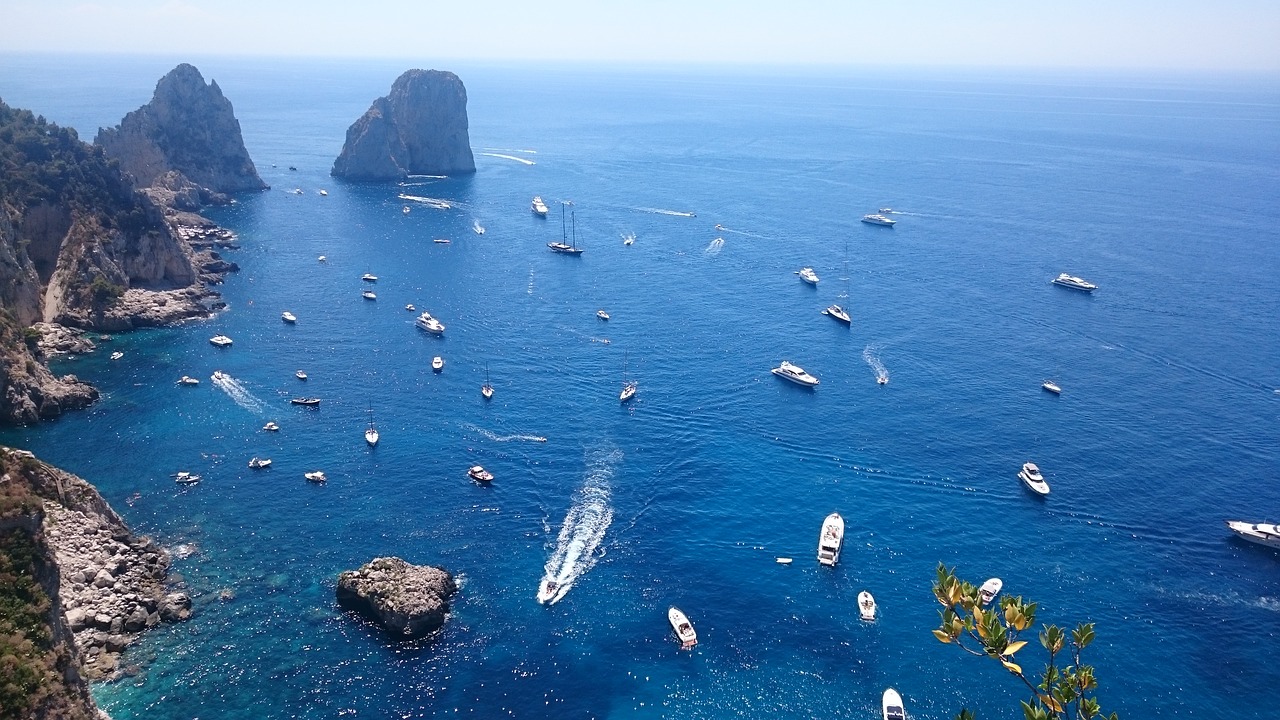
The Faraglioni are the symbol of Capri. There are three of these sea stacks, and each has a name: Stella, the landward stack, still joined to the island and about 111 metres high; the Faraglione di Mezzo (middle stack), pierced by a natural tunnel that boats sail through; and the Faraglione di Fuori (outer stack), also called Scopolo, the only place where the blue lizard lives. The best spot to admire them is the Belvedere di Tragara, but seeing them from the sea, by boat, is a different thrill altogether.
On the south side lies Marina Piccola, where tradition places the Scoglio delle Sirene (Sirens' Rock), linked to the myth of Ulysses. To get there from the centre there is the spectacular Via Krupp, the hairpin road carved into the rock and commissioned by the German industrialist Friedrich Alfred Krupp. It was closed for years because of the risk of landslides and has recently reopened: check whether it is accessible before you go. Its starting point, the Giardini di Augusto (Gardens of Augustus), offers one of the finest views on the island in any case.
Villa Jovis and the Arco Naturale
If you love walking, climb up to Villa Jovis, on Monte Tiberio, 334 metres above the sea. From here Emperor Tiberius ruled the empire from AD 26 to 37. What strikes you most about the ruins are the huge rainwater cisterns and the view over the gulf. Next to it is the precipice known as the Salto di Tiberio (Tiberius's Leap), tied to legends about the emperor's cruelty that historians today play down.
Another lovely walk leads to the Arco Naturale, a great natural rock arch overlooking the sea on the eastern side of the island.
Anacapri: the Blue Grotto and Monte Solaro
The Grotta Azzurra (Blue Grotto) lies within the territory of Anacapri. In Roman times it was a seaside nymphaeum, but it was "rediscovered" in 1826 by the German poet August Kopisch and the painter Ernst Fries. Its blue colour comes from light filtering in through an underwater opening. You enter lying flat in the bottom of small rowing boats, through an opening in the rock just above sea level: whether you can visit depends on sea conditions.
From Anacapri you can go up Monte Solaro, the island's highest peak at 589 metres, by chairlift or on foot. From the top you can see both the Gulf of Naples and the Gulf of Salerno: for us it is the most beautiful view on Capri.
Getting there and when to go
Capri can be reached by ferry or hydrofoil from Napoli and Sorrento; in summer there are also connections from other towns around the gulf. On the island you get around by funicular, minibus and taxi, as cars belonging to non-residents are restricted during the busiest periods. For the Blue Grotto, the chairlift and the archaeological sites, check opening times and tickets on the official websites before you go.
The best time to visit is between May and June or in September and October. In high season we recommend arriving on the first boats of the morning.
Nearby
We have written in-depth pages on Villa Jovis and Villa Damecuta and the Blue Grotto. To taste the island in a glass, read Capri DOC. Opposite Capri, on the peninsula, Sorrento: what to see and the stunning Bay of Ieranto await. To plan the rest of your trip, start with our guide Naples and its surroundings.