The first time we climbed up from Via dei Mercanti towards the Cathedral of Salerno, we did not expect to find, at the top of the steps, such a bright porticoed courtyard, with the bell tower rising above the arches. It is a place that tells a thousand years of the city’s history, and it deserves a slow, unhurried visit.
A Norman cathedral for Saint Matthew
The Cathedral, dedicated to Santa Maria degli Angeli, Saint Matthew (San Matteo) and Saint Gregory VII, was built between 1080 and 1085 at the behest of Robert Guiscard, the Norman duke who had recently conquered the city, putting an end to the Lombard principality. The building work was led by Archbishop Alfanus I, a poet and physician linked to the Salerno Medical School (Scuola Medica Salernitana).
The new church was meant to provide a worthy home for the relics of Matthew, apostle and evangelist, which had arrived in Salerno in 954. It was consecrated in 1084 by Pope Gregory VII, who died the following year in Salerno itself, where he had taken refuge in exile. Today the cathedral holds the rank of minor basilica and is a national monument.
The four-sided portico, the lions and the bronze door
You enter through the Porta dei Leoni (Lions’ Gate), named after the two sculptures that flank it: legend has it that during a Saracen raid the lions came to life to defend the city. Beyond the portal opens the four-sided atrium (quadriportico), with round arches resting on reused columns, some of them taken from the city’s Roman forum.
On one side of the courtyard rises the bell tower, about 52 metres high, built in the 12th century on the initiative of Archbishop William of Ravenna: it is one of the finest examples of Arab-Norman style in Campania. Before entering the church, take a good look at the central portal: the bronze door was made in Constantinople in 1099, a gift from Landolfo and Guisana Butrumile.
The interior: medieval pulpits and Baroque decoration
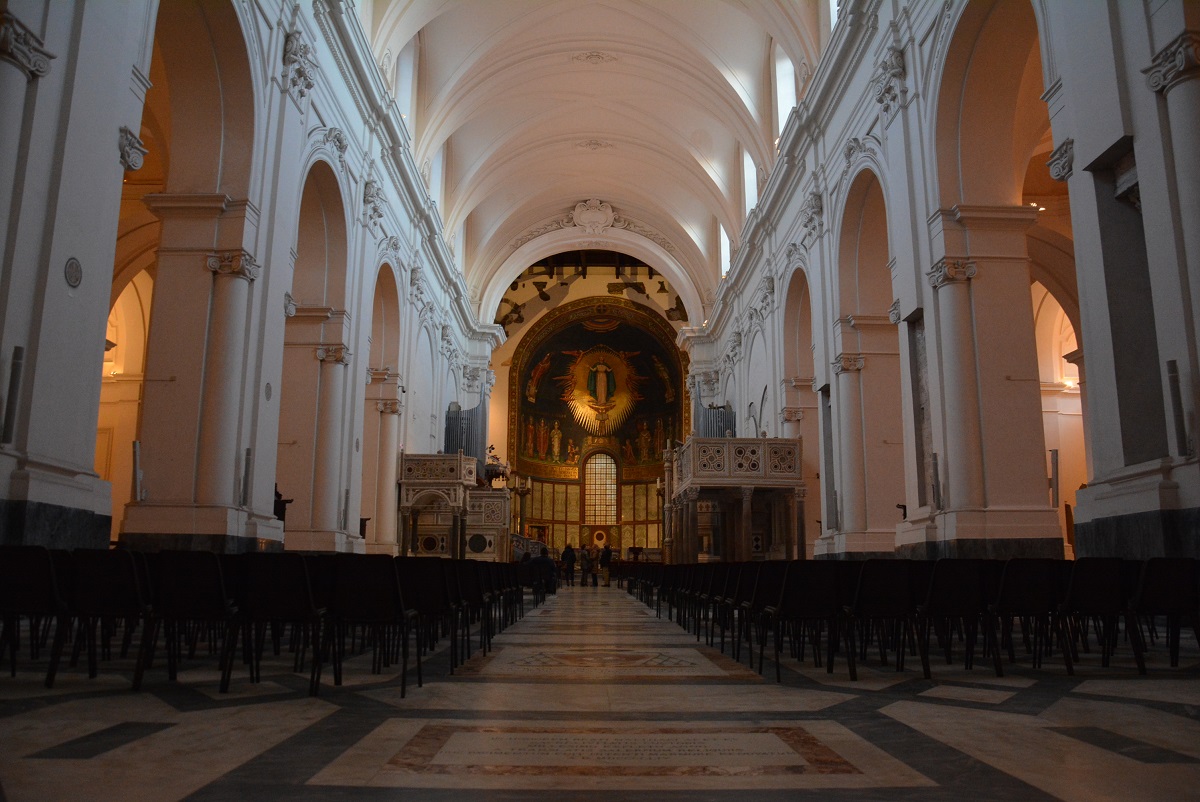
Today the interior looks largely Baroque. After the earthquake of 1688, the cathedral was in fact rebuilt with the help of architects such as Ferdinando Sanfelice and Arcangelo Guglielmelli. From the Middle Ages, however, there remain treasures that left us open-mouthed: the two great mosaic pulpits, the Guarna ambo (1180) and the d’Aiello ambo (1195), with their geometric and figurative decoration.
In the right-hand aisle is the Crusaders’ Chapel (Cappella dei Crociati), which keeps the tomb of Gregory VII beneath the altar. Stop here for a few minutes: it is one of the most contemplative spots in the whole church.
The crypt of Saint Matthew
The real heart of the Cathedral lies beneath the floor. The crypt, with a basilica plan and cross vaults, was remodelled in Baroque style at the beginning of the 17th century to designs by Domenico Fontana and his son Giulio. The vaults are entirely frescoed by Belisario Corenzio with scenes from the Gospels and from the history of Salerno, while the apostle’s tomb stands in the centre. Walking down the stairs, the contrast between the sober atrium and the golden splendour of the crypt is what struck us most.
Every year on 21 September, the statue of the saint leaves the cathedral for the great city procession: we tell you all about it in San Matteo e la processione delle paranze.
The Diocesan Museum
Next to the cathedral, in the former seminary, the Diocesan Museum houses works from the Cathedral and from the churches of the diocese. Its most famous treasure is the collection of Salerno Ivories (Avori Salernitani), a cycle of ivory panels carved in the Middle Ages with scenes from the Old and New Testaments. If you have time, round off your visit here.
Getting there and when to go
The Cathedral stands in Piazza Alfano I, in the upper part of the old town, about ten minutes on foot from the seafront. From Via dei Mercanti you climb up through sloping alleys, so wear comfortable shoes. Remember that this is a place of worship: dress appropriately and keep silent during services, when tourist visits are suspended.
Opening hours and access arrangements change during the year and on public holidays: check the times and tickets for the crypt and museum on the official website before you set off. We recommend early morning or late afternoon, when the light in the portico is softer.
Nearby
- The Cathedral is only the first stop: discover the other churches of the centre in Le Chiese e la Cattedrale di Salerno.
- Just a few steps away is the Lombard chapel of San Pietro a Corte.
- Climbing higher up, you will find Il Giardino della Minerva e la Scuola Medica Salernitana.
- To plan your whole trip, start from our guide Salerno e dintorni.
Read also: The Archaeological Park of Velia