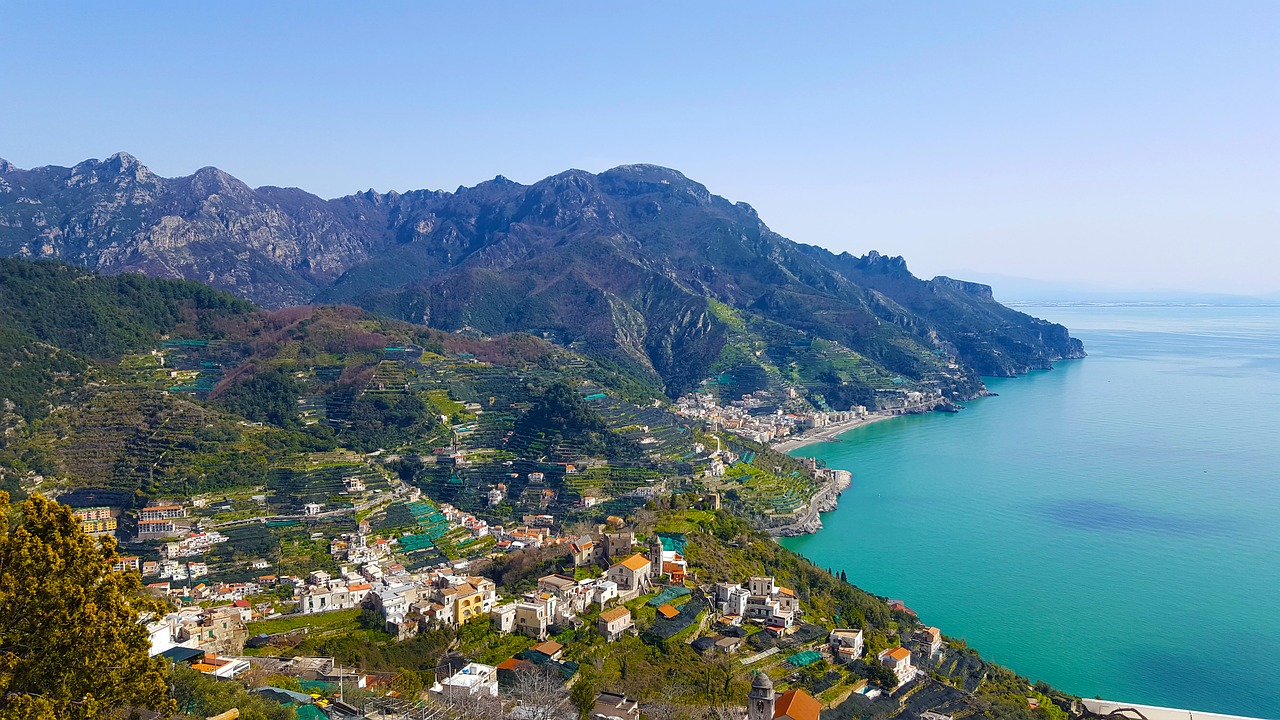
Every time we go up to Ravello we wonder which of the two villas to visit first, and every time we end up seeing both. They are two very different places, one medieval and musical, the other romantic and almost like something out of a novel, but they share one thing: a view over the sea that will leave you speechless.
Villa Rufolo, the merchants’ residence
Villa Rufolo is just a few steps from the cathedral square. Its layout dates back to the 13th century, when it was built by the Rufolo family, wealthy Ravello merchants. Their fame even reached literature: a certain Landolfo Rufolo is the protagonist of one of the tales in Giovanni Boccaccio’s Decameron.
You enter through the entrance tower and continue to the cloister, which struck us with its Arab-Norman style: a double order of columns with decorations reminiscent of Siculo-Arabic art. The complex is dominated by the Torre Maggiore, about 30 metres high, a symbol of the family’s power. Since 2017 it has housed a small vertical museum, reached by climbing a hundred or so steps.
Francis Nevile Reid and Klingsor’s garden
After centuries of decline, the villa was bought in the mid-19th century by the Scotsman Francis Nevile Reid, who began an extensive restoration and redesigned the gardens, giving the complex the appearance we see today. The flower-filled terraces overlooking the gulf are the most moving moment of the visit.
In 1880 Richard Wagner came here: according to tradition, it was in the gardens of Villa Rufolo that the composer pictured Klingsor’s magic garden, the setting for the second act of Parsifal. Ravello’s musical calling was born from this connection. In 1953 the “Wagner Concerts” began in the gardens, later evolving into the Ravello Festival: still today, in summer, the famous stage suspended over the sea is set up in the lower garden.
Villa Cimbrone, an English banker’s dream
To reach Villa Cimbrone you walk for about ten minutes through narrow lanes and stepped alleys to the very tip of the promontory. The estate has ancient origins, but its current look is owed to the British banker Ernest William Beckett, later Lord Grimthorpe, who bought it in 1904. Together with the local builder Nicola Mansi, he transformed the old farmhouse into a villa that blends Gothic, Moorish and Venetian touches, surrounded by a park full of statues, small temples and grottoes.
Beckett died in 1917 and was buried in the garden itself, at the foot of the Temple of Bacchus. Today the villa is a hotel, but the garden is open to the public and can be visited for a fee.
The Avenue of Immensity and the Terrace of Infinity
The route we recommend is simple: follow the Viale dell’Immenso (Avenue of Immensity), the long pergola-covered avenue, and let it lead you all the way to the end. There the Terrazza dell’Infinito (Terrace of Infinity) opens up, the viewpoint adorned with marble busts and perched sheer above the sea, with a view sweeping across the Gulf of Salerno. We lingered for a long time leaning on the balustrade, and it’s easy to understand why Gore Vidal, who lived in Ravello for many years, considered it one of the most beautiful views in the world.
Along the way you’ll come across other evocative corners, such as the small temple with the statue of Ceres, Eve’s grotto and the rose garden. In the 20th century the villa hosted famous guests: from members of the Bloomsbury Group, including Virginia Woolf, to Winston Churchill and Greta Garbo, who stayed here in 1938 with the conductor Leopold Stokowski.
How to get there and when to go
Ravello is reached by the road that climbs up from Amalfi and the Amalfi Coast road, or by scheduled buses: in high season we recommend public transport, as parking is scarce. Both villas can be visited on foot from the centre. The best time is spring, when the gardens are in bloom; summer is perfect if you want to attend a concert at Villa Rufolo. Check opening times and tickets on the official website before you set off.
Nearby
For an overview of the whole province, start from our guide Salerno and surroundings, while for Ravello you’ll find more tips in Ravello: what to see and major events. Heading down to the sea, in Minori you’ll find the Roman villa of Minori, and in Amalfi don’t miss Amalfi Cathedral and the Cloister of Paradise. For walkers there’s the Path of the Gods, and for a toast the area offers Costa d’Amalfi DOC wines.
Read also: Villa Jovis and Villa Damecuta