The first time we arrived in the square in Amalfi, we stopped at the foot of the staircase, heads tilted back, gazing at the striped façade and the golden mosaics shining in the sun. The Duomo is the heart of the town, and a full visit, from the cloister down to the crypt, is a little journey through the history of the ancient Maritime Republic.
A cathedral born from two churches
Amalfi Cathedral is dedicated to Saint Andrew the Apostle, the town’s patron saint. The complex is the result of joining two buildings: the older Basilica of the Crucifix (Basilica del Crocifisso), which rose on the site of an early Christian temple, and the new cathedral built alongside it from the 10th century, in the age of the Dukes of Amalfi. After the year 1000 the two churches were linked into a single large Romanesque structure.
Over the centuries the building changed its appearance several times. Today the interior is Baroque, while the façade we see is from the 19th century: on the night of 24 December 1861 a strong wind brought down part of the crowning, and the façade was rebuilt to a design by the architect Errico Alvino, with mosaics designed by Domenico Morelli.
The staircase, the bronze door and the bell tower
Climbing the great staircase is the first ritual of the visit, and it is also the best spot from which to take in the square. At the top, beneath the portico, is the central bronze door, cast in Constantinople in the 11th century and donated by Pantaleone, a member of a wealthy family of Amalfi merchants: tangible evidence of the trade links between Amalfi and Byzantium. On its panels you can make out Christ, the Virgin, Saint Peter and Saint Andrew.
Next to it rises the bell tower, built between the 12th century and 1276, its upper section clad in Arab-style majolica tiles. We love looking at it from the square in the late afternoon, when the tiles glitter.
The Cloister of Paradise
From the portico you enter the Cloister of Paradise (Chiostro del Paradiso), where the tour of the complex begins: it is the place that enchanted us most. It was built between 1266 and 1268 at the behest of Archbishop Filippo Augustariccio as a cemetery for Amalfi’s noble families: in the Middle Ages, “paradise” meant precisely the burial ground beside an important church.
The cloister is square, with a garden of palm trees in the centre and a portico supported by 120 slender paired columns carrying interlaced pointed arches, in a style that blends Romanesque and Arab influences. Along the sides are chapels, including the Chapel of the Crucifixion with 14th-century frescoes, and several Roman-era sarcophagi reused in the Middle Ages. Strolling in the shade of the portico, with the white arches against the green of the palms, is a moment of rare calm in the crowded centre.
The Basilica of the Crucifix and the museum
From the cloister you pass into the Basilica of the Crucifix, the old cathedral, restored to its medieval form in works that began in 1931. Today it houses the Diocesan Museum, with silverware, liturgical vestments, sculptures and objects from the cathedral treasury. Our advice is not to rush: these are intimate spaces where you can really feel the atmosphere of medieval Amalfi.
The crypt of Saint Andrew
Going down, you reach the crypt, commissioned by Cardinal Pietro Capuano, who in 1208 brought the relics of Saint Andrew from Constantinople to Amalfi. The space is decorated entirely in Baroque style, with frescoes on the vaults and a bronze statue of the saint by Michelangelo Naccherino. According to tradition, the so-called manna of Saint Andrew, a liquid collected and venerated by the faithful, seeps from the tomb. Finally you climb back up into the cathedral proper, with its Baroque naves.
How to get there and when to go
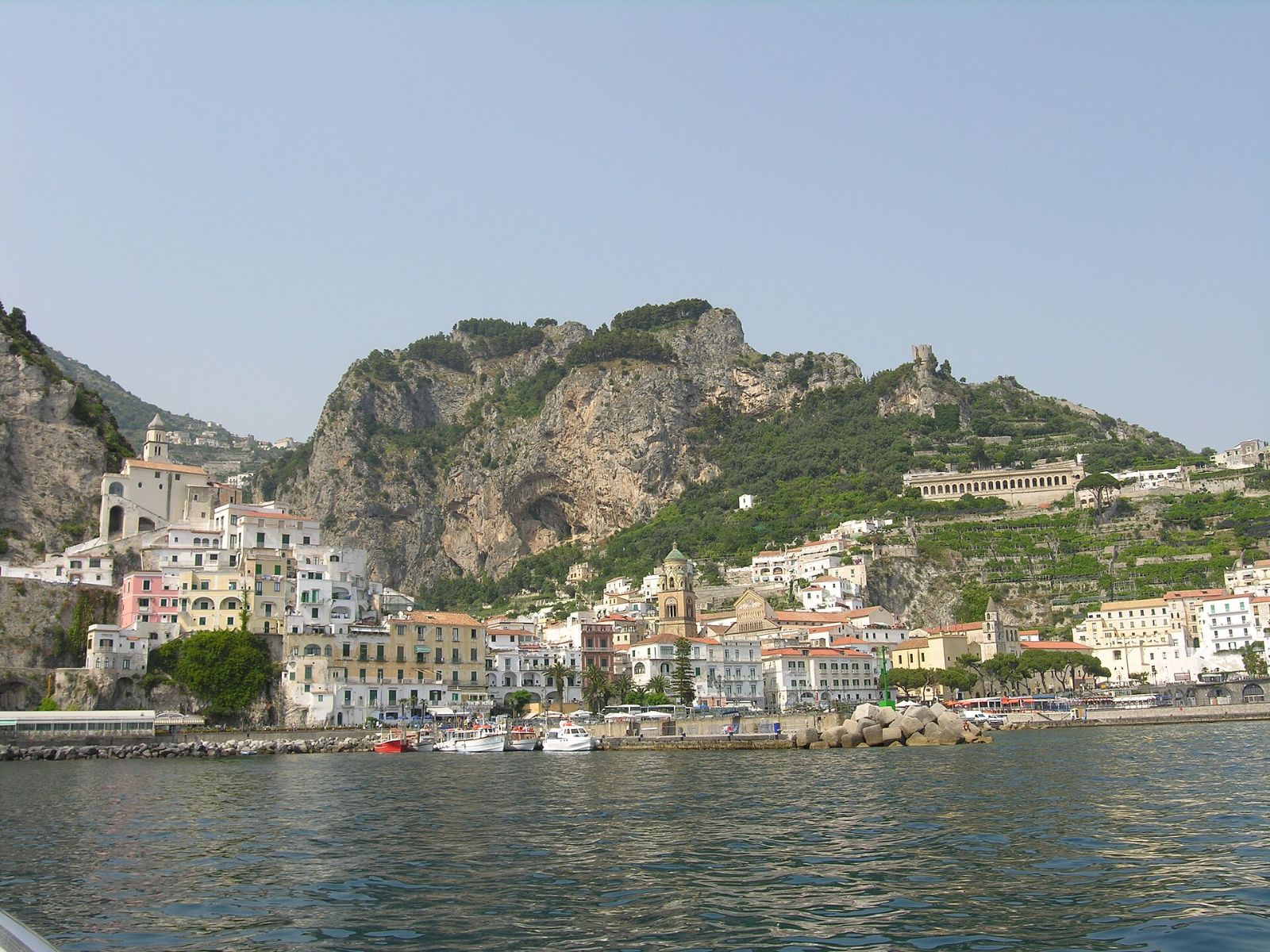
The Duomo stands in Piazza Duomo, in the centre of Amalfi, a few minutes’ walk from the harbour. Amalfi is connected by scheduled buses along the Amalfi Coast road and, in the warmer months, by ferries and hydrofoils from Salerno and the other towns on the coast. The ideal time is spring or autumn; in summer we recommend going early in the morning, before the tour groups arrive. Allow about an hour for a full visit of the complex. Check opening times and tickets on the official website before you set off.
Nearby
To discover the rest of the province, start from Salerno and surroundings, and for the town itself you’ll find all our tips in Amalfi: what to do and what to see. A few minutes’ walk away is Atrani, described in Atrani, the smallest village in Italy, while heading up towards Ravello you’ll find Villa Rufolo and Villa Cimbrone. Further west along the coast, don’t miss the Fjord of Furore.
Top photo (Amalfi): No machine-readable author provided. Sudodana2048 assumed (based on copyright claims)., CC BY-SA 3.0, via Wikimedia Commons.
Read also: Arechi Castle