Every time we go back to Salerno we are amazed at how easy it is to explore on foot: in a few hundred metres you go from the sea to the medieval alleys, and from there climb up to the castle. In this article we tell you about the monuments that, in our view, you should not miss on your first visit to the city.
The Cathedral of San Matteo, the heart of the city
The first place we take you is Salerno Cathedral, dedicated to Santa Maria degli Angeli and to Saint Matthew, the city's patron saint. It was commissioned by Robert Guiscard after the Norman conquest, together with Archbishop Alfanus I, and was consecrated in 1084 by Pope Gregory VII, who is buried right here.
You enter through an elegant quadriporticus, an arcaded courtyard that has always struck us as a small, intimate square. Before going into the church, look up at the 12th-century bell tower, almost 52 metres high, and stop in front of the bronze door that arrived from Constantinople in 1099. In the crypt, rich in Baroque decoration, lie the relics of the evangelist. If you want to learn more about the history and works of the church, read Salerno Cathedral.
The historic centre and Via dei Mercanti
From the Duomo we suggest heading down into the historic centre, one of the most compact and lively in Campania. Its main axis is Via dei Mercanti, which in the Middle Ages was the street of trade and craft workshops and still keeps that air of constant comings and goings.
Along the way you come across noble palaces, small churches and sudden little squares. Walking slowly you will notice how the city grew in layers: Roman traces, Lombard ones, Norman churches and Baroque façades sit a few metres from one another. This is where you understand why Salerno was chosen, from the 8th century, as the capital of the Lombard prince Arechis II.
The Minerva Garden
Climbing the steps of the centre you reach the Minerva Garden, one of the places closest to our hearts. In the early fourteenth century the physician Matteo Silvatico grew a "garden of simples" here, that is, of medicinal plants, considered the forerunner of Europe's botanical gardens.
The garden is built on terraces linked by a staircase with pillars and a pergola, from which a lovely view opens over the rooftops and the sea. Today it is home to more than 300 species of plants. Its history is linked to that of the Scuola Medica Salernitana, which we tell you about in The Minerva Garden and the Scuola Medica Salernitana.
Arechi Castle, the finest view
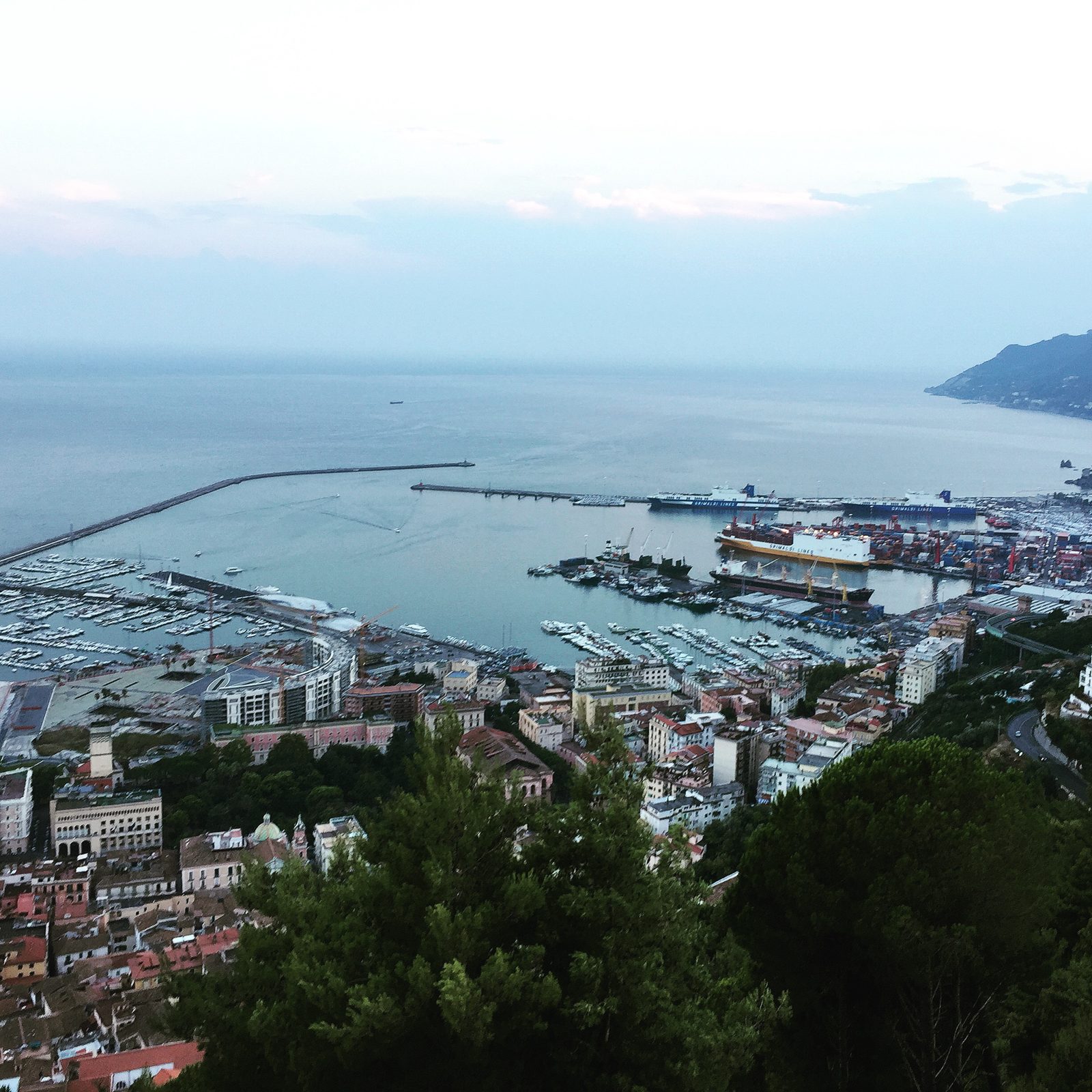
To have Salerno at your feet you need to climb up to Arechi Castle, on the Bonadies hill, at about 300 metres above sea level. The first structure dates back to the 6th century, during the war between Goths and Byzantines; in the 8th century Arechis II made it part of the defensive system of his capital, and later the Normans and Aragonese enlarged it.
From up there the view sweeps over the gulf, from the Amalfi Coast to the Sele plain. Inside is a small museum with ceramics, glass and coins brought to light by excavations. The whole history of the castle is in Arechi Castle.
The medieval Aqueduct
A monument that visitors often do not know about is the medieval Aqueduct, on Via Arce. Built in the 9th century to bring water to the monastery of San Benedetto, it has pointed arches up to about 21 metres high. The people of Salerno call it the "Devil's Bridges": legend has it that the magician Pietro Barliario built it in a single night with the help of demons. We talk about it in The medieval aqueduct of Salerno, the "Devil's Bridges".
The Lungomare Trieste and the Maritime Terminal
We always end the day on the Lungomare Trieste, the long tree-lined promenade overlooking the gulf. At sunset the light on the sea is truly special, and walking among the palm trees is the best way to slow down after a day of monuments.
Towards the port it is worth taking a look at the Maritime Terminal designed by Zaha Hadid and opened in 2016: its curved forms have been likened to an oyster, with a hard shell that protects from the sun. Not far away, on the seafront, is the Teatro Verdi, inspired by the San Carlo in Naples.
How to get there and when to go
Salerno is served by the Naples–Reggio Calabria railway line, where high-speed trains also stop, and by the A2 del Mediterraneo motorway. The historic centre, the Duomo and the seafront are easily visited on foot; for the castle you can use public transport or walk up if you are fit. The best seasons are spring and autumn, when temperatures are pleasant for walking. Check opening times and tickets on the official website before you set off.
In the surroundings
If you have more time, our complete guide is Salerno and its surroundings. For the city's museums and churches read What to visit in Salerno, while for a ready-made programme there is Visiting Salerno in 2 days. A few kilometres away, the ceramics of Vietri sul Mare and the temples described in Paestum and its temples await you.