Walking through the centre of Salerno, a few steps from the shopping streets, we found ourselves beneath a row of very tall, slender arches that seem to hang above the road. These are the Ponti del Diavolo (Devil's Bridges), as the people of Salerno have called the ancient medieval aqueduct for centuries. Here is why they deserve a detour and where such an unsettling nickname comes from.
An aqueduct for the monks of San Benedetto
The medieval aqueduct dates back to the ninth century, the period when Salerno was an important Lombard centre. It was built to carry water to the monastery of San Benedetto, which stood near the city's eastern walls: today that complex houses the museum we describe in The Provincial Archaeological Museum of Salerno.
The aqueduct was made up of two branches: one came down from the hills to the north, the other from the heights to the east, and the two met in the area of today's Via Arce, the street that now runs right under the arches. According to reconstructions, its original length was about 650 metres, of which about 255 metres ran on arches and piers and the rest in underground conduits.
Tall, slender arches, ahead of their time
What struck us most is the proportion of the arches: they are very tall compared with the thickness of the piers, so much so that from below they look almost fragile. At its highest points the structure reaches about 21 metres. Scholars also highlight the use of the pointed arch, a solution that appears here very early compared with its spread in southern Italy.
Do not expect an intact monument, though: over the centuries several stretches were demolished to make room for the growing city, and today only a few hundred metres remain. That is exactly why it is worth taking your time, trying to imagine the water's journey from the hills to the monastery.
The legend of Pietro Barliario and the devils
Where does the name Devil's Bridges come from? According to popular tradition, the aqueduct was raised in a single night by the Salerno magician and alchemist Pietro Barliario, who lived in the twelfth century, with the help of a host of demons. A story probably born of amazement at arches that seemed too daring to be the work of human hands alone.
There is also another legend, linked to the Scuola Medica Salernitana. It is said that right under these arches, sheltering from the rain, four travellers met: the Greek Pontus, the Latin Salernus, the Jew Helinus and the Arab Adela. Discovering that they were all physicians, they decided to found a school together. It is only a tale, but it captures well the spirit of encounter between cultures that made the School famous: we talk about it in The Minerva Garden and the Scuola Medica Salernitana and in the Virtual Museum of the Scuola Medica Salernitana.
A monument to be protected
The aqueduct is a fragile monument. In recent years the Soprintendenza and the Municipality of Salerno have begun checking its state of conservation, after reports of stone fragments coming loose, and the monument has been included in a restoration project supported through the Art Bonus scheme. When you pass by, look at it with respect: it is one of the few examples of early medieval hydraulic engineering still visible in the city.
How to get there and when to go
The Devil's Bridges are in the city centre, along Via Arce, a few minutes' walk from the main shopping street and Salerno railway station. The monument can be viewed freely from the street at any time, so it is easy to include in a walk between the modern centre and the historic centre. We recommend the late afternoon light, when the arches stand out clearly against the sky. In winter, during Luci d'Artista, the area is even livelier: read Luci d'Artista in Salerno.
Nearby
From here you can continue to the San Benedetto complex and its museum, or climb up to the historic centre to discover San Pietro a Corte and Salerno Cathedral. To build a complete itinerary, we suggest spending two days in Salerno and, for the whole province, our guide Salerno and its surroundings.
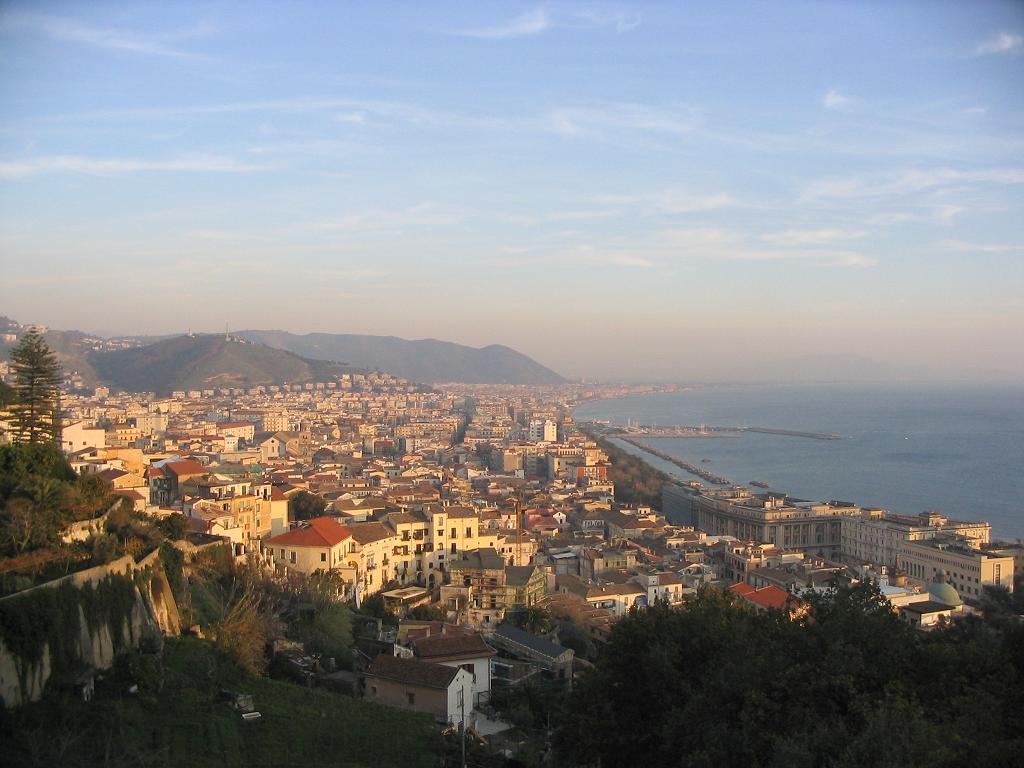
Photo at the top (Salerno): No machine-readable author provided. Giaros assumed (based on copyright claims)., CC BY-SA 3.0, via Wikimedia Commons.