There are places we know from our school books that still leave us speechless when we see them in person: for us, Paestum is one of them. Walking among the Doric temples, with the tall grass and the mountains behind, gave us a sense of how great Magna Graecia was. We are in the municipality of Capaccio Paestum, south of Salerno: here we tell you what to see and how to plan your visit.
From Poseidonia to Paestum: a little history
The city was founded around 600 BC by Greek colonists from Sybaris, in Calabria, who called it Poseidonia, in honour of Poseidon. It was a wealthy city, on a fertile plain near the sea and the mouth of the Sele river, where an important sanctuary dedicated to Hera also stood.
Between 420 and 410 BC the city passed to the Lucanians, an Italic people from the interior, and in 273 BC it became a Roman colony under the name of Paestum. During the Early Middle Ages, malaria and raids led to its abandonment, and vegetation hid it for a long time. This is precisely why the temples have come down to us in such extraordinary condition. Since 1998 the area has been a UNESCO World Heritage Site, together with Velia, the Certosa di Padula and the Cilento Park.
The Temple of Hera, the "Basilica"
The oldest of the three great temples is the Temple of Hera, built around 560 BC. For a long time it was called the "Basilica" because the first scholars, seeing no pediments, mistook it for a Roman civic building. It has an unusual plan, with an odd number of columns on the façade, and the columns have a characteristic swelling halfway up the shaft. Looking at it up close, we appreciated how different it is from the more "classical" temples.
The Temple of Neptune
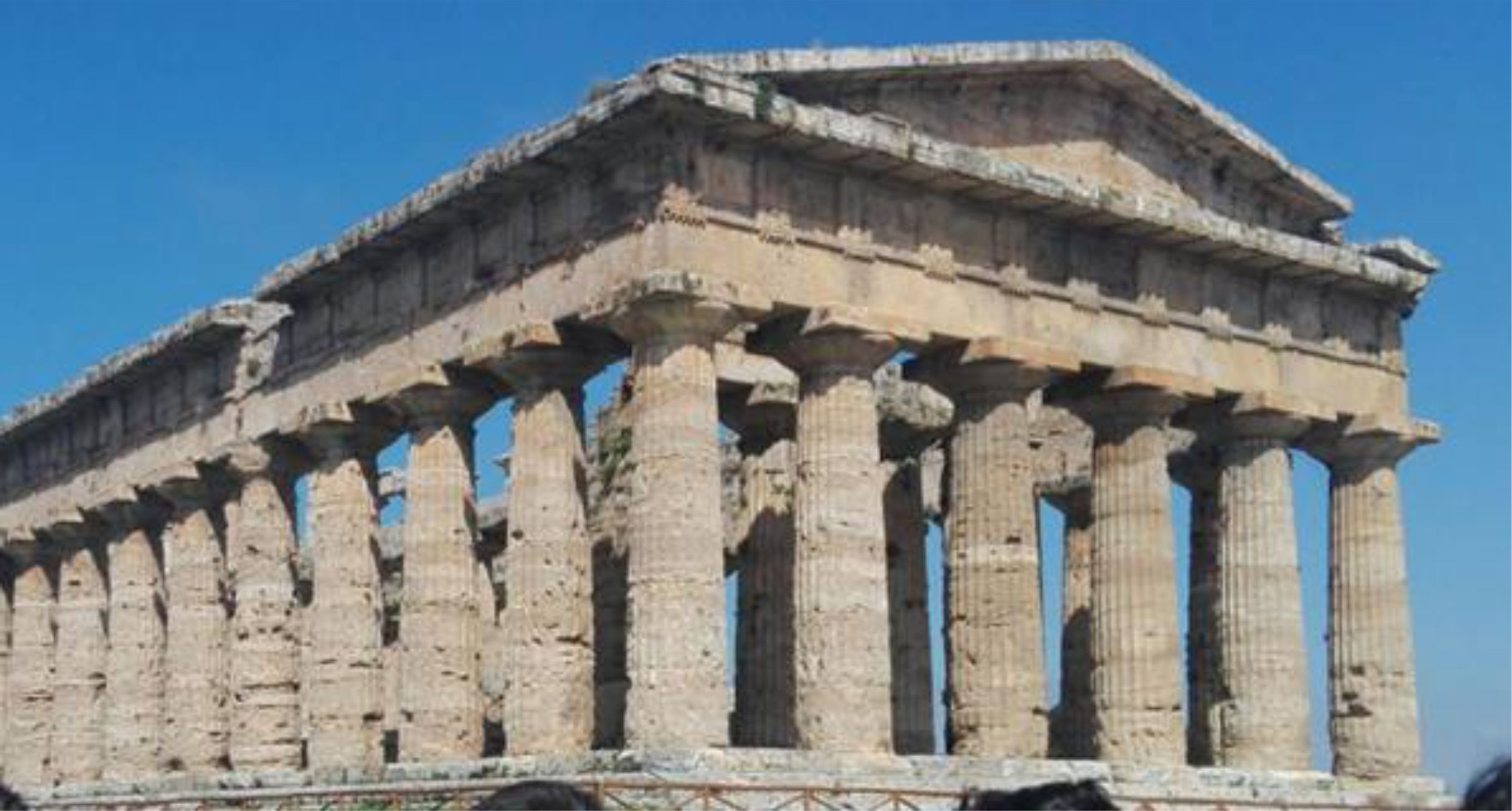
Next to it rises the most imposing and best-preserved temple, traditionally called the Temple of Neptune, though according to many scholars it too was dedicated to Hera. It dates from around 460 BC and is considered one of the best-preserved Doric temples in the entire Greek world: the columns and the entablature are still in place, and inside you can make out the double order of columns of the cella. It is the part of the visit where we lingered the longest.
The Temple of Athena
In the northern part of the city, on the highest point, stands the Temple of Athena, long called the Temple "of Ceres", built around 510 BC. It is smaller than the other two, but its raised position makes it very striking. Between one temple and the next, it is worth walking along the Via Sacra and looking at the remains of the Roman Forum, the small amphitheatre and the houses.
The walls and the Museum with the Tomb of the Diver
The city is surrounded by a circuit of walls about 4.75 kilometres long, with towers and gates still clearly visible: we recommend following a stretch of them, perhaps by bicycle. The essential complement to the temples is the National Archaeological Museum, which holds the Tomb of the Diver. Discovered in 1968 by the archaeologist Mario Napoli, it dates from around 470 BC and is an extremely rare example of Greek painting from the classical age: on the cover slab a young man dives into the water, a beautiful and still mysterious image.
How to get there and when to go
Paestum has a railway station on the line running south from Salerno towards the Cilento, a short distance from the archaeological area. By car, you take the coast road or the state road from Battipaglia. We recommend spring and autumn: in summer there is little shade in the temple area. Allow at least half a day for the excavations and the museum, and check opening hours and tickets on the Archaeological Park's official website before you set off.
Don't leave the area without tasting buffalo mozzarella and the Paestum PGI artichoke, and perhaps a Paestum IGT wine.
Nearby
A little further south is Agropoli: read Agropoli, the old village and the castle. Continuing into the Cilento you will find the Velia Archaeological Park, while for a complete overview start from the Cilento: what to do and what to see and from Salerno and its surroundings.