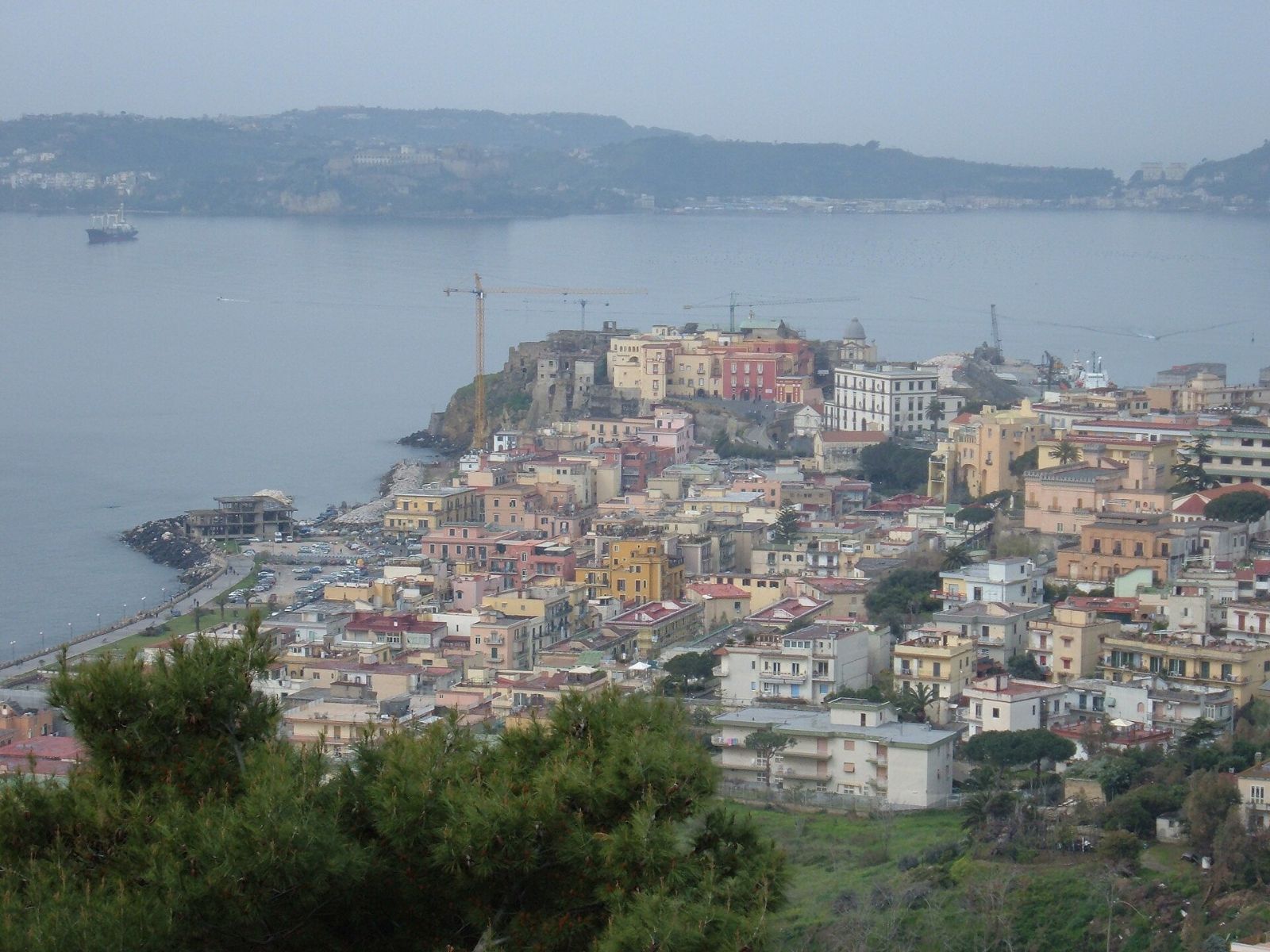
In Pozzuoli you don’t just visit history: you walk right through it. We started from the Flavian Amphitheatre, one of the largest in the Roman world, and headed down towards the harbour to the headland of Rione Terra, where the city was born. In between lies the ancient market that tells the story of how the ground here rises and falls. Come along with us, with a few warnings about the closures caused by bradyseism.
The Flavian Amphitheatre: Italy’s third largest
The Flavian Amphitheatre was built in the second half of the 1st century AD, in the Flavian era, when Puteoli was one of the most important ports in the Mediterranean. An inscription records that the colony built it at its own expense. In terms of capacity it is the third-largest amphitheatre in Italy, after the Colosseum and the amphitheatre of Capua: it measures about 149 by 116 metres and could hold around 40,000 spectators.
Excavations began in 1839, but the monument was only fully uncovered in 1947. Little remains of the exterior, while the ima cavea is well preserved: these are the lowest tiers of seating, reserved for the city’s elite, and on some of the steps you can still see traces of painted plaster.
The underground passages and the memory of San Gennaro
The part that moved us most was the underground passages. You go down beneath the arena and find yourself in a maze of corridors and vaulted rooms, where machinery lifted the wild animals’ cages up to the trapdoors. On the arena floor you can still make out the long central trench used for stage sets.
The amphitheatre is also linked to a deeply felt tradition: in 305 AD, during Diocletian’s persecution, San Gennaro (Saint Januarius) and his companions are said to have been condemned to the beasts here. One of the amphitheatre’s cells has been turned into a chapel dedicated to the martyrs. Along the outer portico there is also a lapidarium with marbles, stelae and architectural fragments.
The Macellum, the “Temple of Serapis”
Heading down towards the sea you come to the Macellum, the food market of the Roman city, long known as the Temple of Serapis because of a statue of the god found here. It is world-famous for its columns: the holes bored by marine molluscs several metres up show that the building was submerged for a long time and then re-emerged. It is the symbol of bradyseism, the slow rising and sinking of the ground typical of the Phlegraean Fields.
At the moment the Macellum is temporarily closed to the public, but you can get a good view of the columns from the street that runs around it.
Rione Terra, where Pozzuoli was born
Rione Terra is the tuff spur overlooking the harbour. According to the tradition reported by Strabo, it was here, around 529 BC, that exiles from Samos founded Dicaearchia; in 194 BC the Romans established the colony of Puteoli here. On the highest point stood a temple from the Republican era, later rebuilt in honour of Augustus to a design by the architect Lucius Cocceius Auctus. Today it is incorporated into the Duomo, the cathedral of San Procolo Martire, reopened for worship in 2014 after the long restoration that followed the 1964 fire: ancient columns and Christian structures stand side by side in the same building.
The district was evacuated in 1970 because of bradyseism. The restoration work, which began in the 1990s, has brought to light streets, shops and rooms of the Roman city, which can be visited along an underground archaeological route that struck us as one of the most evocative experiences in the area. We do have to warn you, though: after the magnitude 4.7 earthquake of 31 July 2026, Rione Terra was closed to the public and some buildings, including the Duomo, were damaged. Before you go, check whether and when it will reopen.
Getting there and when to go
Pozzuoli can be reached from Naples on Line 2 of the railway (the metropolitan link) or on the Cumana railway from Montesanto. From the station, the amphitheatre and the town centre are a short walk away. By car, take the Naples Tangenziale (ring road).
The Amphitheatre is part of the Phlegraean Fields Archaeological Park: it closes one day a week and access to the underground passages is not guaranteed every day. After seismic events the Park may close its sites as a precaution for safety checks. Check opening hours and tickets on the official website before setting off. Spring and autumn are the ideal seasons.
Nearby
From Pozzuoli you can continue towards Bacoli with The Archaeological Park of Baia and towards the ancient Greek colony of The archaeological area of Cuma. For an overview of the area see An excursion to the Phlegraean Fields, while for the local wines there is Campi Flegrei DOC. To plan the rest of your trip, start from Naples and its surroundings.
Top photo (Pozzuoli): unknown author, CC BY-SA 3.0, via Wikimedia Commons.
Read also: The Fontanelle Cemetery: between beliefs and truth


