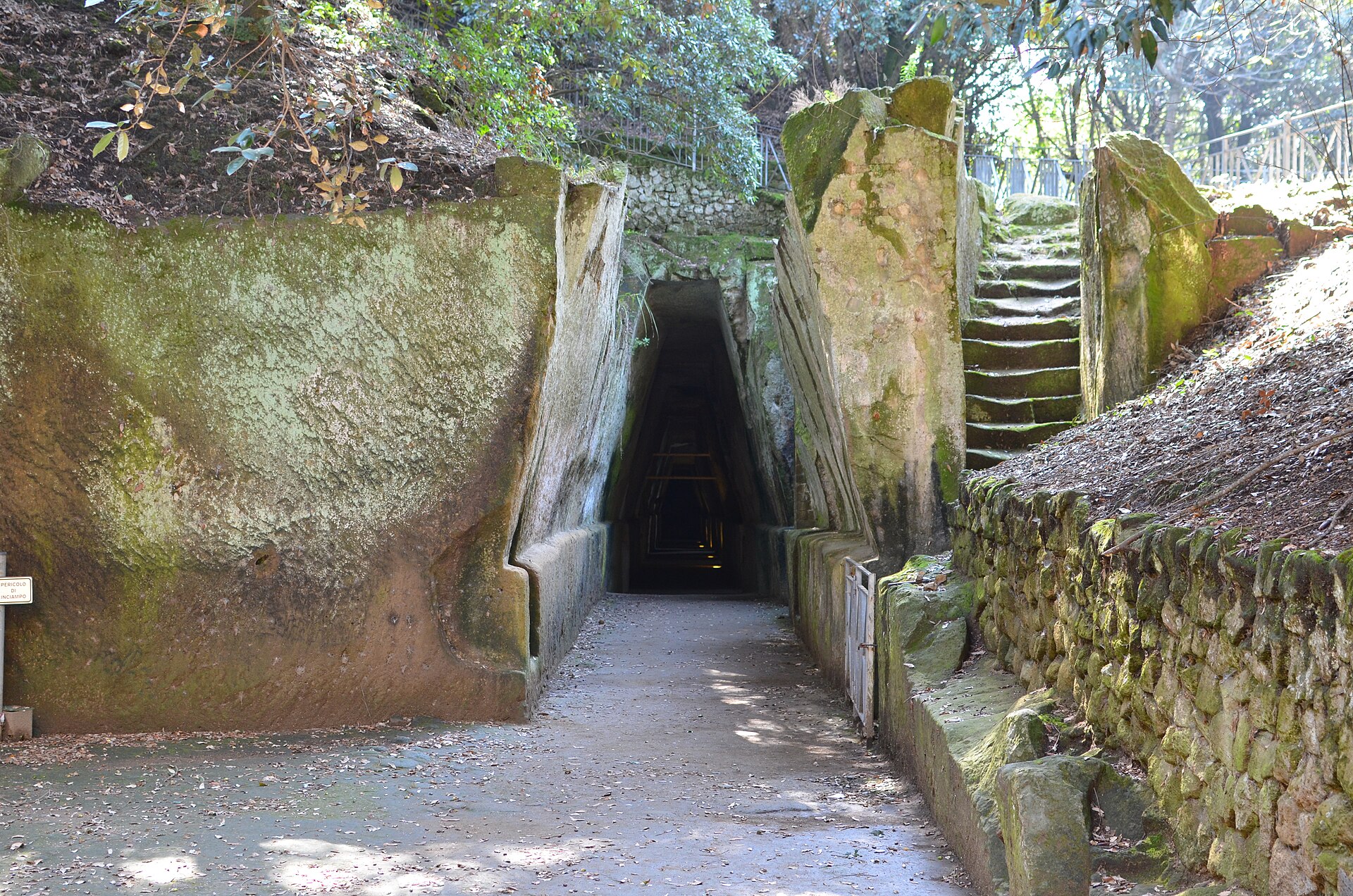
There are places where myth and history overlap so much that you can’t tell where one ends and the other begins. Cumae (Cuma) is one of them: we walked into the Sibyl’s gallery with Virgil’s verses in our heads and climbed up to the acropolis, where the sea opens out without obstacles. Here we tell you about one of the most evocative visits in the Phlegraean Fields.
The first Greek colony in the West
The archaeological area lies in the territory of Pozzuoli, on the stretch of coast facing Ischia, a few kilometres from Bacoli. Here, in the 8th century BC, Greek settlers from Euboea, coming from Chalcis, founded what is considered the first Greek colony in the West. From Cumae, Greek culture, including the alphabet, spread across much of the peninsula.
The city played a leading role in important events: in 474 BC, with the help of Syracuse, it defeated the Etruscans in a famous naval battle. In 421 BC it came under the control of the Samnites and later became Roman. It was finally destroyed in 1207 by the Neapolitans, determined to get rid of the raiders who had taken refuge there.
The Cave of the Sibyl
The most famous spot in the park is the Antro della Sibilla (Cave of the Sibyl), a gallery carved into the tuff, 131 metres long. Its cross-section, trapezoidal in the upper part, creates a play of light and shadow thanks to the side openings facing the sea: walking through it in silence is an experience that has stayed with us.
The archaeologist Amedeo Maiuri brought it to light in 1932 and identified it with the cave described by Virgil in the sixth book of the Aeneid, where Aeneas consults the Sibyl before descending into the Underworld. Its dating is debated, and some scholars think it was rather a military work linked to the defence of the city and its harbour. Either way, its fascination remains intact.
The acropolis and the temples
From the cave you climb up to the acropolis, the fortified hill on two terraces that dominates the plain. Along the Via Sacra you come across the remains of the Temple of Apollo and, higher up, of the Temple of Jupiter, which was turned into a basilica in Christian times: inside you can still make out the baptismal font.
The climb is short but exposed, among holm oaks and Mediterranean scrub. At the top the viewpoint awaits you: on clear days the view sweeps over the open sea and the coast. We lingered here for a long time, and it is the part of the visit we recommend you don’t rush.
The lower town
At the foot of the acropolis lies the lower town, where excavations have uncovered the forum, the Capitolium and the central baths, evidence of Roman Cumae. In recent years the area has been studied by Italian and foreign universities, and on some occasions the Park organises guided tours dedicated to the new excavations.
Just outside the park, on the road linking Cumae to the hinterland, you’ll find the Arco Felice, an imposing Roman arch built in a cutting through Monte Grillo to carry the Via Domitiana towards the city. It is worth a photo stop along the way.
Getting there and when to go
The most convenient way is by car: from Naples take the Tangenziale ring road to Pozzuoli and follow the signs for Cuma. By public transport you can use the Cumana or Circumflegrea railway and continue on local buses, but check connections in advance.
The site belongs to the Archaeological Park of the Phlegraean Fields; it is closed one day a week and entry is limited, with online booking. After seismic events the sites may close as a precaution for safety checks. Check opening times and tickets on the official website before you set off. Avoid the hottest hours in summer: there is little shade on the acropolis. Spring and autumn are perfect.
Nearby
Cumae is easy to combine with The Archaeological Park of Baia and with the visit to Pozzuoli described in The Flavian Amphitheatre and Rione Terra in Pozzuoli. For an overview of the whole volcanic area read An excursion to the Phlegraean Fields, and to end the day with a swim there’s The beaches of Naples and its surroundings. More travel ideas are in Naples and its surroundings.
Top photo (Cumae, Cave of the Sibyl): AlexanderVanLoon, CC BY-SA 3.0, via Wikimedia Commons.
Read also: The Flavian Amphitheatre and Rione Terra in Pozzuoli


