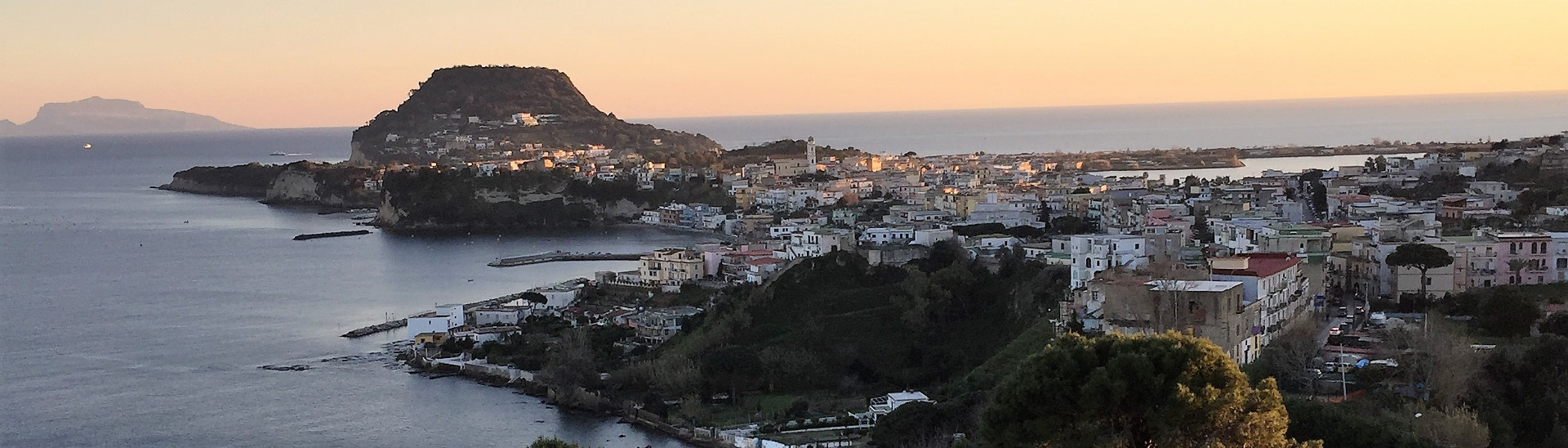
Baia was the most fashionable holiday resort of the Roman aristocracy, and when we climbed up its terraces we understood why: baths, villas and domes looking out over a beautiful gulf. Today this small district of Bacoli offers three different experiences: an archaeological park on the hillside, a museum inside a castle and a Roman city that ended up underwater. Here is how we experienced them.
Baia, the Romans’ holiday resort
From the late Republican era, Baia became one of the favourite retreats of the wealthiest Romans, drawn by the thermal springs and the volcanic landscape of the Phlegraean Fields. Over time, private villas and large bath complexes were built here, later becoming part of the imperial estates.
The gulf itself is an ancient volcanic crater. Because of bradyseism, over the centuries part of the ancient city sank below sea level: that is why, in Baia, archaeology happens both on land and underwater.
The Archaeological Park of the Baths of Baia
The heart of the visit is the Archaeological Park of the Baths of Baia, on the side of the hill. You climb up ramps and stairways over several levels, and with every terrace the view opens up. The complex is divided into sectors:
- the Villa dell’Ambulatio, laid out over six terraces, with marble floors and black-and-white mosaics;
- the Sosandra sector, on four levels, named after a statue of Aphrodite Sosandra found here;
- the Mercury sector, with the so-called Temple of Mercury, actually a large bath hall with a circular pool beneath a dome;
- the Venus sector, with rooms that 18th-century scholars called the “Rooms of Venus” because of the refined stucco decorations on the vaults.
Our favourite moment was stepping inside the Temple of Mercury: the dome has an opening in the centre, the pool still holds water and the hall is nicknamed the “Temple of the Echo” for the acoustic effect created when you speak out loud. Outside the park, along the road towards the harbour, you can also see the remains of the so-called Temple of Venus, a large hall more than twenty-five metres in diameter that even caught the interest of Andrea Palladio.
Baia Castle and the Archaeological Museum of the Phlegraean Fields
The headland closing off the gulf is dominated by the Aragonese Castle of Baia. The Aragonese began building it in 1495, under Alfonso II; after the eruption of Monte Nuovo, the viceroy Pedro de Toledo had it renovated and enlarged between 1538 and 1550.
Today the castle houses the Archaeological Museum of the Phlegraean Fields, which brings together finds from the sites in the area. The piece that left us open-mouthed is the reconstruction of the Nymphaeum of Punta Epitaffio, the Claudian-era banqueting hall found underwater, with its statues. And from the castle terraces, the view over the Gulf of Pozzuoli is one of the finest in the area.
The Underwater Park of Baia
The most unusual part of Baia lies beneath the sea. The Underwater Park of Baia, established in 2002, protects the remains of the sunken Roman city: villas, streets, mosaics, columns and the structures of the ancient Portus Iulius, all just a few metres deep among meadows of posidonia seagrass. It was here, between 1969 and 1980, that the statues of the Nymphaeum of Punta Epitaffio that you now see in the castle museum were recovered.
You can visit it on guided dives, snorkelling or glass-bottom boats: we saw it from above, and even like that, spotting a mosaic beneath the surface is quite something. Activities must be booked in advance with authorised operators.
Getting there and when to go
By car, Baia can be reached from Naples by taking the Tangenziale (ring road) to Pozzuoli and then following the coast towards Bacoli. By public transport you can take the Cumana railway from Naples: from the nearest station, Baia harbour is about a kilometre on foot or a short ride on local buses.
The baths park and the castle are part of the Phlegraean Fields Archaeological Park and close one day a week. Entry may be limited and, after seismic events, the sites may close as a precaution: check opening hours and tickets on the official website before setting off. For the underwater park, the best season runs from spring to autumn, when the sea is calm.
Nearby
A few minutes from Baia you will find the Greek acropolis of The archaeological area of Cuma and, towards Pozzuoli, The Flavian Amphitheatre and Rione Terra in Pozzuoli. The whole area is described in An excursion to the Phlegraean Fields, and if you are looking for a swim, read The beaches of Naples and its surroundings. You will find everything else in Naples and its surroundings.
Read also: The Bay of Ieranto


