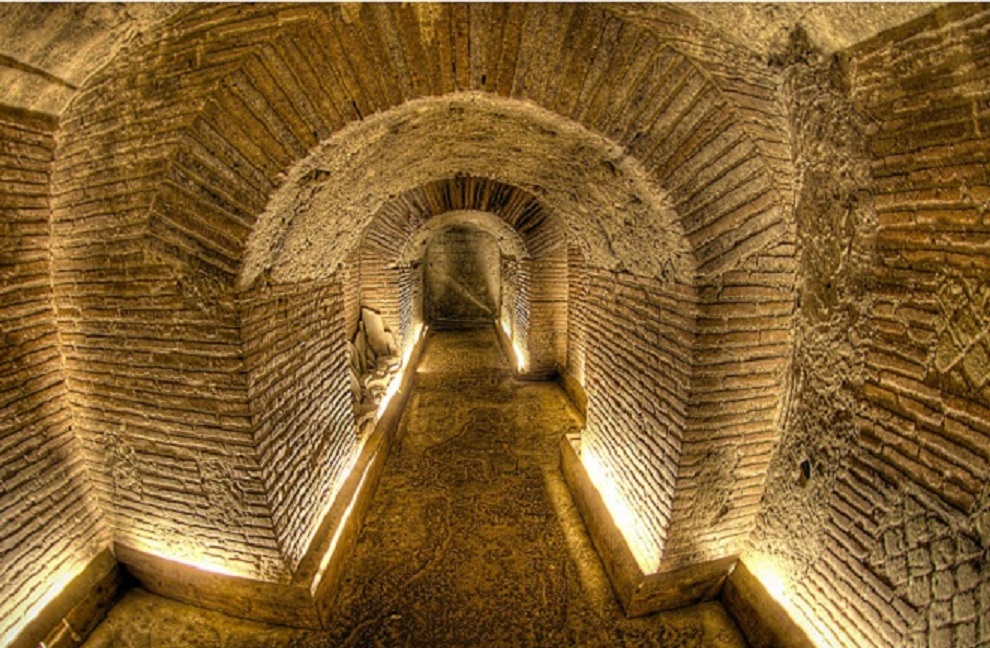
Beneath the crowded streets of the historic centre of Naples lies another city, made of cisterns, tunnels and tuff quarries. We went down to explore it and felt as if we were leafing backwards through Neapolitan history, layer by layer. If you are short on time and want to choose a “different” experience, this is the one we recommend.
A city carved into tuff
The subsoil of Naples is crossed by a huge network of cavities, almost all of them man-made: they are estimated to exceed 900,000 square metres. It all stems from the material the city stands on, Neapolitan yellow tuff, a volcanic stone that is easy to dig yet strong. As early as Greek times, blocks were quarried from underground to build buildings and walls, leaving large voids beneath the city.
The Romans reused and enlarged these cavities, connecting them to an aqueduct system fed by springs some 70 kilometres away, in the Serino area. For centuries the tunnels carried water to the cisterns, from which houses drew it through wells. Their upkeep was the job of the pozzari (well-keepers), who moved nimbly through the underground passages: some link them to the figure of the munaciello, the mischievous little spirit of Neapolitan folklore.
The Piazza San Gaetano route
The best-known route starts from Piazza San Gaetano, on Via dei Tribunali, next to the basilica of San Paolo Maggiore. You go down a long staircase, with low, comfortable steps, to a depth of about 40 metres. Down there the temperature is cool and constant, and our first impression was the silence: above is the chaos of the centre, below only the voices of the group.
The guided tour passes through the cisterns of the ancient Greco-Roman aqueduct, where traces of the waterproof plaster can still be seen on the walls, and the spaces used as air-raid shelters during the Second World War. Thousands of Neapolitans took refuge here from the bombing: graffiti, inscriptions and objects from the period remain, some of them gathered in the small War Museum. Another surprise is the underground gardens, experiments in growing plants in an environment without natural light.
The candlelit tunnel
The most evocative moment, in our view, is walking through a narrow tunnel with a candle in hand, leading to a cistern still full of water. The passage is really narrow and you go through it sideways, which is why it is optional: anyone who suffers from claustrophobia can wait for the group at the exit. If you feel up to it, do it: the play of light and shadow on the water more than repays the effort.
The Roman theatre hidden in the bassi
The tour ends above ground, but with a twist. In the area between Via dei Tribunali and Via San Paolo lie the remains of the Roman theatre of Neapolis, incorporated into the buildings constructed over the following centuries. To see them you enter a typical Neapolitan basso, a ground-floor dwelling: moving a bed aside opens the passage to the rooms of the theatre, where tradition places the dressing rooms of Nero, who loved to perform in Naples. We were struck by how everyday life still goes on, quite literally, on top of antiquity.
Other underground routes
Piazza San Gaetano is not the only way into underground Naples. Beneath the complex of San Lorenzo Maggiore you can walk among the shops of the Roman market, as we describe in San Lorenzo Maggiore and its excavations. In the Chiaia area you can visit the Galleria Borbonica (Bourbon Tunnel), commissioned by Ferdinand II of Bourbon by a decree of 1853 and designed by Errico Alvino, which was also later used as a shelter during the war. Finally, in the Rione Sanità the catacombs open up: you will find everything in The Catacombs of San Gennaro.
Getting there and when to go
Piazza San Gaetano can be reached on foot from the Dante or Duomo stops on metro Line 1. Wear flat, comfortable shoes and bring a sweatshirt even in summer, because it is cool down there. The tour is guided, in Italian and other languages, and the route has no lifts. Be wary of anyone who stops you in the street offering tours: stick to the official channels and check opening hours and tickets on the official website before you go. It is a great idea for rainy days or intense heat.
Nearby
For the rest of your stay, start with our guide Naples and Surroundings. Back at street level, you are in the heart of the old centre described in The most famous streets of Naples, a few steps from Naples Cathedral. If the city’s mysterious side has won you over, continue with Fontanelle Cemetery: between beliefs and truth.
Read also: What to see in Naples


