Every time we arrive in Napoli we realise that you only need to walk to find yourself facing three thousand years of history: royal squares, castles by the sea, Gothic and Baroque churches, all within a few minutes' walk of one another. In this article we take you through the monuments and squares that, in our opinion, cannot be missed on a first visit. For museums, experiences and itineraries we have prepared dedicated articles, which you will find linked along the way.
Piazza del Plebiscito and the Royal Palace
Let's start from the largest and most spectacular square in the city. Piazza del Plebiscito is closed on one side by the curved colonnade of the basilica of San Francesco di Paola, designed by Pietro Bianchi from Lugano and inaugurated in 1846, with a dome reminiscent of the Pantheon in Rome. In front of the colonnade you will see the two equestrian statues of the Bourbon kings: the one of Charles of Bourbon is the work of Antonio Canova, while that of Ferdinand I was begun by Canova and completed by Antonio Calì.
Opposite stretches the façade of the Royal Palace, begun in 1600 to a design by Domenico Fontana. In the niches, since 1888, stand the eight statues of the sovereigns who ruled Naples, from Roger the Norman to Victor Emmanuel II: we like to stop and recognise them one by one. We cover this area in more depth in Spaccanapoli, Piazza del Plebiscito and the Royal Palace.
The Teatro di San Carlo and the Galleria Umberto I
A stone's throw from the palace is the Teatro di San Carlo, commissioned by Charles of Bourbon and inaugurated on 4 November 1737: it is the oldest opera house in the world still in operation, 41 years older than La Scala in Milan. Destroyed by fire in 1816, it was rebuilt in just a few months by Antonio Niccolini. If you can't attend a performance, ask about guided tours: the horseshoe-shaped auditorium is worth it. We tell you all about it in the Teatro di San Carlo.
Right opposite opens the Galleria Umberto I, built between 1887 and 1890, with four arms that cross beneath a great dome of glass and iron. From here begins Via Toledo, the street for shopping and strolling: we talk about it in the Galleria Umberto I and Via Toledo.
The Maschio Angioino and Castel dell'Ovo
Heading down towards the port you come across Castel Nuovo, which everyone calls the Maschio Angioino. It was built by Charles I of Anjou starting in 1279 and has five large cylindrical towers. Between the Torre di Mezzo and the Torre di Guardia stands the marble triumphal arch celebrating the entry into the city of Alfonso of Aragon: it is one of the masterpieces of the Renaissance in Naples. Inside, don't miss the Hall of the Barons. Find out more in the Maschio Angioino.
Following the sea you reach Castel dell'Ovo, on the islet of Megaride, where settlers from Cumae founded the first nucleus of Parthenope. The name comes from the legend of the egg hidden by Virgil in its foundations, which you can read in the legend of Castel dell'Ovo. From its terraces the view over the gulf and Mount Vesuvius always leaves us speechless.
Spaccanapoli, Piazza del Gesù and Santa Chiara
The ancient heart of the city, a UNESCO World Heritage Site since 1995, is crossed along Spaccanapoli, the lower decumanus of the Greco-Roman city. You start from Piazza del Gesù Nuovo, with the spire of the Immaculate Virgin and the church of the Gesù Nuovo, whose diamond-point rusticated façade belonged to the 15th-century Palazzo Sanseverino: the story is in the church of the Gesù Nuovo.
Opposite is the Santa Chiara complex, commissioned by Robert of Anjou and his wife Sancia of Majorca starting in 1310. The majolica cloister, rearranged by Domenico Antonio Vaccaro between 1739 and 1742, is one of the brightest places in the city: read the Santa Chiara complex and its majolica cloister. Carrying on, you reach Piazza San Domenico Maggiore and, a little further on, San Gregorio Armeno, the street of nativity scenes.
The Cathedral and Via dei Tribunali
Along the upper decumanus, today Via dei Tribunali, churches, palaces and little squares follow one after another. Just to the north stands the Cathedral, begun under Charles II of Anjou around 1290, with its neo-Gothic façade redone by Errico Alvino and inaugurated in 1905. Inside are the basilica of Santa Restituta, the baptistery of San Giovanni in Fonte, considered the oldest in the West, and the Chapel of the Treasure of San Gennaro. All the details are in the Naples Cathedral.
How to get there and when to go
Naples is served by Napoli Centrale station in Piazza Garibaldi, with high-speed trains, and by Capodichino airport. In the centre it is best to get around on foot and by metro: the Municipio, Toledo, Dante and Museo stations are convenient for all the places in this article. Spring and autumn are the seasons we prefer, with a mild climate and less heat for walking. Check opening hours and tickets on the official website before you set off.
Nearby
To plan your whole trip, start from Naples and its surroundings. If you want to visit the museums, read what to visit in Naples; to experience the city like the Neapolitans there is things to do in Naples. Church lovers will find more in Naples' churches and basilicas, and those who want to wander aimlessly in the most famous streets of Naples.
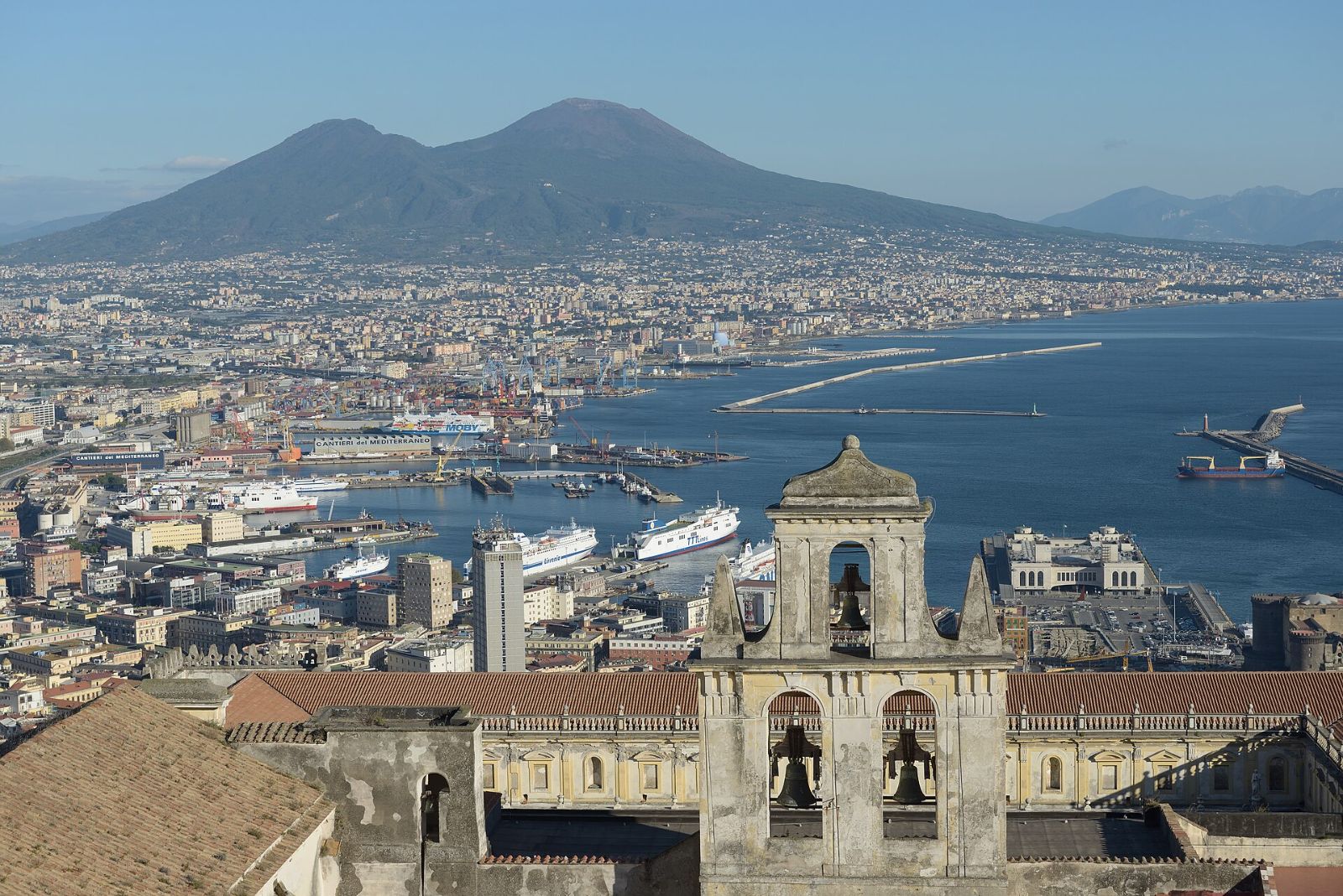
Top photo (Napoli): This Photo was taken by Wolfgang Moroder. Feel free to use my photos, but please mention me as the author and send me a message. This image is not in the public domain. Please respect the copyright protection. It may only be used according to the rules mentioned here. This specifically excludes use in social media, if applicable terms of the licenses listed here not appropriate. Please do not upload an updated image here without consultation with the Author. The author would like to make corrections only at his own source. This ensures that the changes are preserved.Please if you think that any changes should be required, please inform the author.Otherwise you can upload a new image with a new name. Please use one of the templates derivative or extract., CC BY-SA 3.0, via Wikimedia Commons.