When we first stepped into the great cloister of the Certosa (Charterhouse) of Padula, we stood in silence for a few minutes: we hadn’t expected such a vast space. The Certosa di San Lorenzo, in the heart of the Vallo di Diano, is one of the largest monastic complexes in Europe. Here is how to visit it without missing a thing.
Founded by the Sanseverino family
The Certosa was founded on 28 January 1306 by Tommaso II Sanseverino, a powerful feudal lord of the area, and the foundation was confirmed by King Charles II of Anjou in April of the same year. The name San Lorenzo (St Lawrence) comes from a church dedicated to the saint that already stood on the site.
Born in Gothic forms, the Certosa was transformed over the centuries and today it looks mainly Baroque. The last major work is the famous elliptical staircase designed by Gaetano Barba, completed by 1779.
Impressive numbers
The complex covers about 51,500 square metres and has around 350 rooms arranged around three cloisters. The star is the great cloister, roughly 104 by 150 metres, with an area of 15,000 square metres: one of the largest Carthusian cloisters in Europe. Around it open the monks’ cells, real little houses of three or four rooms with a loggia over a small garden, which tell of the life of silence and solitude of the Carthusians.
During our visit we were also struck by the church, the large kitchen and the library, reached by climbing a small stone spiral staircase from the mid-15th century, with about one and a half turns. These rooms show how the Certosa was a true self-sufficient citadel.
The legend of the thousand-egg omelette
In the kitchen visitors love to hear an anecdote: in 1535, when Emperor Charles V passed through Padula, the monks are said to have prepared a thousand-egg omelette for him and his retinue. It is more tradition than documented fact, but it gives a good idea of the Certosa’s wealth in those centuries.
From suppression to UNESCO
The history of the Certosa has not always been a happy one. The monks were sent away a first time in 1807, during the Napoleonic suppressions, and then for good in 1866, after the Unification of Italy. During the two World Wars the abandoned complex was used as a place of imprisonment and as a concentration camp.
Its revival came with restoration and international recognition: in 1998 the Certosa became a UNESCO World Heritage Site together with the Cilento and Vallo di Diano National Park and the archaeological sites of Paestum and Velia. Since 1957 it has also housed the Provincial Archaeological Museum of Western Lucania, with finds from the necropolises of Sala Consilina and Padula, from prehistory to the Hellenistic age.
Getting there and when to go
Padula lies in the Vallo di Diano, in the eastern part of the province. By car, take the A2 del Mediterraneo motorway to the Padula-Buonabitacolo exit, a few minutes from the Certosa. For a full visit you need at least two or three hours and comfortable shoes: the distances inside are considerable. Our advice is to take your time, starting with the church and the monks’ quarters, and then moving on to the great cloister and the elliptical staircase: leaving them until last makes the end of the visit even more spectacular. Spring and early autumn are the best times, when the cloister is pleasant to walk through even in the sun. Check opening hours and tickets on the official website before you set off.
Nearby
The Vallo di Diano deserves at least one more day. A few kilometres away, Teggiano awaits you, described in Teggiano, the town of portals, while further north you can go down into the Pertosa-Auletta Caves. If you carry on towards the sea, the Cilento is close at hand: read Cilento: what to do and what to see and our guide Salerno and its surroundings.
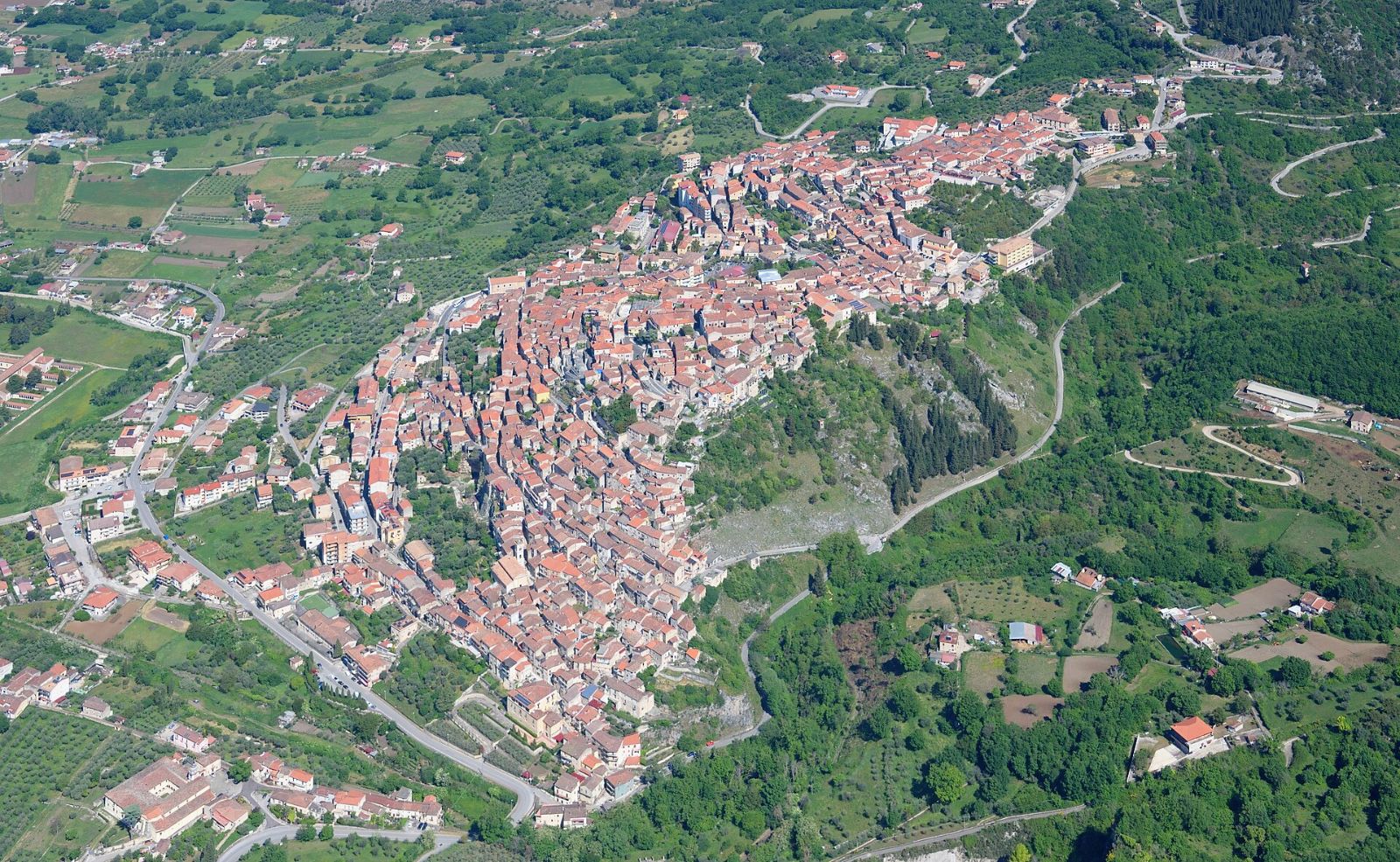
Top photo (Padula): Carsten Steger, CC BY-SA 4.0, via Wikimedia Commons.
Read also: Palinuro and the Natural Arch