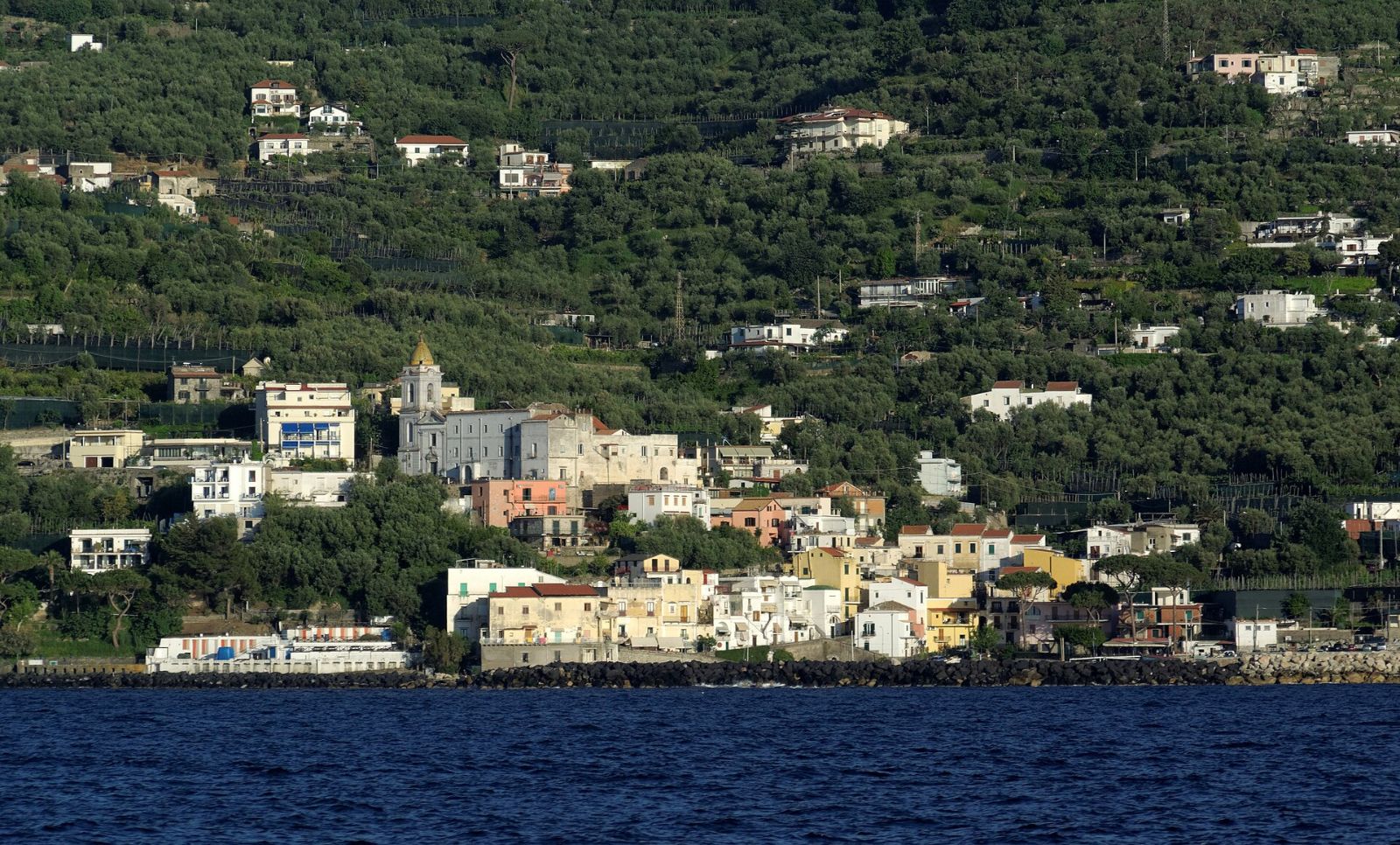
To reach the Bay of Ieranto you have to walk, and in our view that’s exactly the beauty of it. We set off from the village of Nerano with our backpacks on and, after a path through olive groves and dry-stone walls, looked out over a cove of crystal-clear water, with the Faraglioni of Capri in the background. It is one of the wildest places on the Sorrento Peninsula, and here we tell you how to visit it.
Where it is
The bay opens at the very tip of the Sorrento Peninsula, in the municipality of Massa Lubrense, on the side facing the Gulf of Salerno and the island of Capri. It is enclosed between two coastal towers: the Torre di Montalto to the east and the Torre della Campanella on the other side, built in the age of the Spanish viceroys to defend the coast from pirate raids.
The area is part of the Punta Campanella Marine Protected Area and is recognised as a Site of Community Importance. Beneath the surface grow meadows of posidonia seagrass, and the area is a stopover for a great many species of migratory birds.
From quarry to FAI
This paradise has an industrial past. From the early 20th century until 1952, a large limestone quarry operated on the headland, and you can still see its traces on the rock today. In 1987 the steel company that owned the area donated it to the FAI – Fondo per l’Ambiente Italiano (the Italian National Trust), which has protected it ever since and has encouraged the return of Mediterranean vegetation.
We were struck by how nature has reclaimed the spaces of the quarry: where stone was once extracted, scrub, carob trees and olive trees now grow, and the silence is broken only by the sea and the birds.
The myth of the Sirens
The bay also has a mythological soul. According to Pliny the Elder, this is where the Sirens encountered by Ulysses on his voyage lived. Looking down at the rocks and the crystal-clear sea, it is not hard to understand why the ancients imagined creatures here capable of bewitching sailors.
The trail and what to do in the bay
The bay can only be reached on foot, along a moderately difficult path that starts from the little square in Nerano, where it is signposted as "Via Ieranto". The route is about 3.5 kilometres long, takes about 45 minutes and has a height difference of about 250 metres, among dry-stone walls, olive groves and glimpses of the Gulf of Salerno.
In the bay, FAI offers guided tours, botanical walks, kayak trips, snorkelling and family activities. Good news: entry is free. There are no bars or shops, so bring at least a litre and a half of water per person, something to eat and hiking shoes. The route is not suitable for people with reduced mobility.
As for swimming, there is an important update. In March 2026 the Coast Guard of Castellammare di Stabia banned navigation and swimming in the stretch of sea in front of the seafront platform, due to the serious deterioration of the structure. FAI has closed the platform and the other sea accesses on its property as a precaution, but swimming is still possible from the bay’s central beach.
Getting there and when to go
Nerano can be reached by car or bus from Sorrento and Massa Lubrense; parking is scarce in summer, so set off early. Access to the bay by private motorboat is prohibited.
The area follows a seasonal opening calendar: from March to October it is open almost every day of the week, in the winter months only at weekends. Before setting off, check FAI’s announcements for up-to-date information on openings, notices and swimming bans. We recommend spring and September: in high summer the uphill walk back is tough.
Nearby
From here the natural next stop is Sorrento, with Sorrento: what to see and the walk described in The ancient walls of Sorrento. Opposite, across the stretch of sea, lies Capri with The Blue Grotto and Villa Jovis and Villa Damecuta. And if you want to head down towards the coast, read Positano and Praiano: what to visit. More travel ideas are in Naples and its surroundings.
Photo at top (Massa Lubrense): Berthold Werner, CC BY-SA 3.0, via Wikimedia Commons.
Read also: The Capodimonte Museum and Royal Park


