When people talk about San Leucio, they immediately think of precious silks, but what struck us most, as we studied its history, was something else: here, at the end of the 18th century, someone tried to build a small society with surprisingly modern rules. In this article we won't talk about the museum, but about the social history of the colony founded by Ferdinand IV and the silk tradition that grew out of it, still alive today in the Caserta area.
From hunting lodge to Royal Colony
The hill of San Leucio, next to the park of the Reggia, had been bought by Charles of Bourbon in 1750. In 1773 his son Ferdinand IV had a retreat built there, far from court life. The turning point came in 1778, after the death of the crown prince: the king decided to turn the site into something useful, setting up a poorhouse with workshops for silk production.
Thus was born the Royal Colony of San Leucio, designed by the architect Francesco Collecini. Around the Belvedere rose the workers' houses, the workshops and the production spaces, in an ensemble conceived as a small self-sufficient world. We describe the place in detail in The Belvedere of San Leucio.
The 1789 Statute, a code ahead of its time
In 1789 Ferdinand IV signed the code governing the life of the community, entitled Origine della popolazione di San Leucio e suoi progressi fino al giorno d'oggi colle leggi corrispondenti al buon governo di essa (Origin of the population of San Leucio and its progress to the present day, with the laws for its good government). The text was drafted by Antonio Planelli, an intellectual and cleric, in the climate of enlightened reform championed by Queen Maria Carolina. The Royal Printing Works printed just 150 copies.
Reading its contents, you can see why the Statute is still remembered today. Its main provisions included:
- compulsory schooling for children from the age of 6;
- equality between men and women;
- the abolition of dowries and wills, with inheritance divided among the children;
- young people's free choice of spouse;
- a shared charity fund to help those in difficulty;
- a house assigned to workers' families.
The Statute also insisted on simplicity and uniformity in dress, to avoid class differences within the community. It was, of course, an experiment imposed from above, a product of the enlightened absolutism of the time: but some of its ideas seemed truly surprising to us for the late 18th century.
The dream of Ferdinandopoli
The king imagined the colony growing into a real city, Ferdinandopoli, with a circular plan, streets radiating outwards and a central square. The project was never carried out, but as you stroll through the village it's lovely to imagine what it might have become. In 1928 San Leucio was absorbed into the municipality of Caserta.
A tradition that lives on
Silk working remained the community's main activity even after the Unification of Italy, and fabrics inspired by this tradition are still produced in the area today. In 1997 the San Leucio complex became a UNESCO World Heritage Site together with the Reggia di Caserta and the Carolino Aqueduct. If you'd like to see looms and machinery up close, see The Silk Museum of San Leucio.
What has stayed with us above all is the idea of a place where work, home and school were conceived together: visiting San Leucio with this story in mind completely changes the way you see it.
Getting there and when to go
San Leucio is a few kilometres from the centre of Caserta, on the hills north-west of the Reggia, and is easily reached by car in a few minutes. We recommend spring and autumn, when the walk between the village and the Belvedere is most pleasant. Check opening times and tickets on the official website before you go.
Nearby
To build your itinerary, start with our guide Caserta and its surroundings. After San Leucio we recommend The Royal Gardens of Caserta and The Carolino Aqueduct and the Ponti della Valle; for another Bourbon residence linked to work and the countryside there's The Royal Site of Carditello, in San Tammaro.
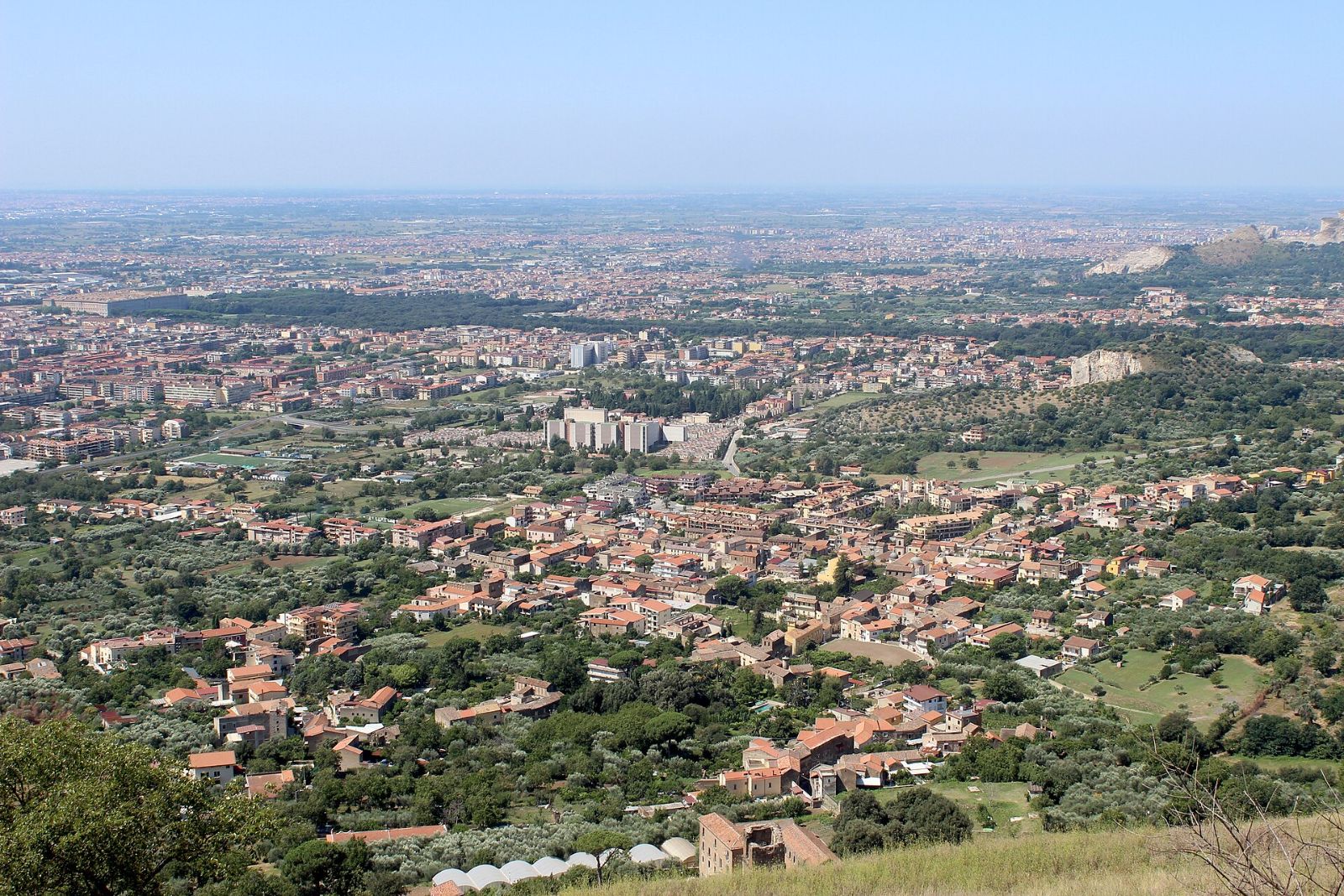
Photo at top (Caserta): Miguel Hermoso Cuesta, CC BY-SA 4.0, via Wikimedia Commons.