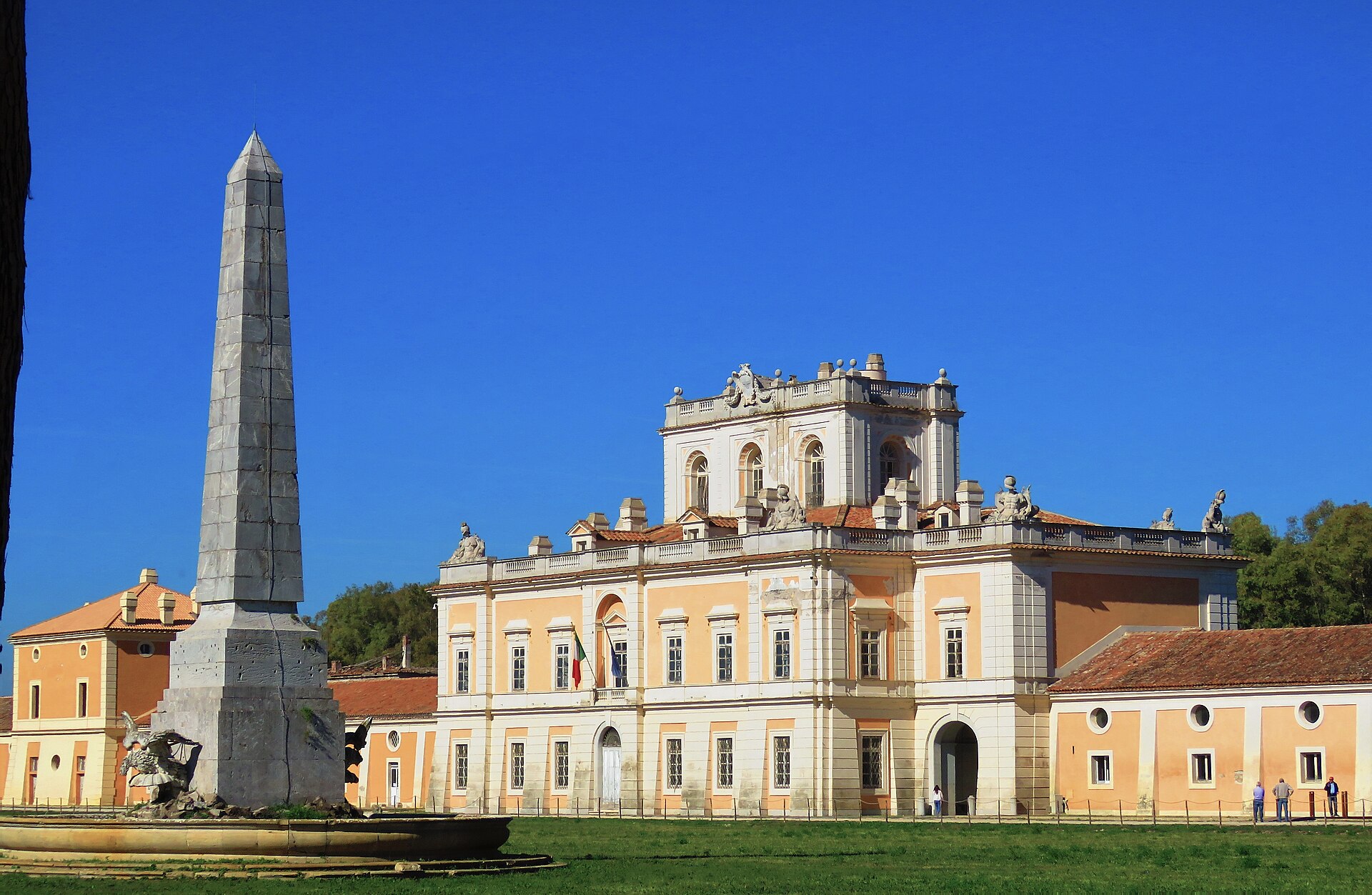
Arriving at Carditello, in the middle of the plain between Capua and Aversa, the first thing that struck us was the sense of scale: an elegant, well-proportioned palace surrounded by a vast open space that was once a track for horses. The Royal Site of Carditello, in the municipality of San Tammaro, is one of the least-known Bourbon residences in the province, but also one with the most eventful history. Let us tell you about it.
A royal farm built by the Bourbons
Carditello's story begins with Charles of Bourbon, who devoted this estate to hunting and horse breeding. But it was his son, Ferdinand IV, who turned it into something different: a true model farm, where farming and breeding techniques that were cutting-edge for the time were tried out.
Work on the complex we see today began in 1787, under the direction of Francesco Collecini, a pupil of Luigi Vanvitelli. The estate originally covered more than 2,000 hectares and combined the role of royal residence with that of a working farm, with cattle breeding and the selection of thoroughbred horses.
The architecture and the racecourse
The style is neoclassical, restrained and elegant. The central palace, intended for the royal family, is flanked by wings and towers that housed the staff and the farming activities. The water it needed came from the Carolino Aqueduct, the same great work that fed the fountains of the Reggia di Caserta.
In front of the building lies the great racecourse, inspired by the shape of Roman circuses and decorated with fountains, two obelisks and a small classical-style circular temple. Walking around its perimeter, we tried to imagine it alive with races and parades of the royal horses: the space is so vast that it takes a few minutes to take it all in.
From decline to rebirth
After the end of the Kingdom of the Two Sicilies, the estate went through a long decline. In 1920 the property was broken up, leaving only the central building and about 15 hectares of land around it. In 1943 it was occupied first by German and then by American troops, and in the following decades it suffered abandonment, theft and vandalism.
Between 2011 and 2013 several auctions failed to find a buyer. In those years the palace was looked after by volunteers, including Tommaso Cestrone, who died in December 2013 and is remembered as the site's volunteer guardian. Shortly afterwards the complex was bought by the State, and in 2016 the Fondazione Real Sito di Carditello was set up to take care of its restoration and promotion. The site reopened to the public in 2017.
What to see during your visit
The visit lets you discover the rooms of the palace and stroll around the racecourse. We recommend taking the time to look at the complex from a distance too: that's where you grasp Collecini's design, conceived as a harmonious blend of architecture and countryside.
Carditello is a fine illustration of an idea typical of the Bourbons: combining court life with agricultural production. It's an idea we also find in the nearby colony of San Leucio, which we describe in San Leucio silk, a Bourbon tradition. And don't forget that this plain is buffalo country: to find out more, read Mozzarella di Bufala Campana DOP.
Getting there and when to go
The Royal Site is on Via Carditello, in the municipality of San Tammaro, on the plain between Capua and Aversa. The most convenient way to get there is by car, from Caserta, Capua or Santa Maria Capua Vetere. The most pleasant seasons are spring and autumn, when it's a pleasure to walk around the racecourse without the summer heat. Check opening times, days and tickets on the official website before you go, as they may change during events and restoration work.
Nearby
To plan your day, take a look at our guide Caserta and its surroundings. From Carditello you can easily reach Santa Maria Capua Vetere for The Campanian Amphitheatre and the Mithraeum of Santa Maria Capua Vetere, or Capua with The Museo Provinciale Campano in Capua. If you love royal residences, the next step can only be The Royal Apartments of the Reggia di Caserta, in Caserta.
Photo at top (San Tammaro): Gianfranco Vitolo, CC BY 2.0, via Wikimedia Commons.