If we had to choose just one place to understand how many eras lie layered beneath the streets of Salerno, we would choose San Pietro a Corte. We went down below street level and in just a few metres passed from Roman baths to the court of a Lombard prince. Here is why this complex is so special.
Four eras, one on top of the other
The San Pietro a Corte complex is like a history book read vertically. At the bottom are the Roman baths of the imperial age, with a frigidarium dating from the late first or early second century AD, probably abandoned in the fourth century after a flood. From the fifth century the same space was reused as an early Christian funerary church.
Above these structures lies the palace chapel of the Lombard palace and, higher still, the rooms that served public functions in the Middle Ages. Looking at the masonry of the different periods side by side is the part that fascinated us most.
Arechi II and the prince's palace
The turning point came in 774. After the fall of Pavia and of the Lombard kingdom in the north, the Duke of Benevento, Arechi II, moved to Salerno and had a new seat of government built here. The Chronicon Salernitanum describes it as a palace of extraordinary size and beauty.
The best-preserved part is the palace chapel, which Arechi dedicated to Saints Peter and Paul. It was decorated with marble-tessera mosaics, and along the walls ran a dedicatory inscription in Latin verse, recalling Lombard examples in Cividale del Friuli and Brescia. If you want to discover the other great place linked to Arechi, read Arechi Castle.
The Chronicon's account and Arechi's inscription
The Chronicon Salernitanum also relates that during the building works for the palace a golden idol was found, a detail that shows how present and visible the Roman ruins still were. The ancient baths had barrel and cross vaults and rose to a height of about 13 metres: Arechi had the roofs knocked down and divided the space with a wall, creating the base of his chapel. The opening of the dedicatory inscription is known, an invitation in hexameters addressed to the prince: "Duc age, duc clemens Arichi, pia suscipe vota", asking the merciful duke to receive the pious prayers.
The frescoed crypt and the bell tower
Between the Norman and Swabian periods an underground oratory was created in the lower rooms, decorated between the twelfth and fourteenth centuries with frescoes of saints and of the Madonna and Child. It is one of the most evocative corners of the visit: the light is low and the colours slowly emerge on the walls.
Next to it rises the fifteenth-century bell tower of the church of Sant'Anna, built on Roman structures. In the thirteenth century the complex also hosted public assemblies and the solemn degree ceremonies of the Scuola Medica Salernitana: a link that makes the visit perfect to combine with the Virtual Museum of the Scuola Medica Salernitana.
Visiting San Pietro a Corte today
Since 2014 the site has been managed by the Ministry of Culture, now through its regional museums directorate. The entrance is on Larghetto San Pietro a Corte, in the heart of the historic centre. The route is not long, but we recommend taking the time to read the panels: without some context you risk missing the meaning of the different layers.
How to get there and when to go
The complex can be reached on foot from the seafront and from Salerno station, along Via dei Mercanti. Being largely underground, it stays cool even in summer and is a good idea for the hottest hours. Check opening times and tickets on the official website before you set off.
Nearby
A few minutes' walk away you will find Salerno Cathedral and the Roberto Papi Museum. For a complete tour of the historic centre, explore the city's art and its churches around the Cathedral. All the other destinations are in our guide Salerno and its surroundings.
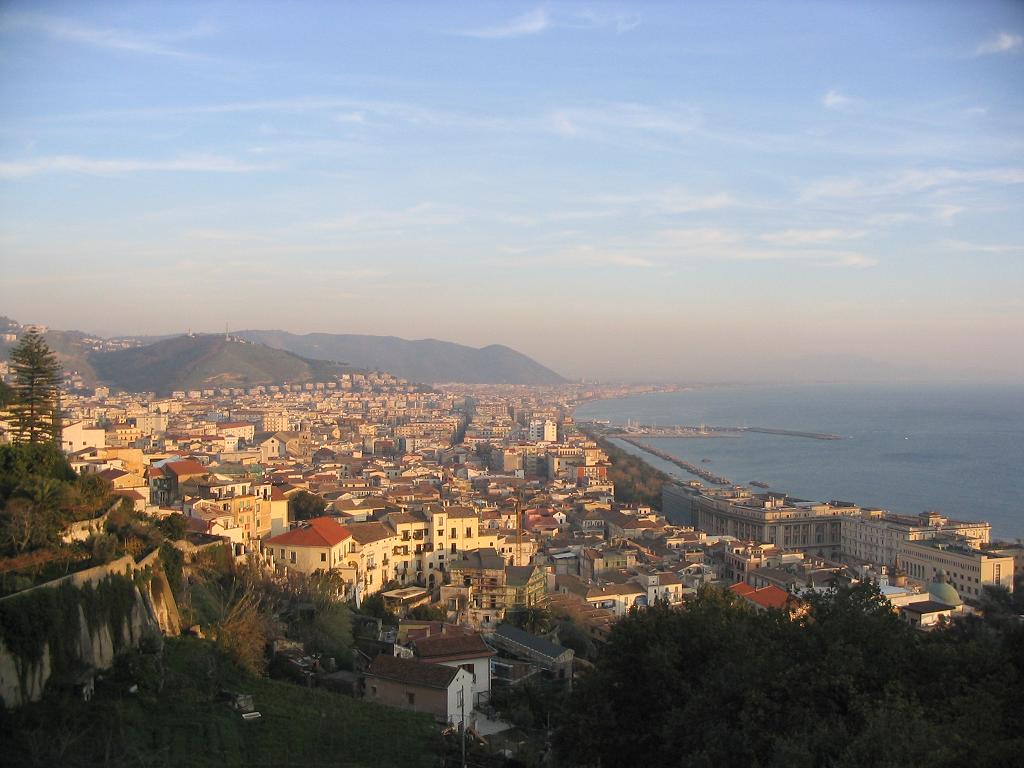
Photo at the top (Salerno): No machine-readable author provided. Giaros assumed (based on copyright claims)., CC BY-SA 3.0, via Wikimedia Commons.