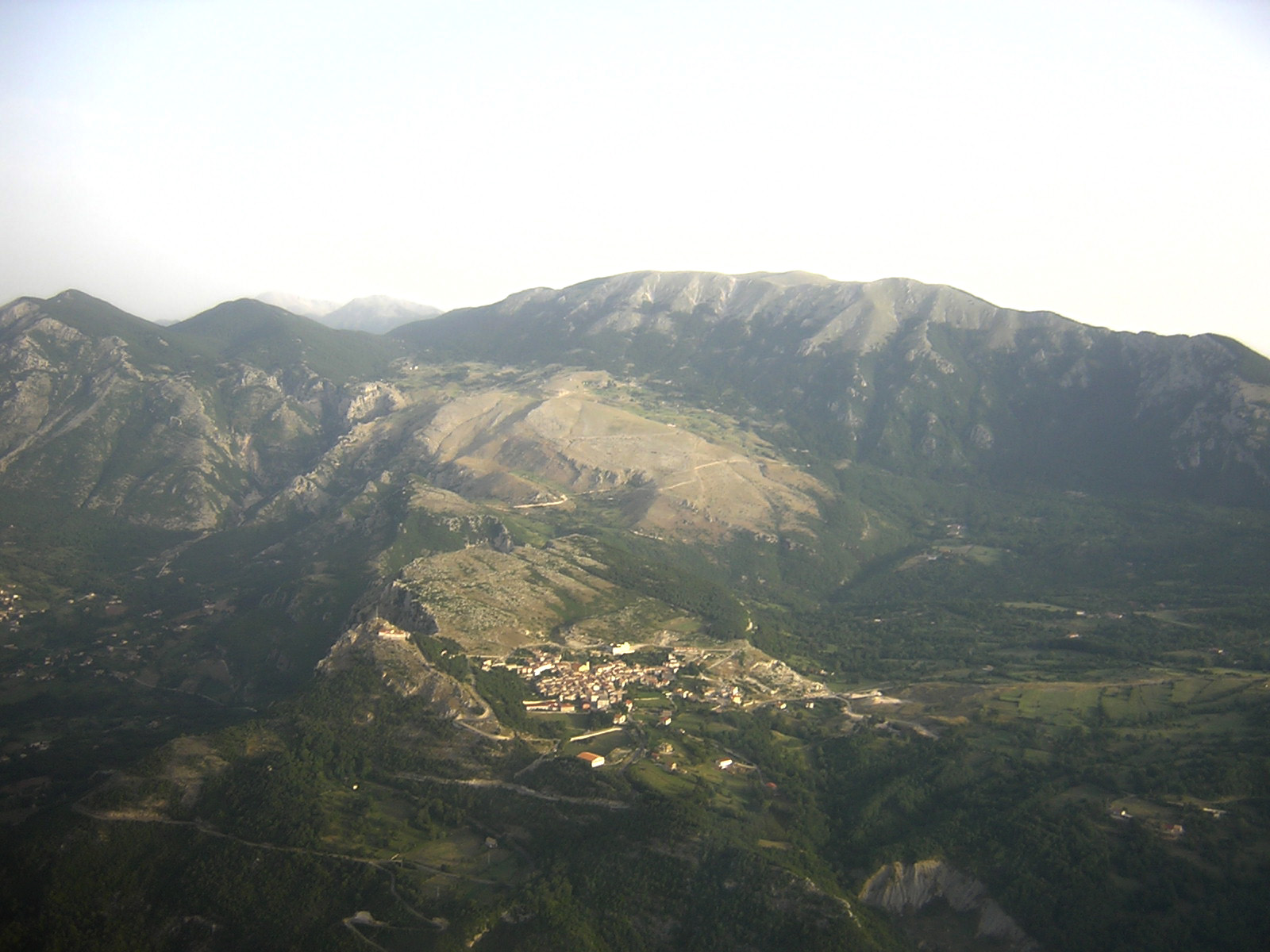
When we drove up to Pietraroja, among the woods of the Matese, the first thing that struck us was the silence: a small village perched high up, guarding one of the most important discoveries in Italian palaeontology. This is where Ciro, the first dinosaur ever found in Italy, came to light. Here is why it is worth coming all the way up here.
A village of red stone at the foot of Mutria
Pietraroja lies on the eastern side of the Matese massif, on the border with Molise. With an average altitude of about 818 metres it is one of the highest towns in the province of Benevento, and its territory reaches up to the 1,823 metres of Monte Mutria. According to tradition, the name recalls the reddish limestone rocks that crop out in the area: the "red stone".
The village's history has been shaped by earthquakes. The one of 5 June 1688 destroyed it so thoroughly that today's settlement does not coincide with the oldest village. As you stroll through the streets, we suggest stopping at the church of Santa Maria Assunta, which has a Romanesque portal carved with animals suckling their young: a detail that really intrigued us.
Ciro, the baby dinosaur
Ciro's story begins in the early 1980s, when a fossil enthusiast, Giovanni Todesco, collected some limestone slabs in the Le Cavere quarry on the edge of the village. For years those finds sat waiting until their importance was understood: they held the almost complete skeleton of a small theropod dinosaur.
In 1998 the palaeontologists Cristiano Dal Sasso and Marco Signore described it scientifically under the name Scipionyx samniticus, and the study made the cover of the journal Nature. The nickname "Ciro", on the other hand, was given to him by a weekly magazine a few years before publication, and by now everyone calls him that.
Ciro lived in the Early Cretaceous, roughly 110 million years ago, in a landscape completely different from today's. He was a very young individual, about 50 centimetres long.
Why Ciro is so special
Plenty of dinosaurs have been found around the world, but Ciro has something unique: his fossil preserves soft tissues. You can make out parts of the intestine, muscle fibres and rings of the trachea. For scientists it was an extremely rare window onto the internal anatomy of these animals, and that is why the name Pietraroja is known to specialists all over the world.
It gave us quite a jolt to think that such an important find spent years inside a house before anyone understood its value.
The Paleolab and the Cavere area
The Paleolab was created to tell this story: it is the museum-laboratory of the Pietraroja Geopalaeontological Park, opened in 2005 in the Civita area, close to where the fossil was found. On display is a cast of Ciro, together with fossils of fish, reptiles and other Cretaceous organisms from the same area.
The exhibition is designed as a multimedia journey: it starts far back, with the history of the Earth, and arrives at the formation of Italy and of Sannio. We found it suitable for children too, who are usually spellbound in front of the little dinosaur. The museum also offers guided tours and educational activities.
It is not open every day: check opening times and tickets on the official website before you set off, especially if you plan to go on a weekday.
How to get there and when to go
Pietraroja can be reached by car from Benevento along the Telesina valley and then up the Titerno valley towards the Matese, passing through Cerreto Sannita or Cusano Mutri. The mountain roads are winding, so allow some extra time.
We recommend going from spring to autumn: in summer it is pleasantly cool up here, while in winter the altitude can bring snow and ice. For a complete day out, combine your visit to the Paleolab with a hike on the trails of Mutria.
Nearby
- A few kilometres away is Cerreto Sannita, rebuilt after the earthquake of 1688: we tell its story in Cerreto Sannita and its ceramics.
- For a complete picture of the province, start from our guide Benevento and its surroundings.
- If you love nature, the other great massif of Sannio is the one described in The Taburno-Camposauro Park.
- Before heading home, discover the typical flavours of the area, from Benevento's cuisine to the local sweets.
Photo at the top (Pietraroja): Domenico Lombardi.The original uploader was Domenico Lombardi at Italian Wikipedia., CC BY-SA 3.0, via Wikimedia Commons.