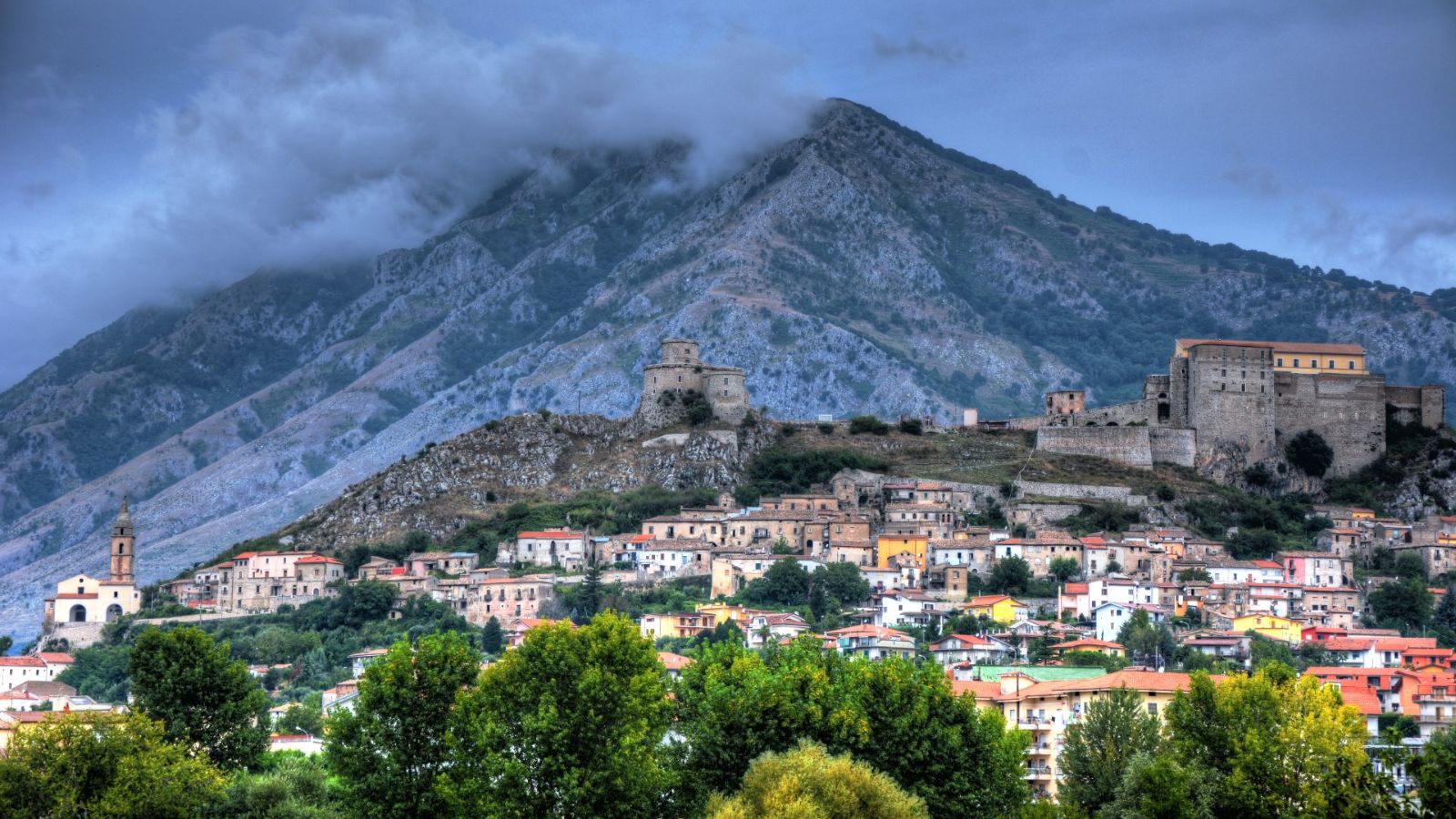
From Benevento you only have to look west to see it: a mountain profile that looks like a sleeping woman. That is exactly why we went there, to walk on that "Sleeping Lady" and find out what lies behind the silhouette. We found beech woods, springs, villages and sweeping views over the whole of Sannio.
An isolated massif in the heart of Sannio
The Taburno-Camposauro Regional Park protects an isolated limestone massif of the Campanian Apennines, lying entirely within the province of Benevento. The park was provided for by a regional law of 1993 and its managing body has been operating since 2002. It covers about 12,370 hectares and includes 14 towns.
There are two main peaks, almost twins: Monte Taburno and Monte Camposauro, both around 1,390 metres. Beside them rise lesser summits such as Monte Pentime. The park also contains two sites of the European Natura 2000 network.
The towns of the park
The fourteen towns are Bonea, Bucciano, Cautano, Foglianise, Frasso Telesino, Melizzano, Moiano, Montesarchio, Paupisi, Sant'Agata de' Goti, Solopaca, Tocco Caudio, Torrecuso and Vitulano.
Each one has its own gateway to the mountain. Our advice is to pick two or three and combine your hike with a stroll around town: Montesarchio with its castle, Sant'Agata with its village perched on tuff, Solopaca with its vineyards, Vitulano and Cautano for the climb towards Camposauro.
The Sleeping Lady of Sannio
Seen from the plain of Benevento, the profile of the massif recalls a woman lying down asleep, with her face, breast and legs clearly recognisable. That is why everyone calls it the Sleeping Lady of Sannio (la Dormiente del Sannio). It is one of those details that, once noticed, you never forget: every time we come back to the city we look for her on the horizon.
Beech woods, springs and water for the Royal Palace
Between the two peaks stretches an ancient beech forest, the most beautiful woodland in the park. In autumn the leaves turn yellow and copper, and that is when we most love walking through it. Lower down the landscape changes: olive groves, vineyards, orchards and vegetable gardens tell of an area that is still very much agricultural.
The mountain is also a great reservoir of water. At its foot rise the Fizzo springs, which Luigi Vanvitelli tapped with the Carolino Aqueduct to carry water all the way to the Reggia di Caserta. Realising that the fountains of the Royal Palace depend on these mountains gave us a new sense of how closely the places of Campania are connected.
For wildlife lovers, the park is home to foxes, badgers and dozens of species of birds, many of which nest here. Remember that snakes also live in the park, vipers included: wear high boots and watch where you put your hands.
Walking on Taburno
The park is crossed by several hiking trails, from routes suitable for everyone to paths for experienced hikers. Climbing to the summits takes a few hours on foot and a minimum of fitness, but you are rewarded with views over the surrounding valleys.
Our advice is to check the condition of the trails beforehand and not to venture off the marked paths alone. If you are not experienced, a local guide can make all the difference.
How to get there and when to go
The massif is easy to reach by car from Benevento, from the Caudina valley (Montesarchio side) or from the Telesina valley (Solopaca and Frasso Telesino side). From every side, roads climb towards the higher altitudes.
The best seasons are spring, with its blossoms, and autumn, with the colours of the beech forest. In summer the woods offer cool shade, while in winter the peaks may be covered in snow: in that case you need proper equipment and experience.
Nearby
- To find your way around the whole province, start from Benevento and its surroundings.
- On the Caudina side, the Castle and the Museo del Sannio Caudino await you.
- One of the park's villages is Sant'Agata de' Goti.
- The vineyards of the northern slope are the stars of Solopaca and its Grape Festival.
- For the wines of the massif, read about Aglianico del Taburno DOCG.
Photo at the top (Montesarchio): Salvatore Di Maro, CC BY-SA 3.0, via Wikimedia Commons.