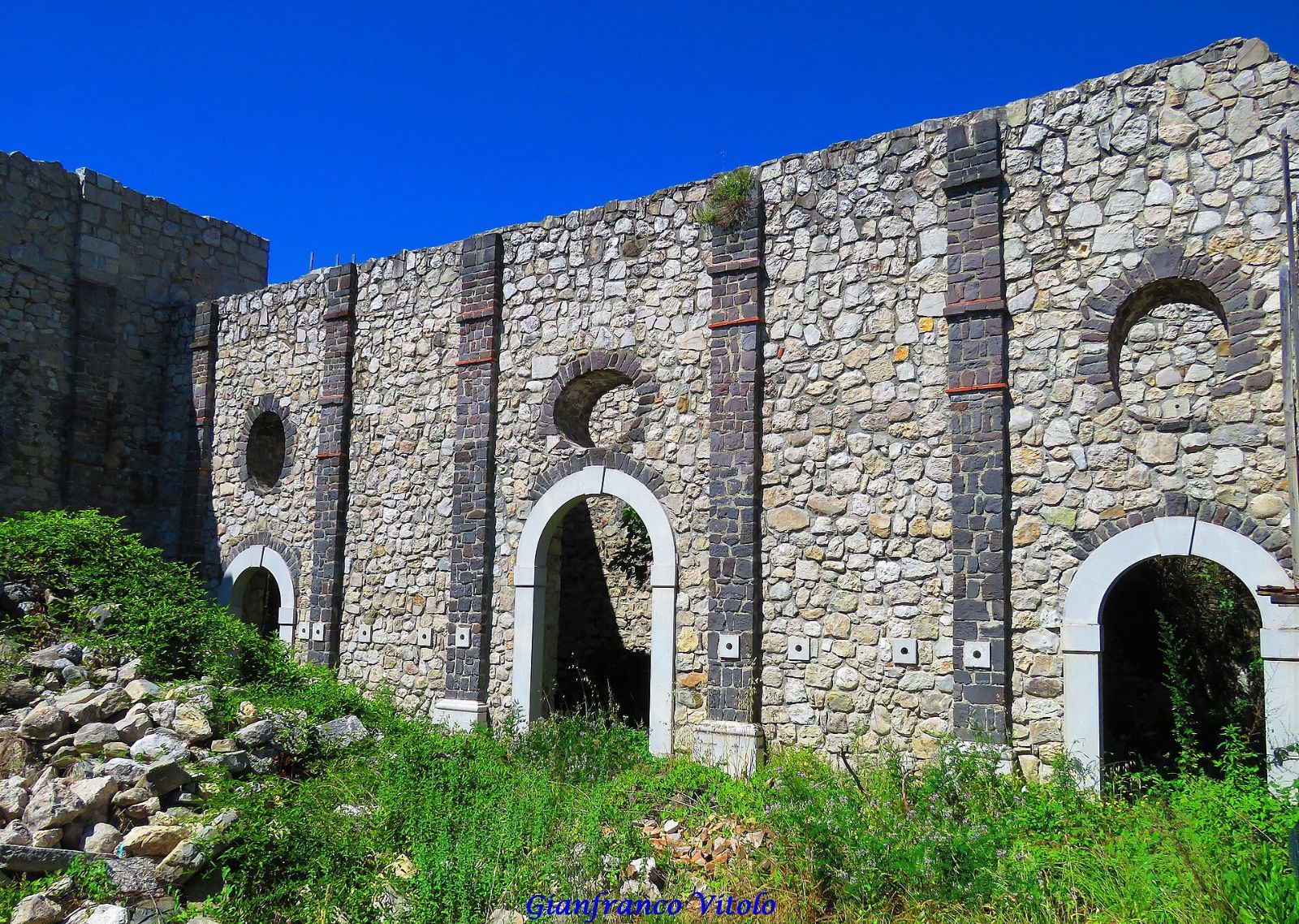
Arriving in Cerreto Sannita, we noticed straight away that something was different: straight, wide streets crossing at right angles, like a town planned on a drawing board. And that is exactly what it is. Then we began to spot the majolica, on the façades and in the shop windows, and we realised that here clay is taken seriously.
A town rebuilt from scratch
The history of Cerreto Sannita changed for ever on 5 June 1688, when an earthquake razed the old town to the ground. The rebirth was led by the feudal lords, the counts Carafa, and in particular Marzio Carafa with his brother Marino. The new town was built further down the valley, on a terrace between two streams, to a design by the engineer Giovanni Battista Manni.
The result is a regular urban layout, with streets crossing as in Roman cities. For an Apennine village this is rare, and you really feel it as you walk around: the vistas are long and the squares spacious. The town has also been awarded the Orange Flag (Bandiera Arancione) of the Touring Club Italiano.
The eighteenth-century churches
The reconstruction left Cerreto with a heritage of churches all from the same period. The Cathedral of the Most Holy Trinity was begun in 1689 and completed in the first half of the eighteenth century: look up at its two bell towers, topped by small domes clad in yellow-green majolica. The Collegiate Church of San Martino, with a nave and two aisles, was rebuilt between 1689 and 1733, again to a design by Manni.
When you step inside these churches, we suggest looking closely at the floors, altars and decorations: local ceramics often make an appearance here too.
Cerreto ceramics: a story born from the rubble
Clay had long been worked in the area, thanks to the materials provided by the Titerno river. But it was after the earthquake that Cerreto ceramics became a true art: Neapolitan masters came for the reconstruction, bringing new techniques and tastes. Among the figures considered to be at the origin of this tradition is Nicolò Russo.
Historic Cerreto majolica is recognisable by its colours: above all yellow, green and orange, later joined by cobalt blue. The eighteenth century brought floral motifs and the chinoiserie of Rococo taste, followed by the classically inspired forms of the Neoclassical period.
In 1997 Cerreto's production was recognised as traditional art ceramics, and the town is a member of the Italian Association of Ceramics Cities. Several workshops are still active in town today, and watching a craftsman hand-paint a plate was one of the things we enjoyed most.
The Civic Museum and Museum of Cerreto Ceramics
To really understand this tradition, the essential stop is the Civic Museum and Museum of Cerreto Ceramics, opened in 1993 in the former eighteenth-century convent of Sant'Antonio. It holds hundreds of pieces from the seventeenth to the nineteenth century, alongside a section devoted to contemporary ceramics.
Much of the historic collection is owed to two enthusiasts: the scholar Salvatore Biondi and the magistrate Vincenzo Mazzacane, who collected and donated hundreds of pieces. Before you go, check opening times and tickets on the official website.
How to get there and when to go
Cerreto Sannita lies in the Titerno valley, at the foot of the Matese, and can be reached by car from Benevento through the Telesina valley. The centre is easy to explore on foot and can comfortably be seen in a day, perhaps together with nearby San Lorenzello, also known for its ceramics.
Any season is fine, but the valley is at its best in spring and autumn. If you enjoy walking, follow the Titerno upstream towards Cusano Mutri: along the way you will come across the so-called Ponte di Annibale (Hannibal's Bridge), a Roman-era arched bridge over the stream which legend links to the passage of the Carthaginian general.
Nearby
- Climbing towards the Matese you reach Pietraroja: its story is told in Pietraroja and the Paleolab, the land of Ciro.
- To find your way around the whole province, start from Benevento and its surroundings.
- For a day among vineyards and traditions, discover Solopaca and its Grape Festival.
- After your visit, discover the flavours of the area and what to eat in Benevento.
Photo at the top (Cerreto Sannita): Gianfranco Vitolo from Sarno (Sa), Italia, CC BY-SA 2.0, via Wikimedia Commons.