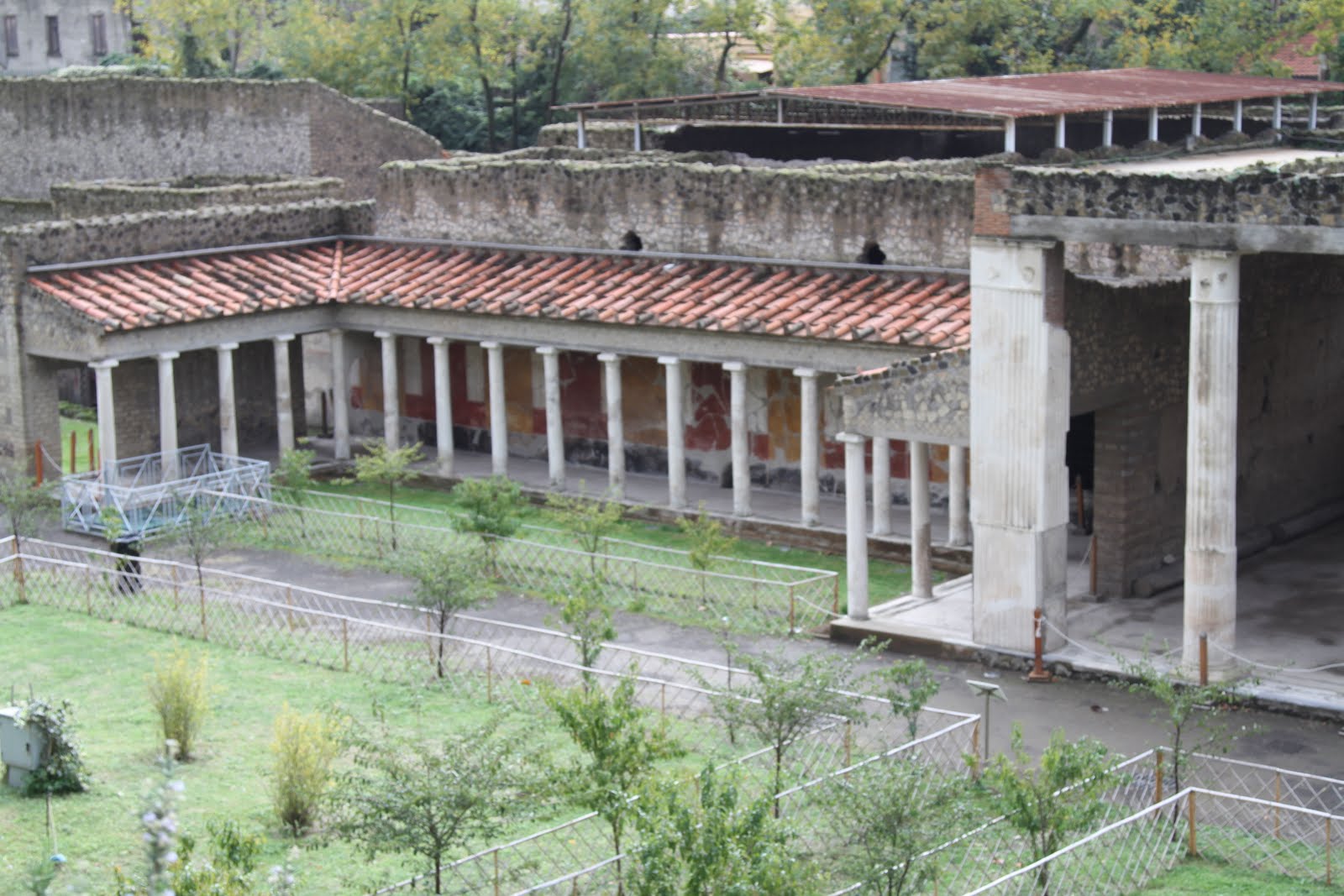
When people talk about Vesuvian archaeology, everyone thinks of Pompeii and Herculaneum. We ask you to make a detour of just a few kilometres, to the excavations of Oplontis: here we found a Roman villa with splendid frescoes, few visitors and time to look at every wall calmly. It was one of the loveliest surprises of our trips around Vesuvius.
Oplontis, the suburb of Pompeii
The excavations are in the centre of Torre Annunziata, surrounded by the modern town. In Roman times Oplontis was a suburban area linked to Pompeii, dotted with villas overlooking the sea. The eruption of 79 AD buried it like the nearby towns, and today the sea is far away: after the eruption the coastline moved considerably further out.
The first explorations date back to the 18th century, but systematic excavations only began in 1964, when the great villa you can visit today came to light. Since 1997 Oplontis has been a UNESCO World Heritage Site together with Pompeii and Herculaneum, and the site is managed by the Archaeological Park of Pompeii.
The Villa of Poppaea
The star is the so-called Villa of Poppaea, also known as Villa A: a large residence built around the middle of the 1st century BC and enlarged over time, still not fully excavated. Its name comes from an inscription painted on an amphora, addressed to a freedman of Poppaea Sabina, second wife of the emperor Nero. This is why the villa is thought to have belonged to her or her family, although the attribution remains a hypothesis.
We were struck by the scale of the complex: reception rooms, inner gardens, service quarters and private baths follow one another without pause. It is a leisure villa designed for enjoying the landscape, and even today, among the columns and the reconstructed gardens, you can sense its spirit.
The frescoes: the real reason to come
Some of the finest paintings in the Vesuvian area are preserved here. Many walls are decorated in the so-called Second Pompeian Style, with painted architecture, columns and perspectives that seem to open the room to the outside. We lingered for a long time in front of these plays of depth, which still fool the eye two thousand years later.
Among the best-loved subjects are the peacocks and the theatrical masks, along with still lifes and glimpses of gardens. In the western sector of the villa an excavation and restoration project is under way: in 2026 the Park announced the discovery of new frescoes in the so-called Hall of the Mask and the Peacock, including the intact figure of a peahen, and opened the site to small groups of visitors on set days. It is worth checking before your visit.
The pool and the gardens
The villa also included a large swimming pool, 61 metres long and 17 wide, flanked by rooms and gardens. Imagining it full of water, with statues and greenery all around, helps you understand the level of luxury of these residences. Thanks to casts, archaeologists have even recovered the imprints of the trees of the ancient garden.
Villa B of Lucius Crassius Tertius
A short distance away is Villa B, known as the villa of Lucius Crassius Tertius, discovered in 1974. It was not a luxury residence but a production complex linked to the wine and oil trade, arranged around a porticoed courtyard. Hundreds of amphorae were found here, along with the treasures known as the Gold of Oplontis. Villa B is normally not open to the public, except for special openings: check the Park’s announcements.
Getting there and when to go
The easiest way is the Circumvesuviana railway: from Torre Annunziata-Oplonti station you can walk to the excavations in a few minutes. By car, take the Naples–Salerno motorway and exit at Torre Annunziata.
The site is largely open-air: in summer go early in the morning; in spring and autumn the light on the frescoes is perfect. Allow about an hour and a half for the visit. Check opening times and tickets on the official website of the Archaeological Park of Pompeii before you set off.
Nearby
Oplontis pairs perfectly with the excavations of Pompeii and Herculaneum, which we describe in Herculaneum and Pompeii: what to see. To understand the volcano that buried all this, read Vesuvius: its history, and if you want to continue towards Naples, stop at The Pietrarsa Railway Museum. Many finds from the Vesuvian area are on display at The National Archaeological Museum of Naples (MANN). All our other ideas are in Naples and its surroundings.
Read also: San Gregorio Armeno, the street of nativity scenes


