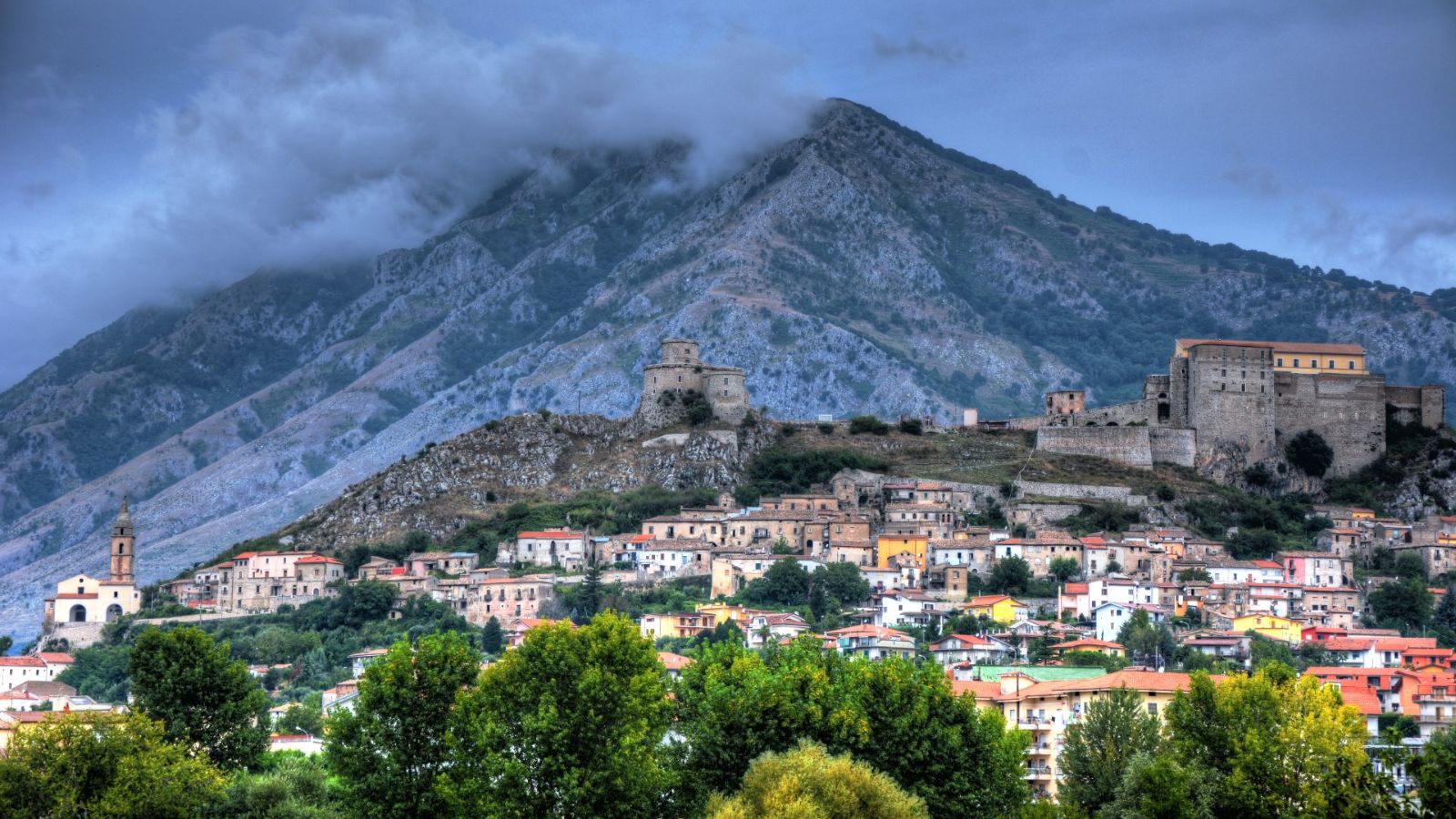
Arriving in Montesarchio along the Caudine Valley, you can see the castle and its great cylindrical tower from afar, clinging to the rocky spur above the town. We walked up, and once at the top we were struck by the view over the valley and the Taburno massif. Inside, one of the finest finds in the whole of Campania was waiting for us.
A castle over the Caudine Valley
The castle stands in a strategic position on a rocky spur, overlooking the Caudine Valley, the valley that tradition links to the episode of the Caudine Forks, the famous humiliation inflicted by the Samnites on the Romans. In antiquity this was the site of the Samnite and later Roman town of Caudium.
The first fortifications probably date back to the Lombard period, and the complex was remodelled over the following centuries. In the Aragonese period the monumental cylindrical tower was added, which is now also part of the museum complex: its double-cylinder structure, lower and more massive than medieval towers, met the new defensive needs of the age of cannon.
A Bourbon state prison
From 1830 the Bourbons turned the castle into a state prison. Risorgimento patriots such as Carlo Poerio, Sigismondo Castromediano, Michele Pironti and Nicola Nisco, opponents of the Bourbon regime, were locked up here. Inscriptions left by the prisoners still survive on the cell walls, and we recommend looking for them: they are among the most moving testimonies of the visit.
The castle remained a place of detention for a long time; after its closure as a prison, in the 1960s it housed an orphanage, the Istituto Mater Orphanorum. Then, after restoration, came its new life as a museum.
The National Archaeological Museum of the Sannio Caudino
The Museo Archeologico Nazionale del Sannio Caudino opened on 30 June 2007 and is now run by the Ministry of Culture. The route tells the story of the valley from prehistory to the Roman age, with particular attention to the culture of the Samnites.
The finds come mainly from the grave goods of the necropolises of Caudium, Saticula (present-day Sant'Agata de' Goti) and Telesia. We were particularly struck by:
- Corinthian pottery and Etruscan and Campanian bucchero ware;
- the many figured vases of Attic and Italiote production, especially kraters, evidence of contacts with the Greek world;
- the multimedia route "Rosso immaginario", set up in the 19th-century wing that the Bourbons had used as a prison.
The Asteas krater and the Rape of Europa
The piece that alone is worth the visit is the Asteas krater, a large red-figure vase from the 4th century BC signed by the Paestum vase painter Asteas, depicting the myth of the Rape of Europa, the maiden carried off by Zeus in the form of a bull.
Its story reads like a novel: it was illegally dug up by tomb robbers in a necropolis at Sant'Agata de' Goti, ended up on the international market and was displayed at the J. Paul Getty Museum in Malibu from 1981. In 2005, thanks to investigations by the Italian authorities, the vase returned to Italy, and today you can admire it a few kilometres from where it was found. We recommend spending time with it: the details of the figures and the colours deserve a close look.
Getting there and when to go
Montesarchio is in the Caudine Valley, on the Via Appia state road between Caserta and Benevento, and is easily reached by car from either city. The castle towers over the town: be ready for an uphill stretch and wear comfortable shoes.
The museum can be visited all year round; clear days in spring and autumn are perfect for enjoying the view too. Opening times and admission arrangements may vary, so check opening times and tickets on the official website before you go. To plan a wider tour of the province, see our guide Benevento and its surroundings.
Nearby
From Montesarchio it's natural to continue towards Sant'Agata de' Goti, the village on the tuff where the Asteas krater came from, or to discover The Taburno-Camposauro Park. Heading on to Benevento, you can complete your archaeological tour with Santa Sofia and the Museo del Sannio and The Roman Theatre of Benevento.
Photo at top (Montesarchio): Salvatore Di Maro, CC BY-SA 3.0, via Wikimedia Commons.