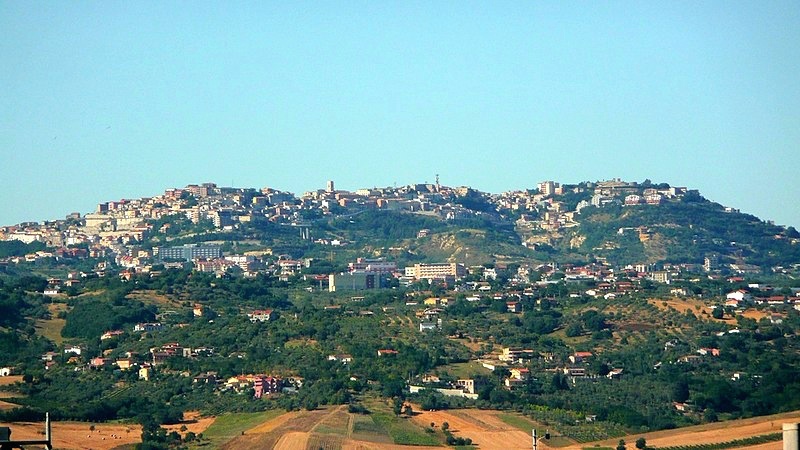
In Ariano Irpino we climbed up to the castle on a windy day, and we understood at once why the history of the Norman kingdom was made right here: from up there you command the valleys all around. Then we went down to the centre for the Museum of Norman Civilisation, which rounds off the visit perfectly. Here is our account of both.
A fortress on the Ariano saddle
The Norman Castle of Ariano Irpino stands on the top of a hill, at about 811 metres above sea level, in a strategic position overlooking the Ariano saddle and three valleys. It is easy to imagine how important it was, in the Middle Ages, to control this crossroads between Campania and Apulia.
Ariano is one of the most interesting destinations in eastern Irpinia, and we are happy to include it in our guide Avellino and its surroundings.
From the Lombards to the Normans
The castle's origins are older than the name we know it by: a document from 892 already records its existence in the Lombard period. But it was the Normans, in the twelfth century, who restored and radically enlarged it, giving it the appearance of a great fortress.
The most famous moment in its history is linked to Roger II, first king of Sicily. In 1140 the Assizes of Ariano were promulgated here, the body of laws that gave order to the new Norman kingdom, and in all likelihood the sovereign held them in the castle itself. Standing within these walls and thinking of that assembly made quite an impression on us.
What the castle is like
The fortress has a trapezoidal plan, with long sides of between 40 and 81 metres, and four large cylindrical towers at the corners, between 13 and 16 metres in diameter. Inside stood the quadrangular keep, the so-called Torre Grande, reached by a bridge and fitted with water cisterns.
Excavations have brought to light locally made pottery and objects linked to sugar refining, dating from the thirteenth to the fifteenth century: a curious discovery that tells of an industrious, productive Ariano, not just a military one.
The public gardens
In the second half of the nineteenth century the castle moats were levelled to create the villa comunale, a large public park of about 40,000 square metres. Today it is the city's green lung: we recommend a stroll along its tree-lined avenues before or after your visit, perhaps enjoying the view over the surrounding hills.
The Museum of Norman Civilisation
For years the Museum of Norman Civilisation was housed in the castle itself. Since July 2023 it has moved to the centre of Ariano, to the seventeenth-century Palazzo Bevere-Gambacorta, owned by the Municipality and restored for the occasion. Bear this in mind when planning your day: the castle and the museum are two separate stops.
The museum tells the story of the Norman-Swabian world through rooms devoted to Roger II and Frederick II, with a significant collection of gold, silver and bronze coins of the kingdom, the lead seals of Roger II and a replica of his coronation mantle.
The same palace houses the "Mario Troso" Arms Museum and Study Centre, with more than two hundred and fifty original pole weapons made between the fifth and the eighteenth century, and a model of the Battle of Hastings of 1066. We really liked the way the two collections speak to each other: you come away with a concrete idea of who the Normans were and how they fought.
How to get there and when to go
Ariano Irpino can be reached by car from Avellino and from Benevento. The castle is in the upper part of the city, inside the public gardens, while the museum is in the historic centre.
- Spring and autumn are the best times; in winter Ariano, because of its altitude, can be very cold and windy.
- Opening times of the castle and the museum may vary: check times and tickets on the official website before you set off.
- Allow half a day to see both stops at a relaxed pace.
Nearby
From eastern Irpinia you can reach other places we recommend:
- The village of Zungoli and more: The most beautiful villages of Irpinia: Zungoli, Monteverde, Nusco.
- Another fortress full of history: The Lombard Castle of Avellino.
- A great medieval monastery: The Abbey of Goleto.
- To discover the local wines: the wines of Avellino and Irpinia.
Photo at the top (Ariano Irpino): Michele, CC BY-SA 2.0, via Wikimedia Commons.