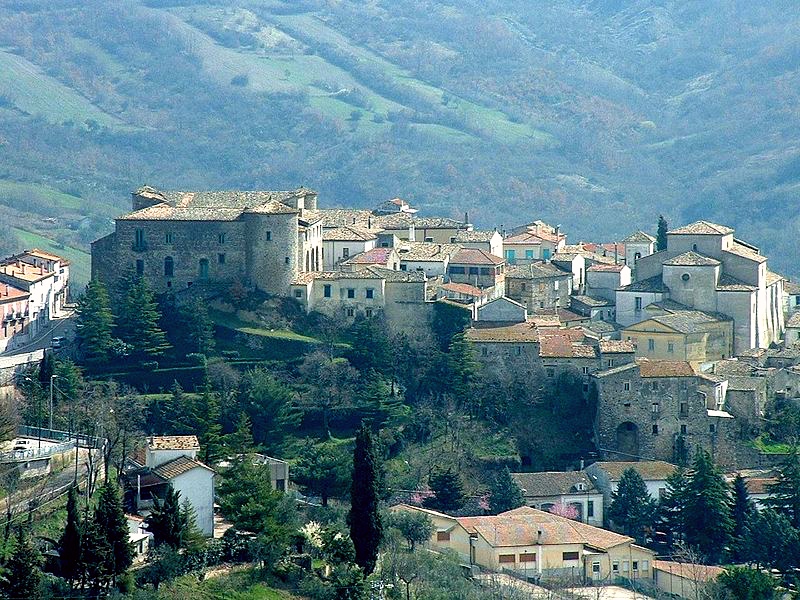
We spent a few days touring inland Irpinia, from one ridge to the next, and in the end we found ourselves thinking above all about three villages: Zungoli, Monteverde and Nusco. Three small stone villages, each with a castle or a cathedral standing guard and views you would never expect. All three belong to the "Borghi più belli d'Italia" club, and here is why they are worth the trip.
The Most Beautiful Villages in Italy club in Irpinia
The Borghi più belli d'Italia (Most Beautiful Villages in Italy) club brings together small towns selected for the quality of their historic heritage and landscape. The province of Avellino is one of the best represented in Campania: besides the three villages we describe here, its members include Frigento, Gesualdo, Savignano Irpino and Summonte. You will find them all in our guide Avellino and its surroundings.
Zungoli, the village on the border with Apulia
Zungoli stands at about 657 metres above sea level in eastern Irpinia, right on the border with Apulia. It is a tiny village with a few hundred inhabitants, and you can walk all of it in a couple of hours.
The highest point is occupied by the Norman castle, built in the eleventh century on an earlier tower and turned into a noble residence in the sixteenth century by the Loffredo family, with its cylindrical corner towers. We were also intrigued by a literary detail: in 1618 the governor of Zungoli was Giambattista Basile, author of the Cunto de li cunti (The Tale of Tales).
In the medieval village you will find the tuff caves, cavities dug underground that local tradition dates back to Roman times. And at the table the star is caciocavallo podolico, made with milk from the Podolica cows that graze along the ancient drove roads between Irpinia and Daunia.
Monteverde, the nest of the black stork
Monteverde lies at about 740 metres, at the eastern tip of Campania, where the region meets Basilicata and Apulia. Its symbol is the castle, built of local stone: on a Lombard tower the Aragonese enlarged the fortress in the fifteenth century, and in 1744 the Sangermano barons transformed it into a stately home. Its restoration was completed in 2006.
Monteverde was a bishop's seat for almost five centuries, as the former cathedral of Santa Maria di Nazareth, rebuilt in 1728, reminds us. But what stayed with us most is the nature all around: the Ofanto valley, Lake San Pietro and the woods where the very rare black stork has chosen to nest, giving the village its nickname.
Nusco, the balcony of Irpinia
Nusco is the highest of the three: it lies at about 914 metres, on the watershed between the Ofanto and Calore valleys. The club describes it as the place "where Irpinia looks like Switzerland", and when the mist rises from the valleys you understand why.
The heart of the village is the cathedral of Sant'Amato, dedicated to the first bishop of Nusco, who lived in the eleventh century. Its bell tower dominates the village skyline, and the Romanesque crypt holds the saint's relics. As you walk through the streets of the centre, we suggest looking up at the stone doorways, noble coats of arms and wrought-iron balconies, and making your way to the Porta Molino viewpoint, where on clear days the view reaches as far as Monte Vulture.
If you go in January, in the second half of the month Nusco celebrates its traditional Festa dei Falò, a festival when the village fills with blazing bonfires.
How to get there and when to go
The three villages are not very close to one another, and it is best to get around by car. Nusco is easily reached from the Ofantina road; Monteverde lies further east, towards the border with Basilicata; Zungoli is in eastern Irpinia, easiest to reach from the A16 motorway and the Ariano Irpino area.
- We recommend setting aside at least a weekend to see them all at a relaxed pace.
- Spring and early autumn are the most pleasant seasons; in winter, at these altitudes, it can snow.
- Castles and churches have variable opening times: check times and tickets on the Municipalities' official websites before you set off.
Nearby
Here is how to extend your tour of the Irpinian villages:
- From Zungoli, the nearby Norman town: The Castle of Ariano Irpino and the Museum of Norman Civilisation.
- From Monteverde, nature and birdwatching along the Ofanto: the WWF Oasis of Lake Conza.
- From Nusco, a trip into the mountains: Lake Laceno and its plateau.
- Another village in the club, on Partenio: The Tower of Summonte.
- In Alta Irpinia, between history and faith: The Abbey of Goleto.
Photo at the top (Zungoli): Giogrande at Italian Wikipedia, Public domain, via Wikimedia Commons.