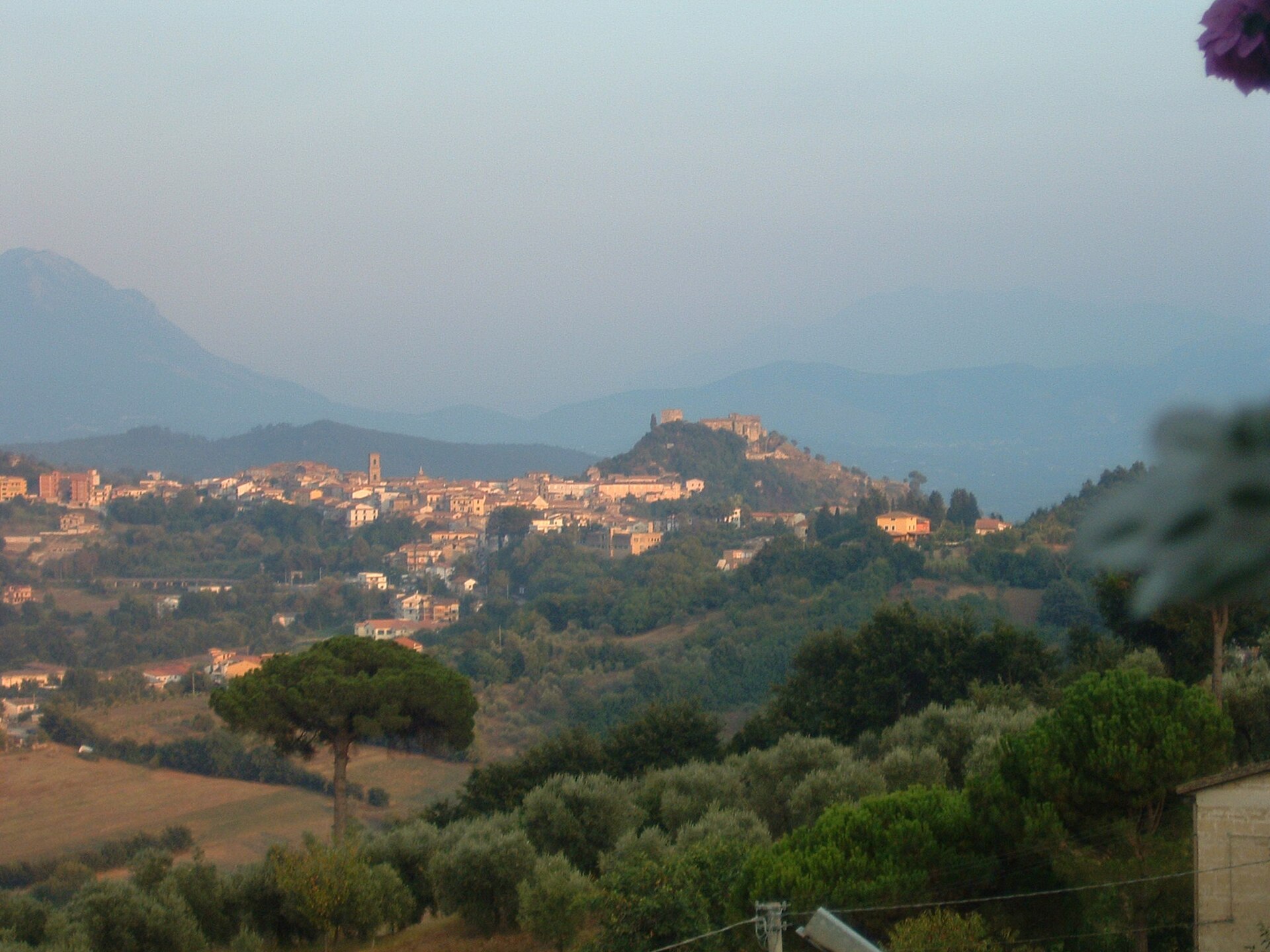
Some villages you visit in a hurry, and some ask for your time: Caiazzo belongs to the second kind. The first time we arrived we planned to stop for an hour, and instead we stayed until sunset, wandering among alleys, noble palazzi and glimpses of the Volturno valley. Here's what we recommend seeing in this town in the province of Caserta, with almost three thousand years of history.
A village overlooking the Volturno valley
Caiazzo stands at an altitude of about 200 metres on a hill overlooking the valley of the Volturno river, east of the Trebulani Mountains. From the historic centre the view sweeps over the surrounding hills and the cultivated plain: it's a strategic position, and that is precisely what explains the town's long history. The municipality also includes the hamlets of San Giovanni e Paolo and Cesarano.
Strolling through the streets, what struck us most was the layering: within a few metres you go from stretches of extremely ancient walls to Renaissance portals, from Baroque churches to stately palazzi.
From ancient Caiatia to the Middle Ages
Caiazzo's origins go back to ancient Caiatia, founded by Oscan peoples between the 9th and 8th centuries BC. From the Osco-Samnites, stretches of the polygonal walls from the 4th century BC are still visible, built with large stone blocks fitted together without mortar: it's worth seeking them out and looking at them up close. In Roman times the city became a municipium with its own institutions.
In the 9th century the Lombards made it the seat of a county; then came the Normans, followed by the Swabians and the Aragonese, each of whom left their mark on the village's appearance.
The castle and the cathedral
The monument that dominates the town is the castle, built by the Lombards, restored by the Normans in 1135 and later rebuilt in the Aragonese period. Even if it isn't always possible to visit the interior, its bulk clearly conveys the military role Caiazzo played for centuries.
Not far away is the Cathedral, with its Baroque façade from 1760 designed by the architect Nicola Tagliacozzi Canale. In 2013 the church was raised to the rank of minor basilica. Stepping into the cathedral after the sunshine of the historic centre is a small pleasure: the atmosphere is hushed and peaceful.
Noble palazzi and the Museo Kere
One of the reasons we liked Caiazzo so much is its palazzi. The most important is Palazzo Mazziotti, from the 15th century, which now houses the municipal library and the Museo Kere, devoted to farming traditions and the memory of the area's rural civilisation. As you stroll, also look up at Palazzo Santoro and Palazzo Savastano, with their richly decorated windows.
Don't miss the Chapel of Sant'Agnese, with a fine Renaissance portal from 1491 bearing the coat of arms of the Egizi family. These are details you only notice when you walk slowly, and that's exactly the beauty of the village.
A memory not to be forgotten
Caiazzo also holds a painful page from the Second World War. On 13 October 1943, on Monte Carmignano, German soldiers killed twenty-two civilians, including women and children. It's a story we invite you to learn about, with the respect it deserves.
The caiazzana olive
On the hills around the town grows the caiazzana olive, a local variety with dark flesh, used both for oil and as a table olive. The table version is protected by a Slow Food Presidium: traditional preparations include the infornata olive, baked with flavourings such as wild fennel and garlic. The harvest takes place in November. If you're interested in the flavours of the area, also read Typical dishes of Caserta.
Getting there and when to go
Caiazzo can be reached by car from Caserta, following the roads that climb the Volturno valley. The town is also served by the historic Alifana railway, but we recommend checking connections and timetables in advance. The best period runs from spring to autumn; in November, during the olive harvest, the hills are especially lively. For museums and monuments, check opening times and tickets on the official website before you go.
Nearby
To discover the rest of the province, we suggest our guide Caserta and its surroundings. From Caiazzo it's easy to reach the medieval village we describe in Casertavecchia, or to head up into the mountains for the trip described in Lake Matese. For another outing among art and history, we recommend The Basilica of Sant'Angelo in Formis, in Capua.
Photo at top (Caiazzo): NicFer at Italian Wikipedia, GFDL, via Wikimedia Commons.