From the outside it looks like a country church, tucked away at the foot of Mount Tifata, with its arched portico and square bell tower. Then we stepped inside and the walls lit up with colour: saints, prophets and Gospel stories painted almost a thousand years ago. The Basilica of Sant'Angelo in Formis is one of those places we recommend seeing at least once in your life.
From a temple of Diana to a Benedictine church
The basilica, dedicated to St Michael the Archangel, stands in the territory of Capua, on the site of the famous temple of Diana Tifatina, one of the most revered sanctuaries of ancient Campania. A first church already existed at the beginning of the 10th century and followed the temple's outline.
The turning point came when the complex passed to the Benedictines of Montecassino. Between 1072 and 1087 Abbot Desiderius, who would later become pope as Victor III, had the church rebuilt in the form we still see today.
The architecture: the portico and the ancient materials
The façade is fronted by a portico with five pointed arches, added in the 12th century, framing a marble doorway. Next to it rises the square bell tower, its base made of large stone blocks and its upper section of brick with mullioned windows.
Inside, the basilica plan has three naves with no transept, closed by three apses. The naves are divided by ancient columns with Corinthian capitals, salvaged from the temple of Diana, and part of the floor also reuses materials from the old sanctuary. We loved this dialogue between the pagan and Christian worlds: you are literally walking on the stones of the temple.
The 11th-century frescoes
The real treasure of Sant'Angelo in Formis is the cycle of frescoes covering almost every wall. It dates from the second half of the 11th century, the time of Desiderius's rebuilding, and is the work of local painters trained in Byzantine culture. It is considered one of the most important Romanesque painting cycles in southern Italy.
Along the naves run stories from the Old and New Testament, to be read like a great illustrated book. We lingered for a long time in front of the scenes from the life of Christ, with their still-vivid colours and the large-eyed faces typical of Byzantine art.
The apse and the Last Judgement
The central apse is dominated by Christ enthroned, giving his blessing. Further down there is a detail we invite you to look for: Abbot Desiderius shown offering Christ a model of the church. He has a square halo, the nimbus reserved for people who were still alive when they were portrayed.
Turn towards the entrance and, on the inner façade, you will find the great Last Judgement, with the blessed on one side and the damned on the other. The faithful saw this scene as they left the church, a final warning before returning to everyday life.
Getting there and when to go
The basilica lies in the hamlet of Sant'Angelo in Formis, on the slopes of Mount Tifata, a few kilometres from the centre of Capua and from Santa Maria Capua Vetere. It is easy to reach by car: from the Capua exit of the A1 motorway it takes just a few minutes. Admission is usually free, but opening times also depend on religious services, so check times and openings on the official website of the Diocese of Capua before you set off.
We suggest going in the middle of a bright day, when the light coming through the windows makes the frescoes easier to read. Remember that this is a place of worship: dress appropriately and keep quiet.
Nearby
In the centre of Capua, visit the Museo Provinciale Campano, which also holds mosaics from Sant'Angelo in Formis. A few kilometres away you can explore the Campanian Amphitheatre and the Mithraeum of Santa Maria Capua Vetere. For another medieval masterpiece, head up to the Cathedral of Casertavecchia. You will find all our other travel ideas in Caserta and its surroundings.
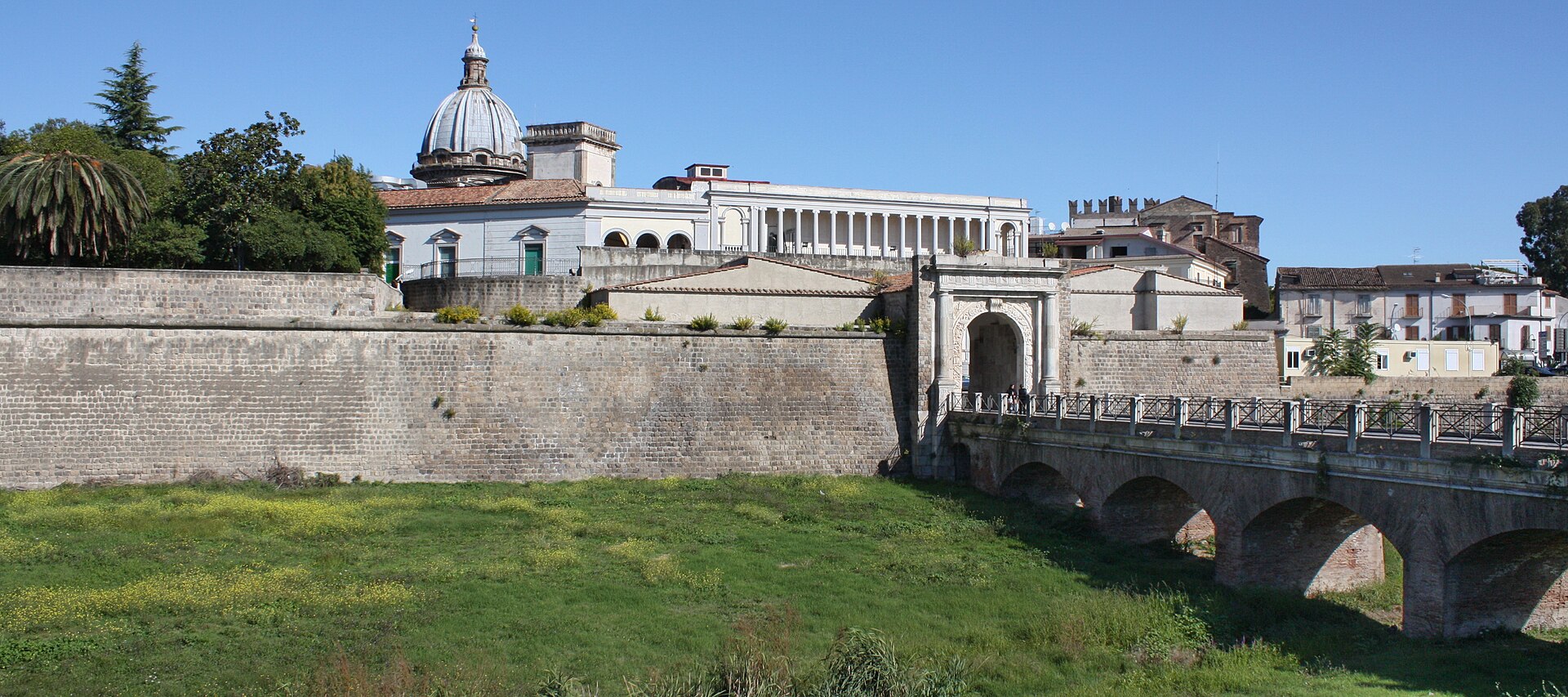
Top photo (Capua): Shadowgate, CC BY 2.0, via Wikimedia Commons.