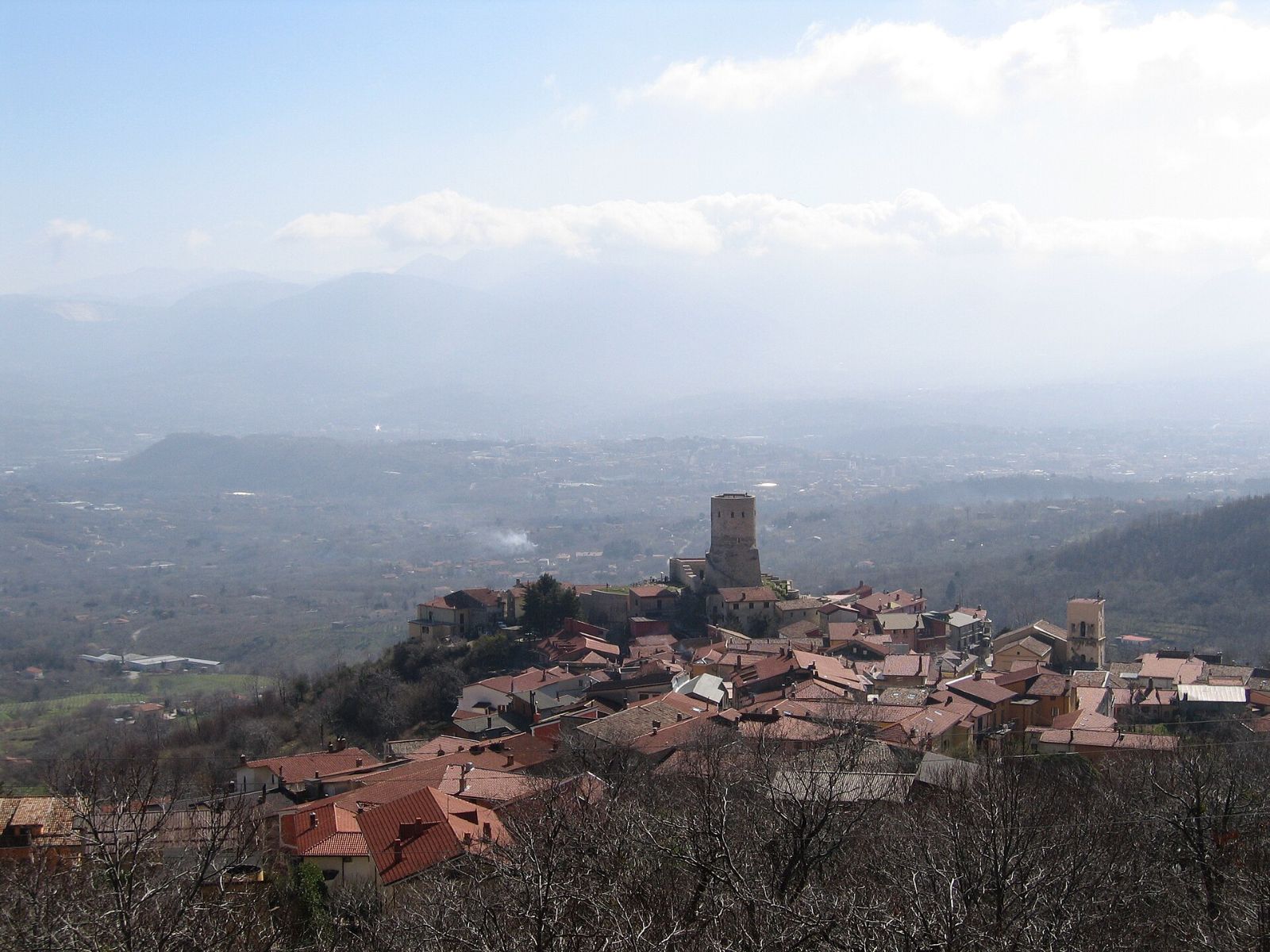
We came to Summonte to see its tower and found ourselves wandering for an hour among stone alleys, stairways and glimpses of the valley. The tower, though, remains the reason the climb is worth it: from its terrace the view stretches a very long way. Here is what to know before you go.
Summonte, a stone village on Partenio
Summonte is a small medieval village nestled on the slopes of Partenio, a few kilometres from Avellino. Since 2017 it has been one of the Borghi più belli d'Italia (Most Beautiful Villages in Italy), and as you stroll through its lanes you understand why: stone houses, carved doorways, little stairways and a constant view over the valley.
According to tradition, it was the Normans who chose this spot for a settlement, precisely because of its position, which commands a wide area. It is one of the stops we suggest in our guide Avellino and its surroundings.
The castle and the Angevin Tower
The castle of Summonte has been documented since at least 1094, when sources mention a castello qui dicitur Submonte, after the village's ancient name. Of that fortified complex what mainly survives today is the Angevin Tower, the only remaining trace of the old castle.
The tower dominates the village from above and has become the symbol of Summonte. Its name recalls the Angevin period, but its history spans the various medieval phases, from the Normans onwards. The lower part, dating from the thirteenth century, was also used to collect rainwater: a detail that made us think about how important it was for a fortress to withstand a siege.
The restoration and the museum
After centuries of neglect, the tower has been restored and rebuilt and can now be visited. Inside is the Civic Museum, with replicas of weapons from the late fifteenth century and archaeological finds from the site, such as pottery and iron and bronze buckles. It is a small display, but it helps you imagine daily life in the castle.
The view from the terrace
The best moment of the visit, for us, was climbing up to the terrace. From up there you can see the Partenio Regional Park, the Sanctuary of Montevergine on the mountaintop and, on clear days, even the Gulf of Naples. We recommend bringing a camera and choosing a fine day: the view more than repays the climb.
And if you want to reach the sanctuary you can see in the distance, you will find everything in our article The Sanctuary of Montevergine.
What to see in the village
After the tower, we suggest spending some time in the historic centre:
- The Church of San Nicola di Bari, built in the fifteenth century and remodelled in Baroque style in the seventeenth, with a nave and two aisles.
- The great linden tree in Piazza De Vito, a centuries-old tree listed among the Monumental Trees of Italy: we were happy to linger in the shade of its branches.
- The stone alleys and stairways, where every corner offers a different glimpse of the valley.
Summonte is also a land of hazelnuts and chestnuts: the hazelnuts are turned into artisan torrone, and in autumn the village celebrates the chestnut with its traditional festival. A good reason to come back in season.
How to get there and when to go
Summonte is a short drive from Avellino, climbing towards Partenio. It is best to leave your car at the entrance to the village and continue on foot: the historic centre is small and easy to explore.
- Spring and autumn are the best seasons, with clear air and splendid colours.
- In summer the village is pleasantly cool compared with the plain.
- Opening times of the tower and the museum may vary: check times and tickets on the Municipality's official website before you set off.
- Wear comfortable shoes: there is a lot of walking on stone and steps.
Nearby
Summonte is an excellent base for exploring this part of Irpinia:
- The sanctuary on Partenio, at Mercogliano: The Sanctuary of Montevergine.
- In Avellino, the city's medieval history: The Lombard Castle of Avellino.
- More villages not to be missed: The most beautiful villages of Irpinia: Zungoli, Monteverde, Nusco.
- And for a sweet taste of autumn: The Montella IGP chestnut.
Photo at the top (Summonte): T4bacc0 at Italian Wikipedia, CC BY-SA 3.0, via Wikimedia Commons.