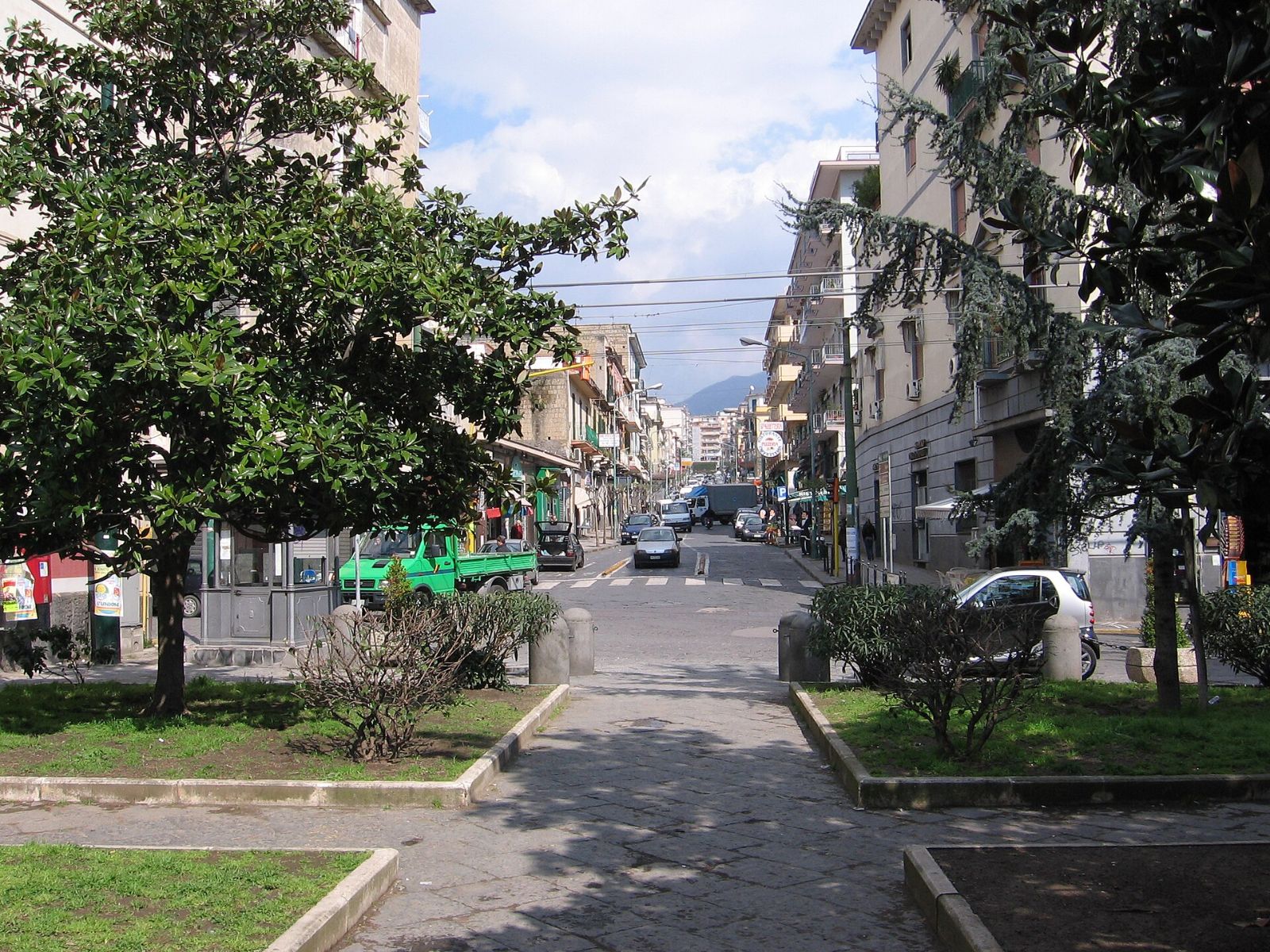
The first time we drove along the Miglio d'oro, the Golden Mile, between Portici and Herculaneum (Ercolano), we had to stop several times: behind the traffic and peeling façades appeared monumental gateways, courtyards and gardens that told of another era. Here, in the eighteenth century, the Neapolitan aristocracy built their country residences at the foot of Vesuvius. Let us take you to discover the Vesuvian villas.
What the Golden Mile is
The Golden Mile is a stretch of the old road that linked Naples to Calabria, now the SS18 state road. Strictly speaking it runs from Villa De Bisogno, in Herculaneum, to Palazzo Vallelonga, in Torre del Greco; today the name is used for a wider area that also includes San Giorgio a Cremano, Portici and the Neapolitan districts of San Giovanni a Teduccio and Barra.
The Ente per le Ville Vesuviane, set up by a law of 1971 to protect and restore this heritage, has listed 122 villas. The name "golden" says a lot about the wealth of this stretch, with its noble residences, gardens and orchards.
The Royal Palace of Portici, where it all began
The story of the Golden Mile begins with a king. In 1738 Charles of Bourbon decided to build a residence in Portici: the Royal Palace was designed by Giovanni Antonio Medrano and, from 1740, by Antonio Canevari. Where the king settled, the nobility followed, and within a few decades the road was lined with villas.
One curiosity that struck us: the old road to Calabria still runs through the palace's large octagonal courtyard today. In the same period the excavations of Herculaneum began, and the Herculanense Museum was set up in the palace with the finds, which were later moved to Naples. Since 1935 the palace has housed the Agriculture department of the University of Naples Federico II, with its Botanical Garden and park.
Villa Campolieto
This is the villa that left the strongest impression on us. It was commissioned by Lucio di Sangro, Duke of Casacalenda, and work began in 1755 to a design by Mario Gioffredo. Then Luigi Vanvitelli, the architect of the Royal Palace of Caserta, took over and profoundly changed the design; his son Carlo Vanvitelli completed it in 1775.
The finest sight is at the back: a broad elliptical portico opening towards the sea, like an embrace. Inside there are decorations by artists such as Fedele Fischetti. Today the villa is managed by the Ente Ville Vesuviane and hosts exhibitions and cultural events.
Villa Favorita and its park by the sea
Not far away is Villa Favorita, designed by Ferdinando Fuga from 1762. The property passed to the Prince of Aci, who in 1768 held a grand reception there for the sovereigns of Naples, and in 1792 it was acquired by Ferdinand IV.
The king created a large park that ran down from the Golden Mile to the sea. In the park we recommend looking for the Palazzina dei Mosaici, with walls covered in fragments of mother-of-pearl and porcelain, and the Bourbon landing stage.
Other villas worth knowing
In Herculaneum there is also Villa Ruggiero, likewise managed by the Ente. In Torre del Greco, instead, is Villa delle Ginestre, linked to Giacomo Leopardi, who stayed here and wrote La ginestra. Many other villas are private or awaiting restoration: even just seeing them from outside gives you an idea of how rich this stretch of coast once was.
Getting there and when to go
The villas are easy to reach from Naples on the trains of the Vesuvian line or by car along the state road. We recommend spring and early autumn, when the gardens are at their best and walking is a pleasure. Some villas may be closed for works: check opening hours and tickets on the official website before you go.
Nearby
To plan your trip, start from our guide Naples and its surroundings. The Golden Mile pairs perfectly with the excavations described in Herculaneum and Pompeii: what to see and with the climb up the volcano, which we cover in Mount Vesuvius: its history. Close to Portici there is also the Pietrarsa Railway Museum, while for another ancient villa we recommend The Excavations of Oplontis.
Top photo (Herculaneum): Shii, CC BY-SA 3.0, via Wikimedia Commons.
