The historic centre of Salerno is small, but every corner hides a church: some date back to the Lombard era, others were clad in stucco and frescoes in the Baroque period. We visited them following a chronological thread, and that is how we recommend you discover them too, to understand how the city changed over the centuries.
The Cathedral of San Matteo, the religious heart of the city
There is no other place to start than the Duomo. The cathedral was built between 1080 and 1085 at the behest of Robert Guiscard, the Norman leader who had conquered the city, and it was consecrated in 1084 by Pope Gregory VII, who died in exile in Salerno and is buried here.
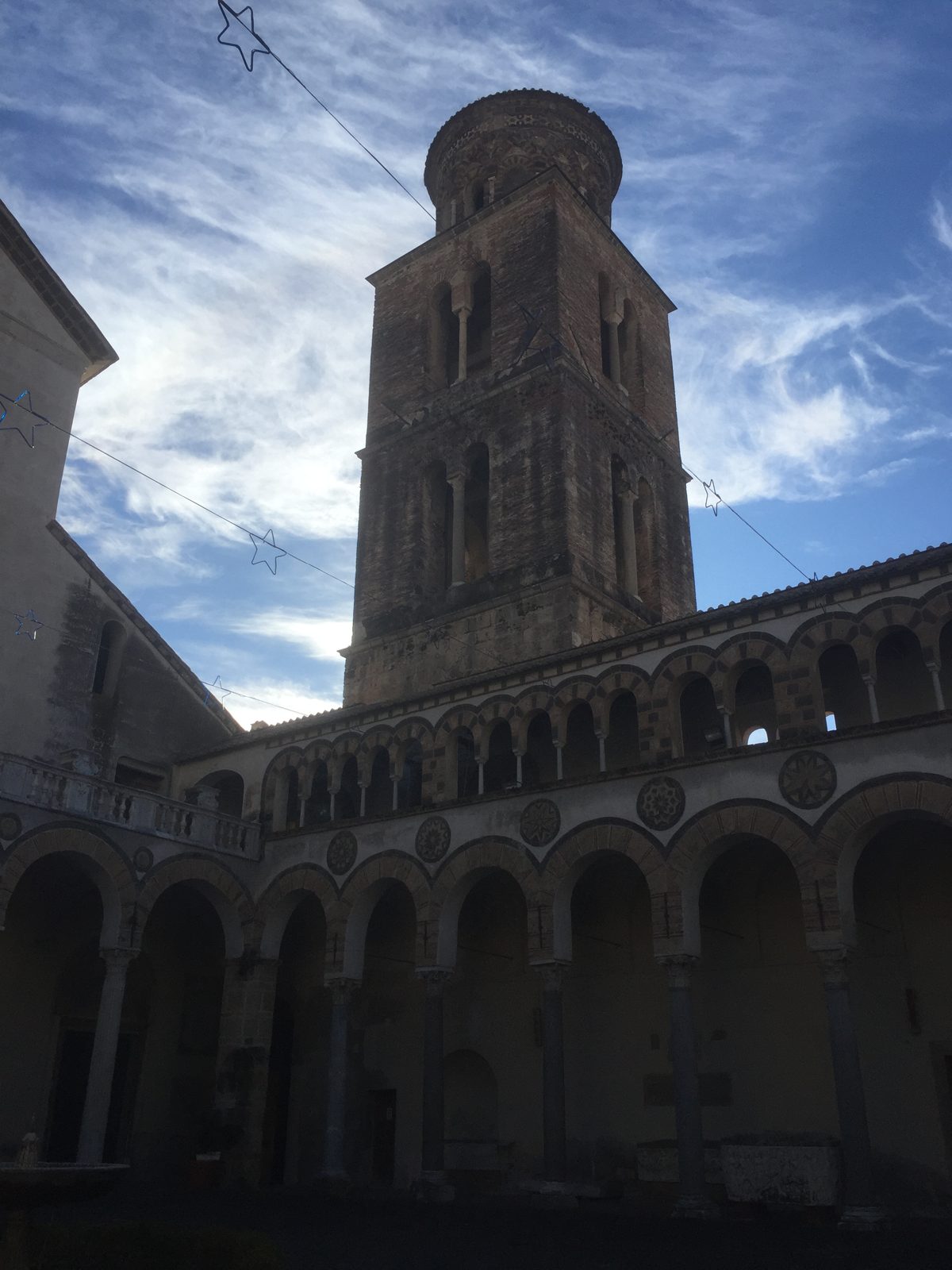
You enter through an elegant quadriporticus with round arches, dominated by the 12th-century Arab-Norman bell tower. The central portal still has its bronze door, cast in Constantinople in 1099; inside we were struck by the two great medieval mosaic ambos and, downstairs, by the Baroque crypt with the relics of Saint Matthew, the city's patron saint. You will find the full history of the monument in Salerno Cathedral.
The Lombard churches: San Pietro a Corte, Sant'Andrea de Lavina, Santa Maria de Lama
Before the Normans, Salerno was the capital of a Lombard principality, and some churches still bear its traces. The most surprising is San Pietro a Corte: the palatine chapel was built under Prince Arechis II, in the second half of the 8th century, on top of a Roman bath building. In the hypogeum you can see medieval frescoes and, according to the sources, in the 13th century the church also hosted public ceremonies such as the conferring of degrees of the Medical School. We have devoted an in-depth article to it: San Pietro a Corte.
Not far away is Sant'Andrea de Lavina, founded in 832 and rebuilt several times after floods: of the medieval building only the bell tower remains, while the present church has Baroque forms. Finally there is Santa Maria de Lama, with its two-nave lower church built between the end of the 10th and the beginning of the 11th century on Roman remains: here the walls show two fresco cycles, the more recent from the 13th century. These are intimate, silent places, which we recommend visiting with a guide or during special openings.
The Santissimo Crocifisso and its crypt
The church of the Santissimo Crocifisso, with three naves and three apses, already existed before the thirteenth century and was once dedicated to Santa Maria della Pietà. Its name comes from a cross painted in the 13th century, now kept in the diocesan museum. The real surprise, though, is the crypt, rediscovered in 1950: it holds a large Crucifixion frescoed in the first half of the thirteenth century, with a suffering Christ with closed eyes, which struck us with its intensity.
The Baroque: San Giorgio and the Santissima Annunziata
If you love the Baroque, the stop not to miss is the church of San Giorgio, considered by many the most beautiful Baroque church in the city. The complex began as a Benedictine monastery, documented as early as 819; the present church was completed in the seventeenth century and its walls are entirely frescoed. Among the artists who decorated it are Angelo Solimena and his son Francesco Solimena, one of the great painters of the Neapolitan Baroque, and Andrea Sabatini, known as Andrea da Salerno. The architect Ferdinando Sanfelice was responsible for the eighteenth-century redesign of the monastery.
Sanfelice also worked on the church of the Santissima Annunziata, rebuilt in 1627 after a flood: his is the monumental bell tower with four superimposed orders, which you notice from afar as you enter the historic centre from the west.
Churches that are now museums
Some sacred buildings have found a new life. The church of San Gregorio, on Via dei Mercanti, built around the year 1000, now houses The Virtual Museum of the Scuola Medica Salernitana, with multimedia installations on medieval medicine. The San Benedetto complex, a former Benedictine abbey, is instead home to The Provincial Archaeological Museum of Salerno. Two visits that combine well with a tour of the churches, not least because they are a few steps from the Duomo.
How to get there and when to go
All the churches we have described are in the historic centre, a few minutes' walk from the railway station and the seafront. The streets are uphill and often narrow: comfortable shoes and no rush. Some sites, such as the Lombard hypogea, have limited opening hours, so check opening times and tickets on the official websites before you set off, and remember that visits are not allowed during services.
We recommend spring and autumn; in September, around the feast of the patron saint, the city comes alive with the celebrations of San Matteo and the procession of the paranze.
In the surroundings
- To fit the churches into a complete itinerary, read our guide Salerno and its surroundings.
- A few steps from the Duomo, The Minerva Garden and the Scuola Medica Salernitana await you.
- For lovers of sacred art and painting, an art weekend in Salerno can take you through its churches and museums.
- Outside the city, in Cava de' Tirreni, The Badia di Cava, the Abbey of the Holy Trinity is well worth a trip.