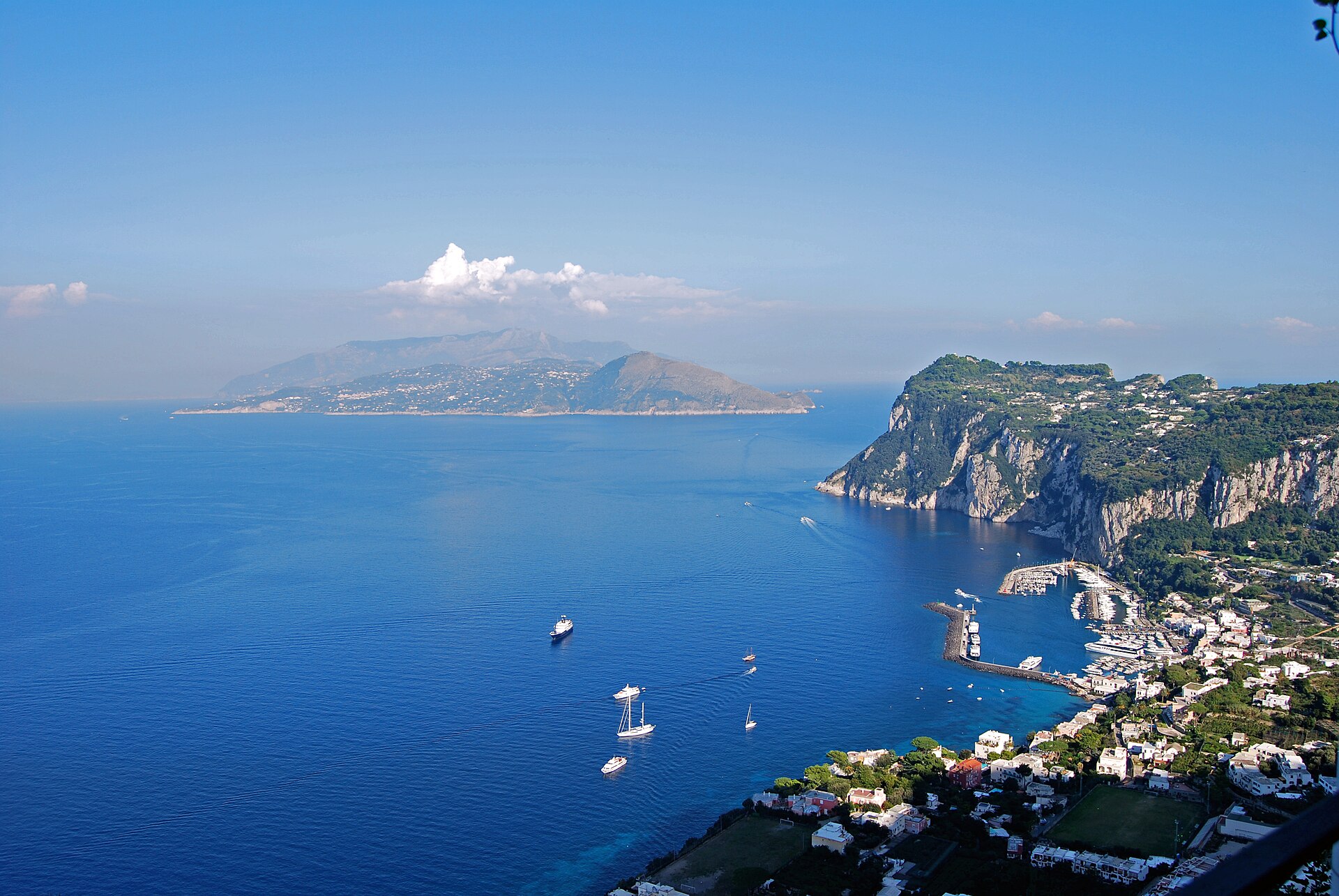
There are images we have known forever that still manage to surprise us when we see them for real. The Blue Grotto (Grotta Azzurra) is one of them. We went in lying flat on the bottom of a little rowing boat, a few centimetres from the rock, and when we sat up again we were surrounded by a blue that seemed lit from within. Here is how to visit it and what to know before you go.
Where it is and what it is like
The grotto opens onto the north-west coast of Capri, in the municipality of Anacapri. It is a karst cave partly flooded by the sea: the main chamber, called the Duomo Azzurro (Blue Cathedral), is about 60 metres long and about 25 wide, with a vault averaging around seven metres high.
The entrance is the most famous part: a narrow opening, about one metre above the waterline when the sea is calm. To get through you have to lie down in the boat, while the boatman pulls himself inside by gripping an iron chain fixed to the rock face. It is a brief but thrilling moment. On peak days, boats gather in front of the entrance waiting for their turn: be patient and enjoy the coastline in the meantime, with its rock walls plunging sheer into the sea.
The secret of the colour
The intense blue is not a lighting trick. Below the visible entrance there is a second opening, much wider and underwater: sunlight enters through the water, which absorbs the red and lets the blue through. The result is water that seems lit from below.
What struck us was the contrast: outside, the full light of Capri; inside, a soft darkness in which all the colour comes from the water. You only stay inside for a few minutes, but it is the kind of moment that stays with you.
The nymphaeum of Tiberius
The grotto was already known in Roman times. In the days of Emperor Tiberius it was used as a sea nymphaeum, a space decorated with statues of sea gods. In the 1960s, during underwater archaeological research, statues of Poseidon and a Triton were found; they are now displayed in Anacapri in the Casa Rossa museum.
Right above the grotto stands Villa Damecuta, one of the residences attributed to Tiberius: a visit that pairs perfectly with this one.
The “discovery” of 1826
For centuries the island’s fishermen had steered clear of the grotto out of fear. Its modern fame began on 17 August 1826, when the German poet August Kopisch and the painter Ernst Fries, accompanied by local guides, explored it. It was Kopisch who wrote about it and made it famous as the “Blue Grotto”, and from then on it became a must-see stop for travellers on the Grand Tour.
Getting there and when to go
There are two ways. By sea, you leave from Marina Grande on the boats that run to the grotto; in front of the entrance you transfer to the small rowing boats of the boatmen. By land, you take the bus from Anacapri to the small stairway that leads down to the boarding point: this option often saves both time and money.
The grotto can only be visited when the sea allows: with a north wind or a swell the entrance is closed, sometimes suddenly, and in winter access is never guaranteed. The middle of the day in summer is the busiest time, with queues on the water that can be long. Our advice is to check conditions that same morning and aim for late spring or September. Check opening hours and tickets on the official website before setting off, bearing in mind that the entrance ticket and the boat are paid for separately.
Nearby
After the grotto, head up to see the imperial villas described in Villa Jovis and Villa Damecuta and complete your tour of the island with The island of Capri: what to see and do. If you love places where the sea cuts into the rock, The Bay of Ieranto awaits you on the coast opposite. To raise a glass with the island’s wines, read Capri DOC, and for other itineraries start from Naples and its surroundings.
Top photo (Anacapri): Elenagm, CC BY 3.0, via Wikimedia Commons.


