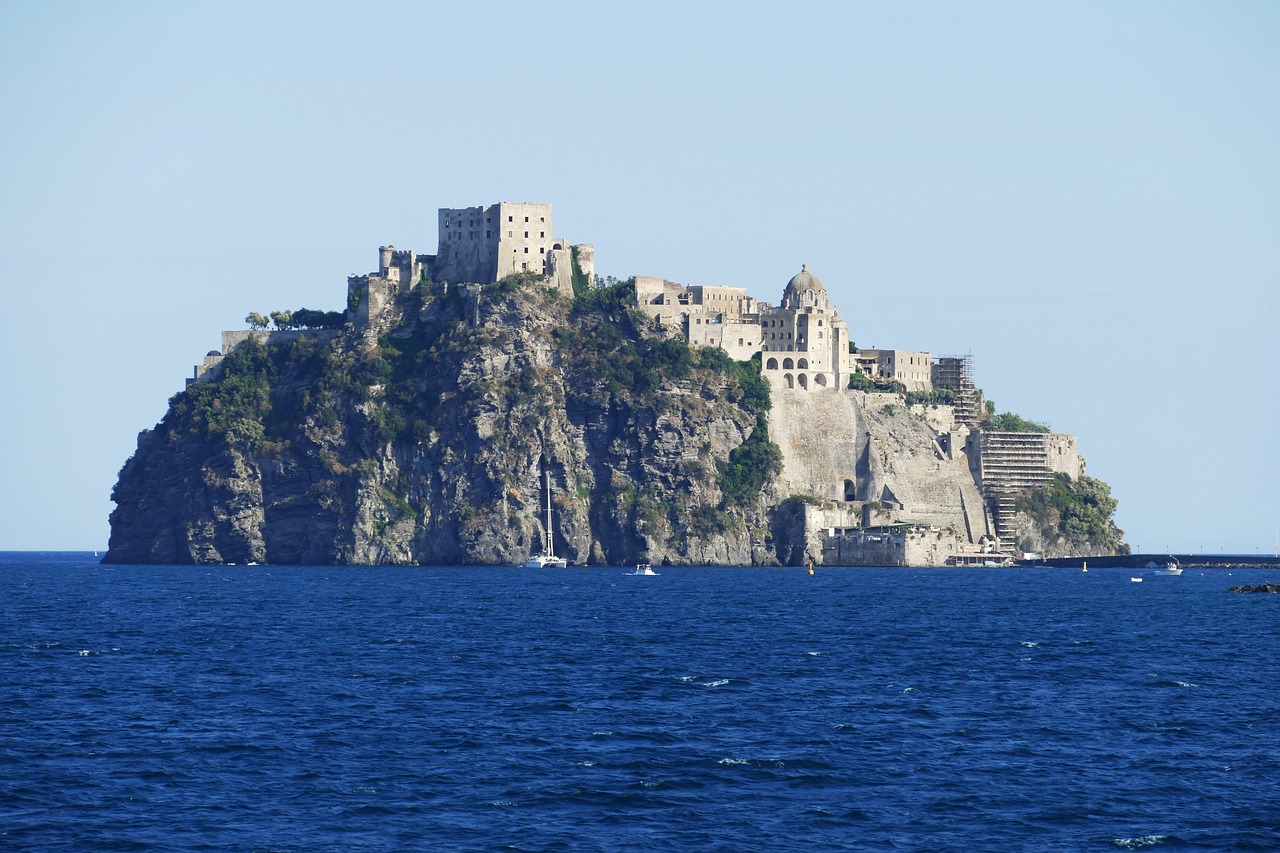
As you arrive in Ischia Ponte, the Aragonese Castle suddenly comes into view: an islet of dark rock crowned with walls, churches and towers, joined to the coast by a long bridge. We crossed it on foot one sunny morning and lost ourselves for hours among terraces and ruins. On the way out, just a few steps away, the small Sea Museum (Museo del Mare) was waiting for us. Here is how we spent the day.
An island within the island
The castle stands in the municipality of Ischia, on an islet of trachyte rock formed by a volcanic eruption, about 113 metres above the sea and with a surface area of about 56,000 square metres. The first fortification dates back to 474 BC, when Hiero I of Syracuse built a stronghold here after helping Cumae against the Etruscans.
Over the centuries the islet was fought over and fortified many times. The turning point came in 1441 with Alfonso V of Aragon: he had the bridge to the island built, originally in wood, along with a tunnel cut into the rock so that people could climb up safely. It is from him that the castle takes its name.
The inhabited castle and Vittoria Colonna
The Aragonese Castle was not just a fortress: it was a small town. At the end of the 16th century, 1,892 families lived here, with thirteen churches, convents and a seminary. Between 1501 and 1536 the poet Vittoria Colonna stayed here, and a lively circle of writers and artists gathered around her.
Decline came in the 18th century, when the population moved to the main island. In 1809 the castle was bombarded by the British, and later the Bourbons turned it into a prison, including for political prisoners. Since 1912 it has been privately owned, and today it can be visited as a place of art and culture.
What to see in the castle
You go up on foot through the tunnel and along the paths, or by lift, and then you are free to wander along the routes. The stops you should not miss:
- the Cathedral of the Assumption, now in ruins and all the more evocative for it, with its frescoed crypt;
- the Cemetery of the Poor Clares, beneath the convent, where deceased nuns were placed sitting on stone seats: a place that makes you think;
- the Church of the Immacolata and its terrace;
- the Bourbon prison;
- the Terrazza degli Ulivi (Olive Tree Terrace), one of the most beautiful viewpoints.
What struck us was the constant alternation of ruins, gardens and viewpoints: on one side the village of Ischia Ponte, on the other the open sea towards Procida and Capri. Bring time and curiosity, because every path leads to a different view.
The Sea Museum in Ischia Ponte
Back on the main island, a few steps from the bridge, you will find the Sea Museum, housed in the Palazzo dell’Orologio on via Giovanni da Procida. Opened in 1996, it is spread over three floors and devoted to the island’s seafaring culture: fishing gear, navigation instruments such as compasses and sounding lines, anchors, lanterns, model boats, nautical charts and vintage photographs.
It is a small, unpretentious museum, but it tells the story of the island’s fishermen and captains well. We lingered in front of the old photos of the village, which put faces to the stories of the sea that the castle only lets you imagine.
Getting there and when to go
You reach Ischia by ferry or hydrofoil from Naples and Pozzuoli, landing at Ischia Porto, Casamicciola or Forio. From Ischia Porto you can get to Ischia Ponte by bus or with a stroll along the main street. The castle can be visited in a couple of hours, but we recommend setting aside a whole morning for it.
The castle is closed for annual maintenance from January to early March, while the Sea Museum has reduced seasonal opening hours in winter. Check opening hours and tickets on the official website before setting off. Spring and early autumn are the best seasons to enjoy the terraces without too much heat.
Nearby
To discover the rest of the island, read The island of Ischia: what to do and see and, if you are looking for relaxation, Spa tourism in Campania: Ischia and the other spas. From the castle you get a good view of nearby Procida: we tell you all about it in La Corricella in Procida. For a glass of local wine there is Ischia DOC, and all the other destinations are in Naples and its surroundings.
Read also: The Archaeological Park of Baia


