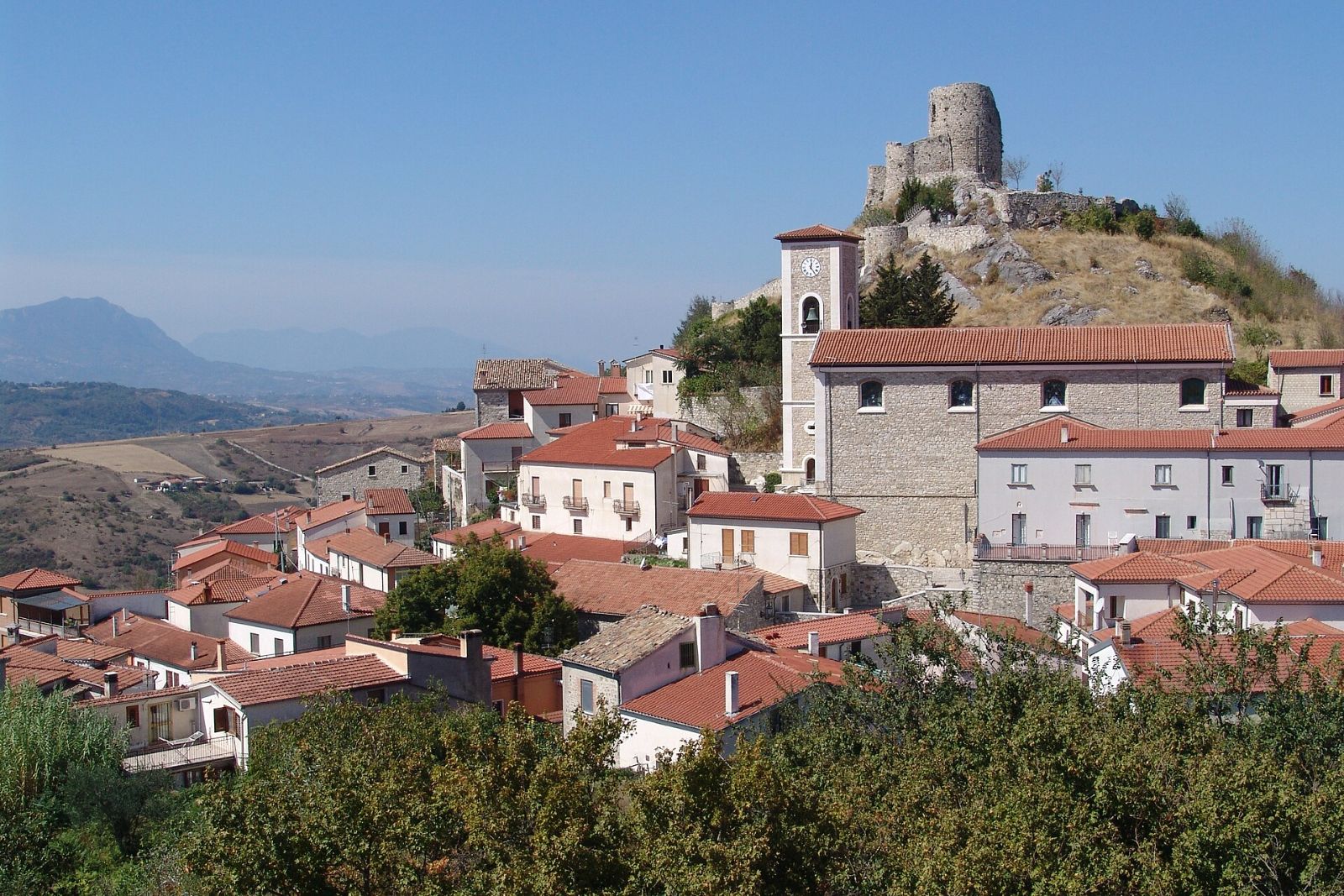
There are places you can sense before you even see them, and the Mefite is one of them: the smell of sulphur reaches you while the pool is still hidden behind the hill. When we looked out over the grey water bubbling in the middle of the bare earth, we understood why the ancients believed they were standing before a gateway to the Underworld. Here is our account of this corner of Irpinia, beautiful and to be treated with respect.
Where the Valle d'Ansanto is
The Valle d'Ansanto lies in the territory of Rocca San Felice, in Alta Irpinia, not far from Villamaina and Torella dei Lombardi. At the centre of the valley is the Mefite: a small pool of muddy water that gurgles constantly because of the gases rising from below ground, surrounded by land almost devoid of vegetation. It is one of the most unusual stops we suggest in our guide Avellino and its surroundings.
A unique natural phenomenon
What you see bubbling is not hot water: it is gas escaping from the earth. According to studies by researchers at the CNR and the INGV, the Mefite emits about 2,000 tonnes of carbon dioxide a day, which makes up around 98% of the gas, together with small amounts of nitrogen, hydrogen sulphide and methane. It is considered the largest emission of low-temperature CO2-rich gas ever measured in a non-volcanic setting.
The gas is invisible, but it is heavier than air and settles low down: near the pool its concentration can reach lethal levels up to 2–3 metres above the ground. It is no coincidence that dead animals are often found downwind along the valley.
An important piece of advice: always stay at the higher viewpoints, do not go down towards the pool, do not bend down to the ground and do not bring children or animals near the water. Avoid windless days, when the gas lingers most.
The goddess Mefitis and the sanctuary of the Hirpini
The name comes from Mefitis (Mefitis), an Italic goddess worshipped by the ancient Hirpini. Her sanctuary stood right here and was visited for many centuries: research dates it back to at least the sixth century BC, with worship continuing into Roman times.
The sanctuary excavations yielded the famous Italic-style wooden statuettes, exceptionally well preserved by the gas-soaked soil. Today they are kept in the Museo Irpino in Avellino, and we recommend going to see them: we tell you about it in The Museo Irpino and the former Bourbon Prison.
Virgil's gateway to the Underworld
The valley was already famous in antiquity. In Book VII of the Aeneid, Virgil describes the Ansanto valley as a gloomy place where a passage opens towards the Underworld: it is from here that the Fury Allecto returns to the realm below. Cicero, too, in his De divinatione, recalls the area as an ill-omened place.
Reading those lines from the edge of the valley, with the smell of sulphur and the gurgling of the water, is truly striking.
Rocca San Felice, the village above the valley
After the Mefite we suggest going up to the village of Rocca San Felice. Dominating the rocky spur is the castle, of Lombard origin, with its cylindrical twelfth-century tower. In the village, the church of Santa Maria Maggiore is worth a stop, and, towards the valley, the sanctuary of Santa Felicita, linked by tradition to the Christian cult that replaced that of the pagan goddess.
How to get there and when to go
From Avellino, take the Ofantina state road towards Alta Irpinia, then follow the signs for Rocca San Felice and the Mefite. The village is a few kilometres from Sant'Angelo dei Lombardi.
- Spring and autumn are the most pleasant seasons to visit the valley and the village.
- Choose a windy day and always stay on the paths and at the viewpoints.
- The area is not an equipped park: ask the Municipality about access conditions.
- For the castle and the sites open to visitors, check opening times and tickets on the official website before you set off.
Nearby
The Valle d'Ansanto is an excellent starting point for discovering Alta Irpinia:
- At Sant'Angelo dei Lombardi, one of the great medieval monuments of the area: The Abbey of Goleto.
- In Avellino, the finds from the goddess's sanctuary: The Museo Irpino and the former Bourbon Prison.
- Nature and birdwatching along the Ofanto: the WWF Oasis of Lake Conza.
- For lovers of unusual places: the most mysterious and fascinating places in and around Avellino.
Photo at the top (Rocca San Felice): GDA, CC BY-SA 3.0, via Wikimedia Commons.