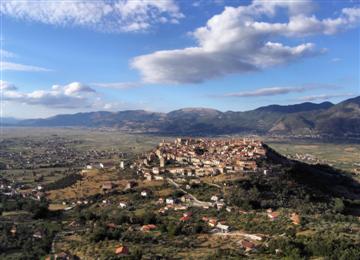
Approaching Teggiano from the valley floor, you see the town gathered on its hill, standing alone in the middle of the Vallo di Diano. Once inside, though, what struck us were the doorways: portals of pale stone, arches, coats of arms carved above the entrances of the palazzi. We found ourselves walking with our eyes at the height of the door frames, discovering a new detail in every alley.
From Tegianum to Teggiano
Teggiano stands at 637 metres above sea level, on a height overlooking the Vallo di Diano. Its origins are ancient and debated: some link them to Greek settlers, others to the Italic peoples and the Lucanians. In Roman times the town was known as Tegianum and later as Dianum, and it is from Diano that the whole valley takes its name.
The town was called Diano until 1862, when the new Italian state asked towns with the same name to distinguish themselves: Teggiano was chosen, reviving the Latin name. Traces of the Roman past also remain in the layout of the historic centre, which partly preserves the ancient street pattern. Today Teggiano is part of the Cilento, Vallo di Diano and Alburni National Park, a UNESCO World Heritage Site.
A walk among portals and palazzi
The best way to get to know Teggiano is to lose yourself in the historic centre, among steep lanes, little squares and arched passageways. This is where you understand why we like to call it "the city of portals": many noble palazzi, especially from the Renaissance, can be recognised by their carved stone entrances, with frames, arches and the coats of arms of the families who lived there. There is no set route: we suggest walking unhurriedly and looking up often.
Because of its wealth of doorways, Teggiano has also been described as the "village of a hundred doors": it is not an exact number, but it conveys well the idea of a town where every corner opens onto an arch, a courtyard or a passage.
The Castello Macchiaroli and the Barons' Conspiracy
The upper part of town is dominated by the Castello Macchiaroli, a fortress of Norman origin linked to the powerful Sanseverino family. It was within its walls, in 1485, that the famous Barons' Conspiracy against the King of Naples, Ferrante of Aragon, was organised. In 1497 the castle withstood a long siege, holding out longer than expected. Stretches of wall and towers of the old town defences still survive.
The Cathedral and the churches
Teggiano is also a town of churches. The most important is the Cathedral of Santa Maria Maggiore, consecrated in 1274. Inside, we suggest looking for the ambo carved in 1271 by Melchiorre da Montalbano, supported by columns and decorated with the symbols of the Evangelists, and the funerary monuments, including those of Enrico Sanseverino (1314) and of the Sienese physician Orso Malavolta (1488). After the 1857 earthquake the church was enlarged and Teggiano became the seat of a diocese.
Also not to be missed are the church of San Francesco, founded in 1307, with fragments of fourteenth- and fifteenth-century frescoes and a fine painted wooden ceiling, and the church of the SS. Pietà, with its Renaissance portico. The patron saint is San Cono, a monk born in Teggiano and deeply venerated in the town.
Museums and traditions
The church of San Pietro houses the Diocesan Museum, which brings together sculptures, architectural elements and works of art from Roman times to the eighteenth century. The town also has a museum devoted to rural life and the Museo delle Erbe, dedicated to medicinal plants.
Every summer the historic centre is transformed by "Alla Tavola della Principessa Costanza" (At Princess Costanza's Table), the re-enactment that brings the atmosphere of the Sanseverino court back to the streets, with costumes, music and period cooking. It is a recurring tradition: check the programme if you want to plan your visit for those days.
How to get there and when to go
Teggiano can be reached by car from the A2 del Mediterraneo motorway, exiting in the Vallo di Diano and continuing for a few kilometres up the hill. We recommend spring and early autumn for a relaxed walk through the historic centre, or summer if you want to see the re-enactment. Check opening times and tickets for churches and museums on the official website before you set off.
Nearby
To discover the rest of the province, start from our guide Salerno and its surroundings and, for the Park, from The Cilento: what to do and what to see. A few kilometres away, in Padula, The Certosa di Padula awaits you, while at the other end of the Vallo are The Pertosa-Auletta Caves. If you like the quiet villages of the interior, try Roscigno Vecchia, the abandoned village too.
Photo at the top (Teggiano): Enzo D'Elia, Public domain, via Wikimedia Commons.