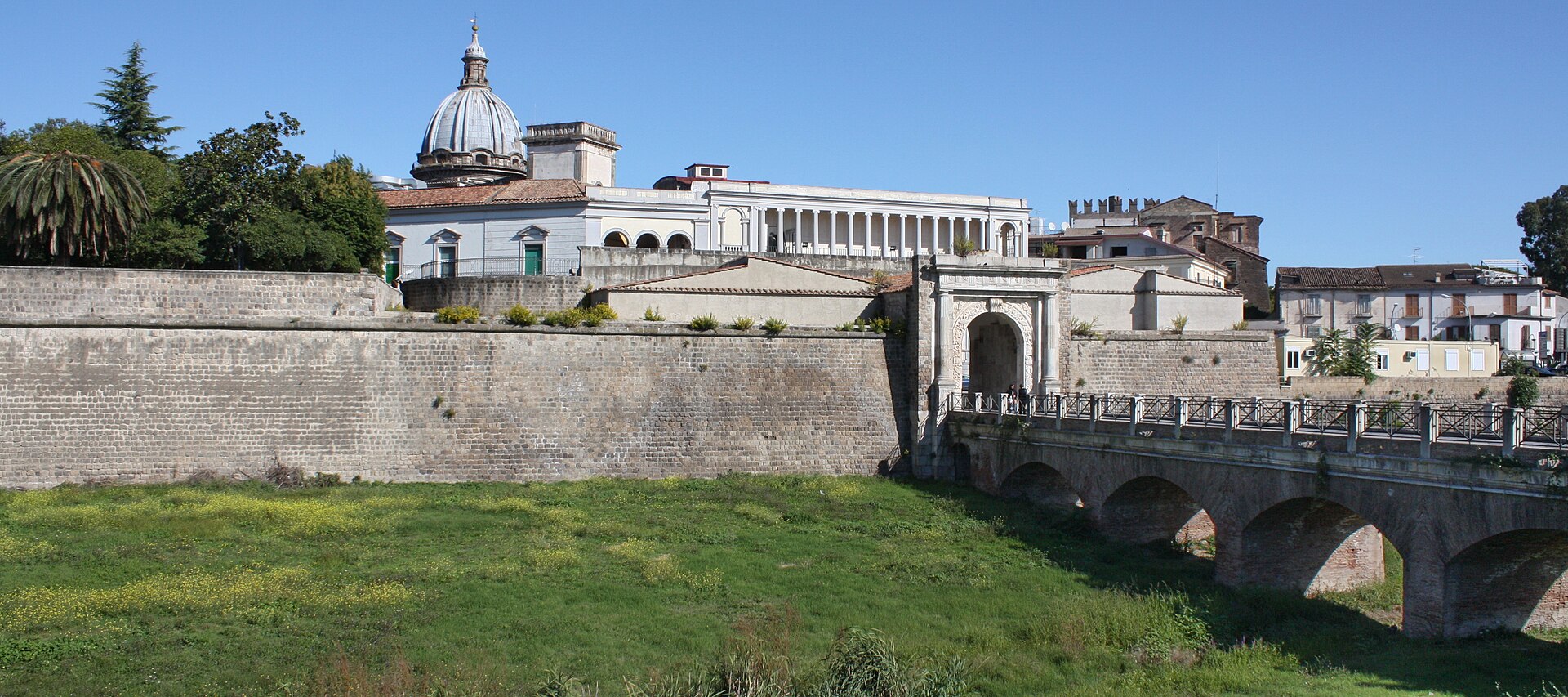
Some museums you visit in a hurry, and some stay with you. For us, the Museo Campano in Capua belongs to the second kind: we walked through the portal of a 15th-century palazzo and found ourselves facing dozens of stone mothers, seated with their newborns in their arms. An image we have never forgotten.
A museum in the heart of Capua
The Museo Provinciale Campano was founded in 1870 on the initiative of the archaeologist Gabriele Iannelli and opened to the public in 1874. It is in the historic centre of Capua, the city that grew up on the banks of the Volturno after the destruction of ancient Capua, and belongs to the Province of Caserta. The archaeologist Amedeo Maiuri called it the most significant museum of the Italic civilisation of Campania.
During the Second World War Capua was heavily hit by the bombing of 1943, and the museum was damaged too; rebuilt after the war, it reopened in 1956.
Palazzo Antignano
The museum is housed in Palazzo Antignano, a building whose origins date back to the Lombard founding of Capua in the 9th century, but which owes its present appearance to the 15th century. In 1453 Alfonso I of Aragon confirmed Francesco Antignano's rights over the building.
Before you even go in, stop in front of the Catalan Gothic portal, one of the finest in the region. In the courtyard there's a monumental open staircase, and you can make out Lombard-era capitals and columns, as well as the remains of the medieval church of San Lorenzo ad Crucem.
The Matres Matutae
The reason many people come all the way here is the Matres Matutae: more than 150 tuff statues, almost all depicting seated women holding one or more newborns in their arms, sometimes as many as twelve. They were votive offerings linked to motherhood and children's health, dedicated to a deity who protected childbirth.
They come from the sanctuary of Fondo Patturelli, in what is now the municipality of Curti, near ancient Capua. The first discoveries date back to 1845, and excavations continued over the following decades. The statues span a very long period, from the Archaic age to the 1st century BC.
The rooms that house them left us speechless: simple faces, massive bodies, an almost primeval strength. Take your time to look at them one by one, because no two are alike.
Frederick II and the Gate of Capua
The second major section is devoted to the Middle Ages. Here you'll find the remains of the sculptures from the Gate of Capua, the monumental gateway built by Frederick II of Swabia between 1234 and 1240 at the entrance to the city on the Volturno, and later demolished. The fragments include the bust of the emperor's statue and the busts traditionally identified as two men of his court, Pier della Vigna and Taddeo da Sessa.
It's a piece of European history: the gate was a manifesto in stone of imperial power at the entrance to the Kingdom.
Lapidarium, mosaics and picture gallery
The museum also holds a rich lapidarium of ancient inscriptions, considered the second in Campania after that of the Naples Archaeological Museum, and material ranging from protohistory to the Roman age: pottery, architectural terracottas, bronzes, coins and Hellenistic statuettes. There are also medieval mosaics, including fragments from Sant'Angelo in Formis, and a section with paintings and portraits of the ruling houses. The complex is completed by a historical archive and a library of more than 70,000 volumes.
Getting there and when to go
The museum is on Via Roma, in the historic centre of Capua. The town has a railway station and is close to the Capua exit of the A1 motorway. Allow at least an hour and a half for the visit. Opening hours are shorter on some days of the week, so check opening times and tickets on the official website before you go.
The museum is indoors and can be visited in any season; in summer it's an excellent refuge during the hottest hours.
Nearby
From Capua, head up to the foot of Mount Tifata for The Basilica of Sant'Angelo in Formis, with its 11th-century frescoes. A few kilometres away, in neighbouring Santa Maria Capua Vetere, The Campanian Amphitheatre and the Mithraeum of Santa Maria Capua Vetere awaits you. Heading north, you can continue with Teano and Sessa Aurunca, between the Romans and the Middle Ages. The rest of the province is covered in Caserta and its surroundings.
Photo at top (Capua): Shadowgate, CC BY 2.0, via Wikimedia Commons.