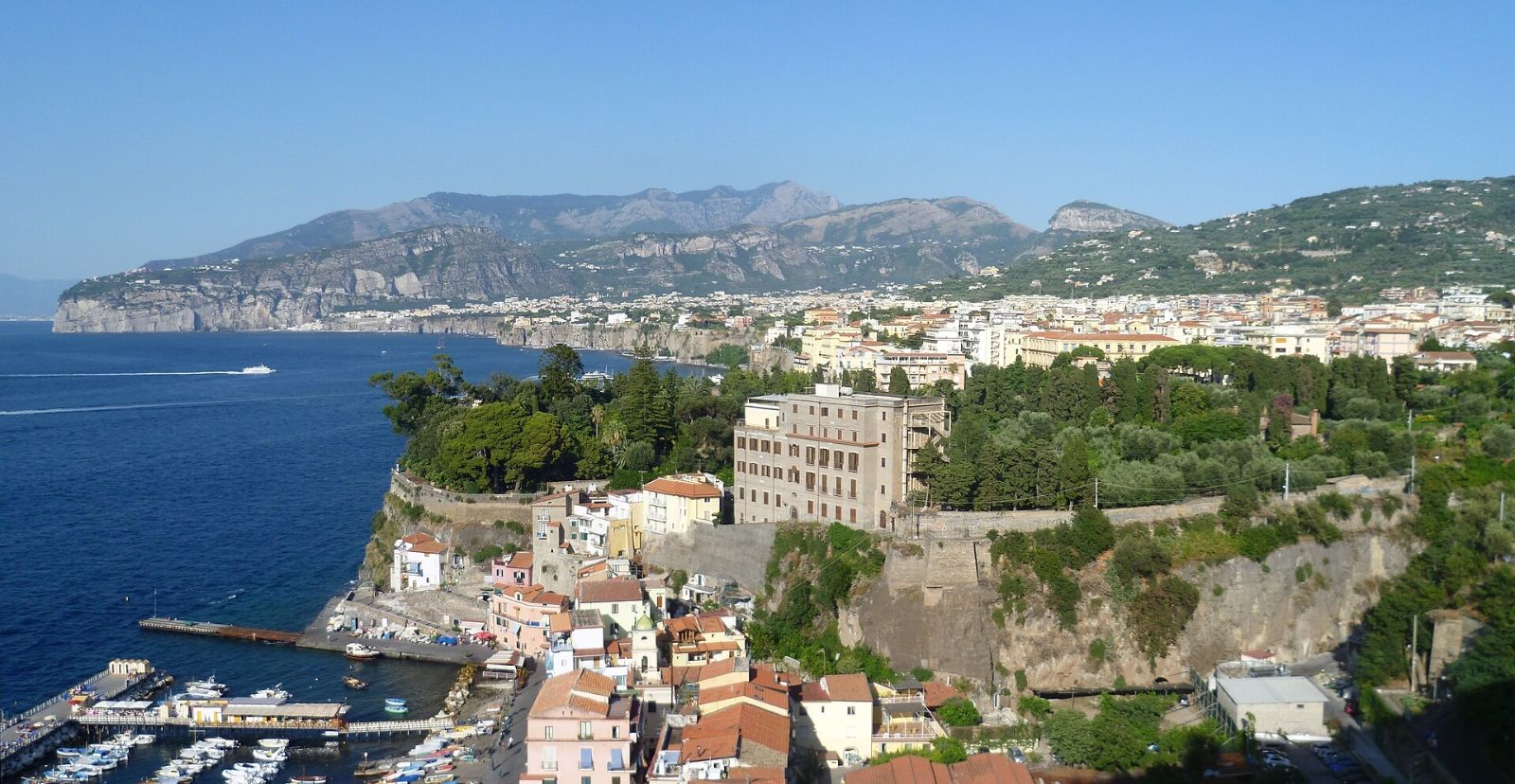
Almost everyone comes to Sorrento for the terraces overlooking the sea and the shopping along the main street. This time, though, we followed a different trail: that of the ancient walls, which still mark the edge of the old town today. Walking along bastions and curtain walls, we discovered a quieter Sorrento that tells of centuries of defence against attacks from the sea. Come along with us.
A town protected by nature
The old town of Sorrento sits on a tuff terrace that drops sheer into the sea. Inland it is protected by deep gorges, such as the famous Vallone dei Mulini (Valley of the Mills), which you can see by looking over the edge from Piazza Tasso. For centuries this position, with natural walls on three sides, was the town's first line of defence, and the walls completed its protection.
The origins of the circuit are ancient. Already in Roman times the town had a defensive wall, later strengthened with towers, and some scholars attribute the building technique of two of the town gates to Greek know-how, although no actual Greek remains have been found in Sorrento.
The medieval walls
In the Middle Ages the fortifications more or less kept to the ancient line: a perimeter of about 1,600 metres enclosing around 29 hectares. There were four gates, two facing the sea and two facing inland, each with its own drawbridge. Trade came mainly by sea, which is why the gates facing the harbours played a central role in town life.
The 1558 raid and the viceregal walls
The date that changed the history of the walls is 13 June 1558, when the Turks captured and sacked Sorrento. It was a deep wound, and straight afterwards the Spanish viceregal government began rebuilding the defences.
The project was entrusted to the engineer Pedro Trevigno, who redesigned the fortifications according to the modern bastion system, built to withstand artillery: reinforced curtain walls, embrasures for cannons and bastions dedicated to saints, including San Valerio, Sant'Antonino, Sant'Attanasio and San Renato. This is why today they are known as the viceregal walls.
What you can see today: the Parsano Bastion and the sentry walk
The best-preserved stretches are along Via degli Aranci, right next to the centre. Here rises the Parsano Bastion, one of the most striking points of the circuit, linked to the old Porta Parsano gate.
Since 7 November 2024 you can once again walk the sentry walk connecting the Parsano Bastion to the San Valerio Bastion, recovered through a restoration funded by the Ministry of Culture after years of neglect and overgrown vegetation. Walking it was the best part of our visit: you tread where the guards once patrolled and, looking down, you realise how exposed the town must have felt. Along the route, some digital content helps you read the history of the walls.
Getting there and when to go
You can reach Sorrento from Naples on the Circumvesuviana train, by hydrofoil from the port of Naples, or by car along the Sorrento coast road. The station is just a few minutes' walk from Piazza Tasso and Via degli Aranci.
The sentry walk has opening hours set by the municipality, which may vary with the seasons: check times and access arrangements on the official website before you go. The walk is pleasant all year round, but we recommend a late afternoon in spring or autumn, when the stone glows in the light and the centre is less crowded.
Nearby
For the rest of the town, read Sorrento: what to see and, for a toast with the local wines, Penisola Sorrentina DOC. Heading on towards the tip of the peninsula, in the municipality of Massa Lubrense, the Bay of Ieranto awaits, while boats leave the harbour for the island described in The island of Capri: what to see and do. Everything else is in Naples and its surroundings.
Top photo (Sorrento): Kim Traynor, CC BY-SA 3.0, via Wikimedia Commons.
