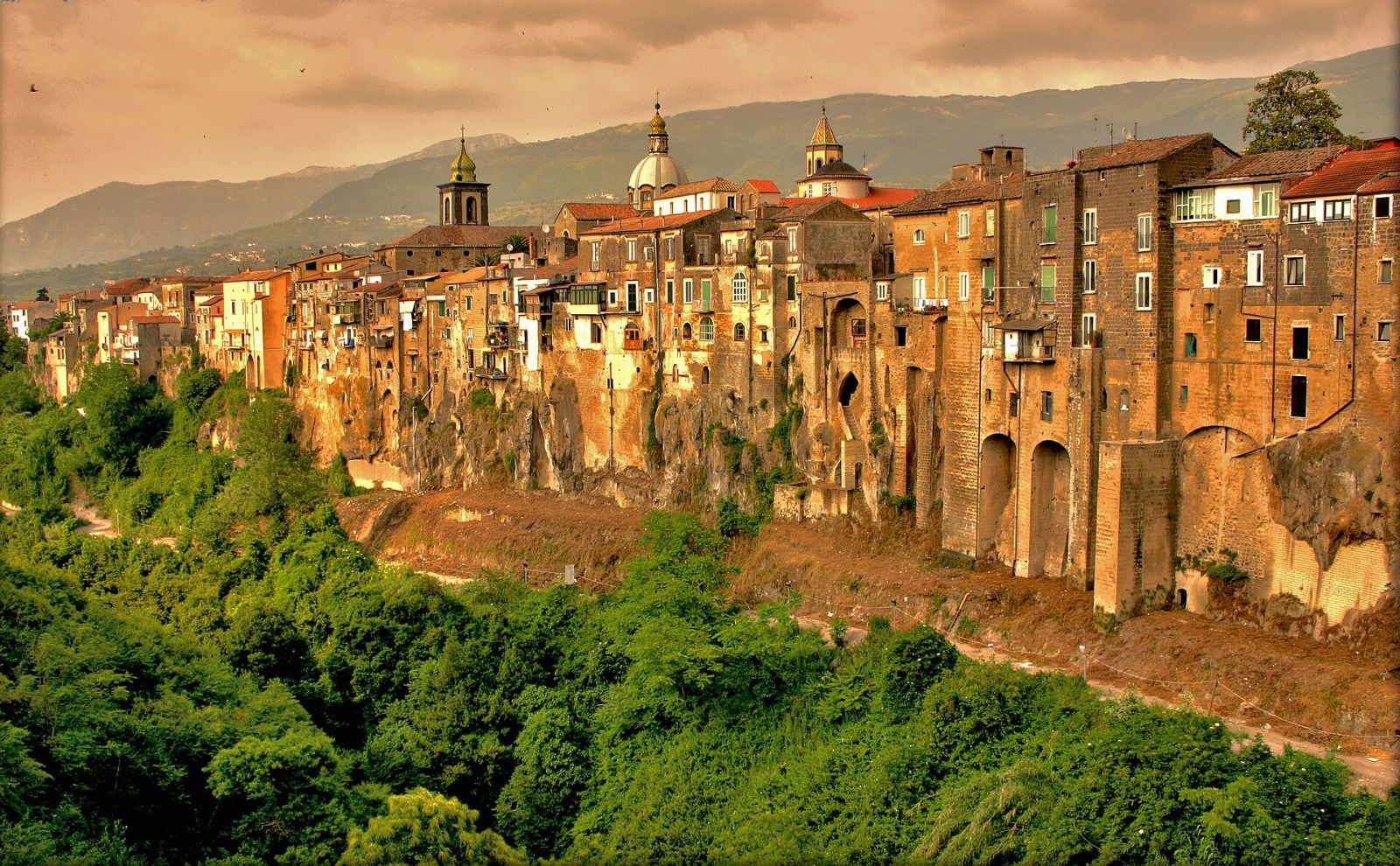
The first time we saw Sant'Agata de' Goti from the bridge, we stopped without saying a word: the houses seem to grow straight out of the tuff cliff, suspended above the stream. It's one of the most spectacular villages in inland Campania, and within its walls it hides churches that are worth the trip on their own.
A village suspended on the tuff
Sant'Agata de' Goti stands on a tuff spur in the western part of the province of Benevento, on the border with the province of Caserta. At the foot of the cliff flow the Martorano and the Riello, and a little further on the Isclero. It is precisely this position, with the houses dropping sheer to the water, that gives the village its unmistakable profile.
The village is one of the places awarded the Bandiera Arancione (Orange Flag) by the Touring Club Italiano, and part of its territory falls within the park we describe in The Taburno-Camposauro Park.
From Saticula to the Lombards: a brief history
Historians place the ancient Samnite city of Saticula here, and Samnite-era necropolises have been found in the area. The present name has two parts. "Sant'Agata" comes from the dedication to Saint Agatha of Catania, chosen by the Lombards. The "de' Goti", which everyone associates with the Goths, according to several scholars actually refers to the Drengot, a Norman family that ruled the area: a small misunderstanding that has lasted for centuries.
A name that comes up often here is that of Saint Alphonsus Maria de' Liguori, bishop of the diocese from 1762 to 1775. The town has dedicated a square and a large statue to him, and in the bishop's palace a section of the diocesan museum recalls the places where he lived.
The Cathedral and its crypt
The Cathedral, dedicated to the Assumption, was founded in 970, rebuilt in the 12th century and then transformed in the 18th century. In front of the façade is a portico with ancient columns. The part that moved us most, however, is underneath: the crypt with cross vaults, supported by columns with capitals from different periods and decorated with 14th-century frescoes. Going down there is like stepping into another time.
Not far away is the Diocesan Museum, with sacred art, reliquaries and manuscripts linked to the diocese's long history.
The Annunziata and the Last Judgement
If you only have time for one church, we recommend the church of the Annunziata, founded in the 13th century. Inside it preserves fresco cycles from the late 14th and early 15th centuries, and above all a great Last Judgement covering an entire wall: Christ the judge, angels with trumpets, the resurrected, heaven and hell. Spend a few minutes looking at the details, because every corner tells a story.
San Menna and the castle
The church of San Menna, built against the walls, is a small Romanesque gem consecrated at the beginning of the 12th century by Pope Paschal II. It preserves remains of a mosaic floor with geometric patterns, among the oldest in southern Italy that can be precisely dated.
The castle, on the other hand, has Lombard foundations and bears the marks of Norman and 18th-century alterations. You can see it clearly as you walk around the old village.
Getting there and when to go
Sant'Agata can be reached by car from both Benevento and the Caserta area, through the Isclero valley. Once there, leave your car outside the historic centre and explore it on foot: it's compact and can easily be visited in half a day.
Don't miss the view from the Ponte Vittorio Emanuele, the best spot for admiring the village on its cliff, especially in the late afternoon. Spring and autumn are our favourite times, with mild temperatures and the surrounding countryside in full colour. For the churches and the museum, check opening times and tickets on the official website before you go.
Before you leave, taste the local produce: the area grows the annurca apple and produces wines from Falanghina and Aglianico.
Nearby
- For an overview of the whole province, start with our guide Benevento and its surroundings.
- Not far away is Montesarchio, whose story we tell in The Castle and the Museo del Sannio Caudino.
- If you want to discover the local grape varieties, read Falanghina del Sannio DOC.
- Another village linked to wine is Solopaca: we tell you about it in Solopaca and the Grape Festival.
Photo at top (Sant'Agata de' Goti): Kris De Curtis from Maddaloni, Italy, CC BY 2.0, via Wikimedia Commons.