The first time we went up to Roccamonfina we didn't immediately realise we were inside a volcano: all around us there were only chestnut woods, meadows and small scattered hamlets. Then, looking at the shape of the hills all around, we understood that we were in the middle of a huge basin. In this article we tell you about the northernmost extinct volcano in Campania and the park that protects it, one of the most surprising green destinations in the province of Caserta.
A volcano that has slept for fifty thousand years
The Roccamonfina volcano was active between about 630,000 and 50,000 years ago. Over its long history it went through different phases: around 400,000 years ago the great original cone collapsed, forming a central caldera almost 6 kilometres across. Inside this basin, during a later eruptive phase, new peaks formed, including Monte Santa Croce, which at 1,005 metres is the highest summit of the complex.
Today the volcano shows no activity at all, but its legacy is visible everywhere: in the dark rocks, in the extremely fertile soil and in the very shape of the landscape. Walking along the trails, we enjoyed picking out the rim of the caldera, which traces a ring of heights around the town.
The Roccamonfina–Foce Garigliano Regional Park
To protect this area, the Roccamonfina–Foce Garigliano Regional Park was set up in 1993, covering more than 11,000 hectares. It includes the municipalities of Roccamonfina, Conca della Campania, Galluccio, Marzano Appio, Sessa Aurunca, Teano and Tora e Piccilli: a varied territory that runs from the slopes of the volcano down to the mouth of the Garigliano river, on the border with Lazio.
If you love walking, you'll find plenty of routes here through woods and clearings, easy even for those who aren't experienced hikers. We recommend getting hold of a trail map before you set off and choosing clear days: from the higher points the view stretches far, towards the plain and the sea.
The chestnut woods and the Castagna di Roccamonfina
The fertility of the volcanic soil has encouraged the growth of dense chestnut woods, which in autumn turn everything yellow and copper. These trees produce the Castagna di Roccamonfina, recognised as a PGI product and grown in eight municipalities in the park area. The most widespread variety is the Tempestiva, perfect for roasting.
If you go in October, when the chestnuts are harvested, you'll breathe a truly special atmosphere: the woods are full of life and the villages celebrate the traditional festivals dedicated to the fruit. For the local wines, see our article on Roccamonfina IGT.
The Sanctuary of Santa Maria dei Lattani
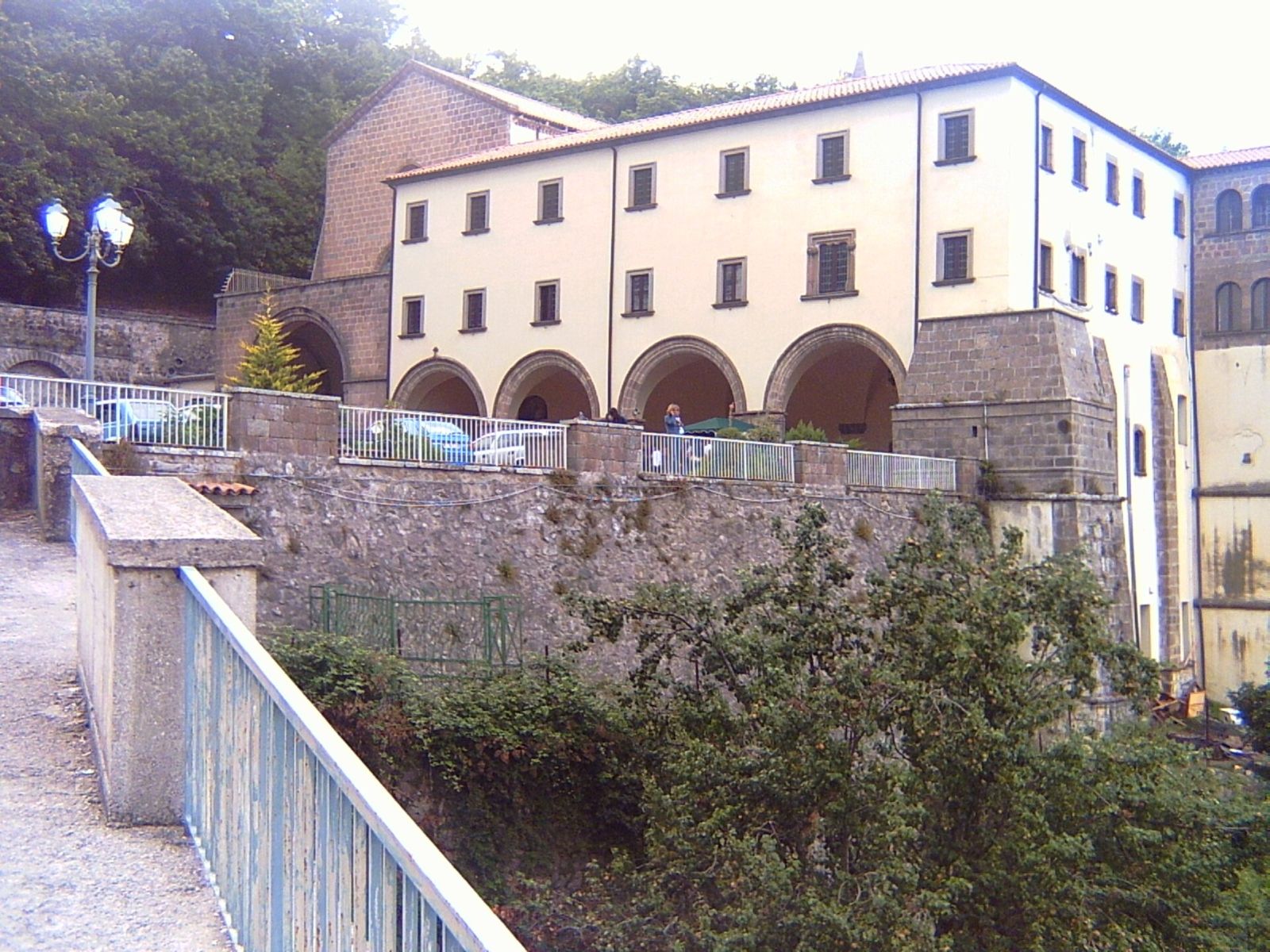
Surrounded by greenery above the town stands the Sanctuary of Santa Maria dei Lattani, one of the places that made the deepest impression on us. According to tradition, a shepherd found a stone statue of the Madonna in a cave; in 1430 the Franciscan preacher Saint Bernardino of Siena founded the sanctuary here. The building, originally Gothic, was altered over the centuries with Renaissance and Baroque elements.
The part that won us over most is the cloister: strolling under the arcades, in the silence of the woods, is a lovely way to take a break. Every year in May the tradition of the Calata di Sant'Antonio dai Lattani is renewed, with a procession carrying the statue of the saint from the sanctuary down to the centre of town.
The Devil's Footprints
A few kilometres away, in the municipality of Tora e Piccilli, are the Ciampate del Diavolo (Devil's Footprints), footprints left by hominins on an ancient deposit of volcanic ash. They have been dated to about 350,000 years ago and attributed to individuals of the species Homo heidelbergensis; their scientific study began in 2003. For centuries the locals attributed them to the devil, the only one, it was said, who could walk on lava without getting burned.
Standing in front of these footprints had quite an effect on us: it's one of those places where time suddenly seems to compress. Before you go, find out how visits are arranged, as the site is fragile.
Getting there and when to go
Roccamonfina is in the Alto Casertano, in the north-western part of the province. By car, leave the A1 motorway at the Caianello exit and continue on the provincial roads climbing towards the volcano; public transport is more complicated, so we recommend driving. The best time is autumn, for the colours of the woods and the chestnut season, but spring and early summer are also ideal for hiking. For visits to the sanctuary and the park's sites, check opening times and arrangements on the official website before you go.
Nearby
For a complete picture of the province, read our guide Caserta and its surroundings. From the volcano you can easily head down to two towns with a very long history, described in Teano and Sessa Aurunca, between the Romans and the Middle Ages. If you're interested in the wines of the volcanic hills, take a look at Galluccio DOC and, to broaden your view to the whole province, The wines of Caserta.
Photo at top (Roccamonfina): Twilight, CC BY-SA 2.5 it, via Wikimedia Commons.