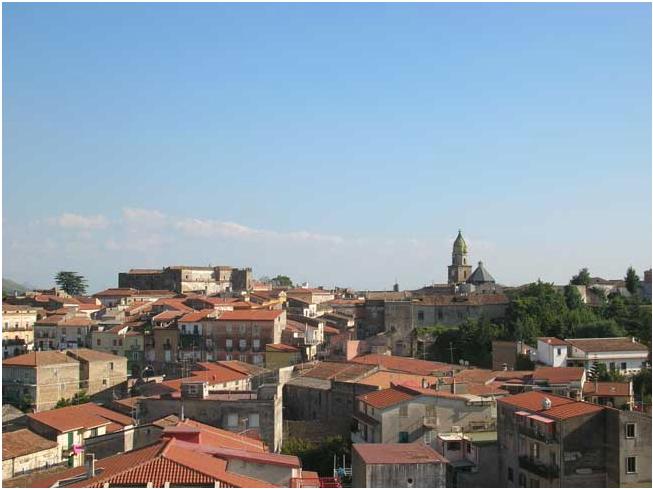
In the north of the province of Caserta, between the extinct volcano of Roccamonfina and the Garigliano valley, there are two towns that surprised us with how much history they manage to pack into just a few kilometres. In Teano and Sessa Aurunca we found Roman theatres, Romanesque cathedrals and castles, almost always without crowds. Here's how we organised our day.
Teano, the city of the Sidicini
Teano was the capital of the Sidicini, an Italic people who lived in this area before the Romans. After becoming Roman under the name of Teanum Sidicinum, it grew into an important crossroads between the consular roads.
Its most spectacular monument is the Roman theatre, built at the end of the 2nd century BC, in the Republican period, with radial vaulted structures that were highly innovative at the time. It was rebuilt in the Augustan age and reached its greatest splendour at the beginning of the 3rd century AD, under Septimius Severus. With a diameter of about 85 metres, it could hold more than 5,000 spectators. We were struck by its setting, in the middle of the countryside, surrounded by hills.
The museum, the Cathedral and the 1860 meeting
In the historic centre we recommend the Archaeological Museum of Teanum Sidicinum, opened in 2001 in a fine late-Gothic building linked to the Marzano family, known as the Loggione e Cavallerizza. It holds around a thousand finds, from prehistory to late antiquity, and helps you understand what this city was before Rome.
Not far away is the Cathedral of San Clemente, built between the 11th and 12th centuries and rebuilt after damage in the Second World War, with its three-aisled plan.
Teano's name has also made it into the school books: on 26 October 1860 Giuseppe Garibaldi and Victor Emmanuel II met in this countryside, in the famous meeting of Teano that marked the passage of southern Italy to the newborn Kingdom of Italy. The exact spot of the meeting is still debated by historians today.
Sessa Aurunca, a Latin colony on the slopes of the volcano
From Teano you head down towards the sea and reach Sessa Aurunca, nestled on the slopes of Roccamonfina. This was the land of the Aurunci; after the Roman conquest, in 313 BC, the Latin colony of Suessa Aurunca was founded here. The town is considered the birthplace of Lucilius, the satirical poet.
The Roman theatre was brought to light in excavations over recent decades and could hold more than 6,500 spectators. In the 2nd century AD it was enlarged and embellished at the behest of Matidia the Younger, sister-in-law of Emperor Hadrian. In the town you can also visit the Roman cryptoporticus, a long underground vaulted space.
The Cathedral and castle of Sessa
The monument that has stayed closest to our hearts is the Cathedral, dedicated to Saints Peter and Paul, begun at the start of the 12th century and considered one of the masterpieces of Campanian Romanesque. The portico with the portal sculptures, the Cosmatesque-style mosaic floor and the splendid pulpit on columns, covered in mosaics, are worth the journey on their own.
Above the town towers the ducal castle, of Lombard origin, remodelled in the Swabian period and turned into an aristocratic residence in the 15th century. Today it houses the Archaeological Museum, which displays finds from the ancient city, including the black marble statue of Matidia. In the surrounding area, the Ponte degli Aurunci, also known as Ponte Ronaco, an ancient Roman bridge with twenty-one arches, is worth a stop.
If you're in Sessa during Holy Week, you'll come across the traditional processions of the Mysteries, one of the most heartfelt rituals in the province.
Getting there and when to go
Teano is close to the Caianello exit of the A1 motorway, and Sessa Aurunca is about half an hour's drive from there. Both have a railway station, but a car is the most convenient way to get around between the sites. Museums and archaeological areas have different opening times and sometimes open by appointment only: check opening times and tickets on the official website before you go.
The best seasons are spring and autumn, when the countryside is green and it's a pleasure to walk among the ancient remains.
Nearby
You're right next to the volcano: read The Roccamonfina volcano and its park. This is also the land of Falerno del Massico DOC and, a little further north, of Galluccio DOC. For more Romans, head south to The Campanian Amphitheatre and the Mithraeum of Santa Maria Capua Vetere and The Museo Provinciale Campano in Capua. All the itineraries in the province are in Caserta and its surroundings.
Photo at top (Teano): Specializedturin at Italian Wikipedia, CC BY-SA 3.0, via Wikimedia Commons.