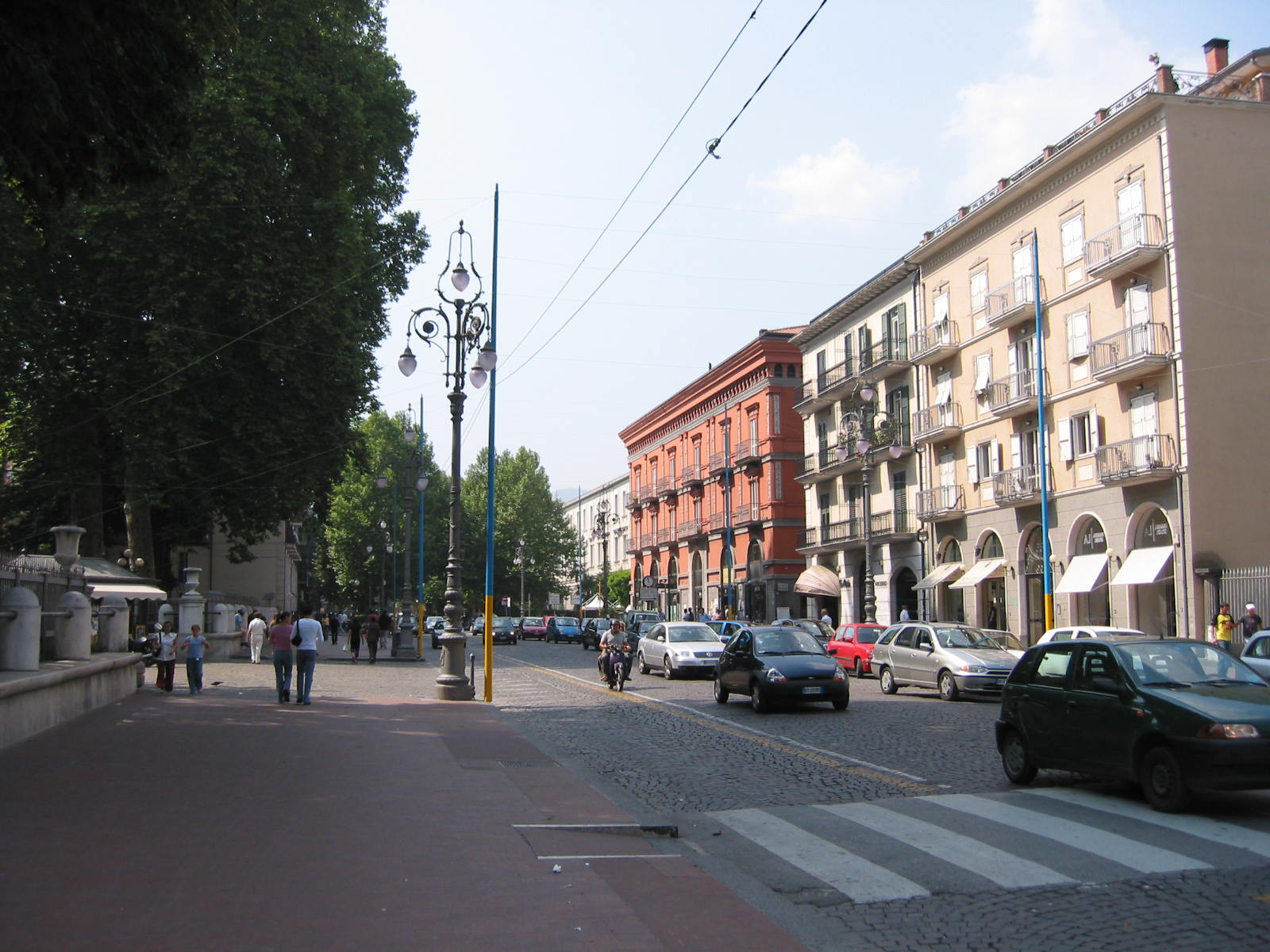
Walking through the historic centre of Avellino, we kept stopping to look up: first in front of the "Bronze King", then beneath the Clock Tower, and finally outside a palace that, as a child, hosted one of the greatest French writers. Come with us on this short walk through the seventeenth and eighteenth centuries.
The monument to Charles II, the "Bronze King"
In the heart of the old town of Avellino, in Piazza Amendola, stands the Obelisk of Charles II of Habsburg, erected in 1668. It was designed by Cosimo Fanzago, the architect and sculptor from Bergamo who worked for many years in Naples and left his mark on many monuments of southern Baroque.
The monument was commissioned by Prince Francesco Marino Caracciolo, lord of Avellino, as an act of devotion to the very young sovereign. Charles II had in fact come to the throne of Spain, and therefore of Naples too, at just four years old, after the death of his father Philip IV. That is why the bronze statue portrays him as a child.
The people of Avellino affectionately call him the "Re di bronzo" (Bronze King) or "Carlucciello" (little Charles), and we loved these nicknames: they speak of a familiar relationship with a monument that, elsewhere, would be merely celebratory.
The Dogana and the seventeenth-century square
Piazza Amendola is one of the most history-laden corners of the city. Next to the obelisk stands the Dogana (Customs House), which began as the office of the feudal lord who collected duties on goods brought in by outsiders, and was also used as a grain store, where quality and prices were controlled.
The building was acquired in the 1660s and, according to scholars, its revival and that of the square could be read as a sign of rebirth after the terrible plague of 1656. We suggest looking at the square in this light: together, the obelisk, the Dogana and the tower tell the story of a city trying to get back on its feet.
The Clock Tower
A short distance away rises the Clock Tower, one of the symbols of Avellino. Its first documented mention dates back to 1586, in an inventory, while its date and original use remain uncertain. In the nineteenth century it was suggested that Cosimo Fanzago had worked on it, but no documents confirm this.
The tower underwent major works in 1782, and what we see today is the result of interventions completed after 1830. From below it is a view well worth a photo, especially in the late afternoon light.
Palazzo De Conciliis and Victor Hugo
The second star of this walk is Palazzo De Conciliis, built in the second half of the eighteenth century for the family of the same name, members of the city's wealthy middle class.
The story that struck us most concerns an exceptional guest: Victor Hugo stayed here as an eight-year-old, between January and July 1808, to be with his father, an officer in the French army then stationed in Avellino. Imagining the future author of Les Misérables spending months in these rooms makes the palace feel much closer.
The palace today
The palace was donated to the city council by Michelina De Conciliis, who wished it to become a centre for the care of mothers and children. After the restoration that followed the 1980 earthquake, it now houses the "Guido Dorso" Research Centre and the Municipal Historical Archive: it is therefore a place of study rather than a museum, but its façade and history are worth a stop.
If you want to fit this walk into a wider itinerary, start from our guide Avellino and its surroundings and our tips on what to see in Avellino.
How to get there and when to go
The Obelisk, the Dogana and the Clock Tower are in the historic centre and can easily be seen on foot in an hour or a little more. It is best to leave your car in a car park in the centre and walk between the squares.
- The monuments are outdoors and can be seen at any time of year.
- For access to Palazzo De Conciliis and the Archive, check opening times and arrangements on the official website before you set off.
- The late afternoon offers the best light for photos of the square.
Nearby
From Piazza Amendola you can carry on exploring the city and Irpinia:
- The ruins of the castle, a short distance away: The Lombard Castle of Avellino.
- Archaeology and painting in The Museo Irpino and the former Bourbon Prison.
- A trip up Partenio to The Sanctuary of Montevergine.
- And for a tasty break, sample the local specialities of Avellino.
Photo at the top (Avellino): unknown author, CC BY-SA 3.0, via Wikimedia Commons.