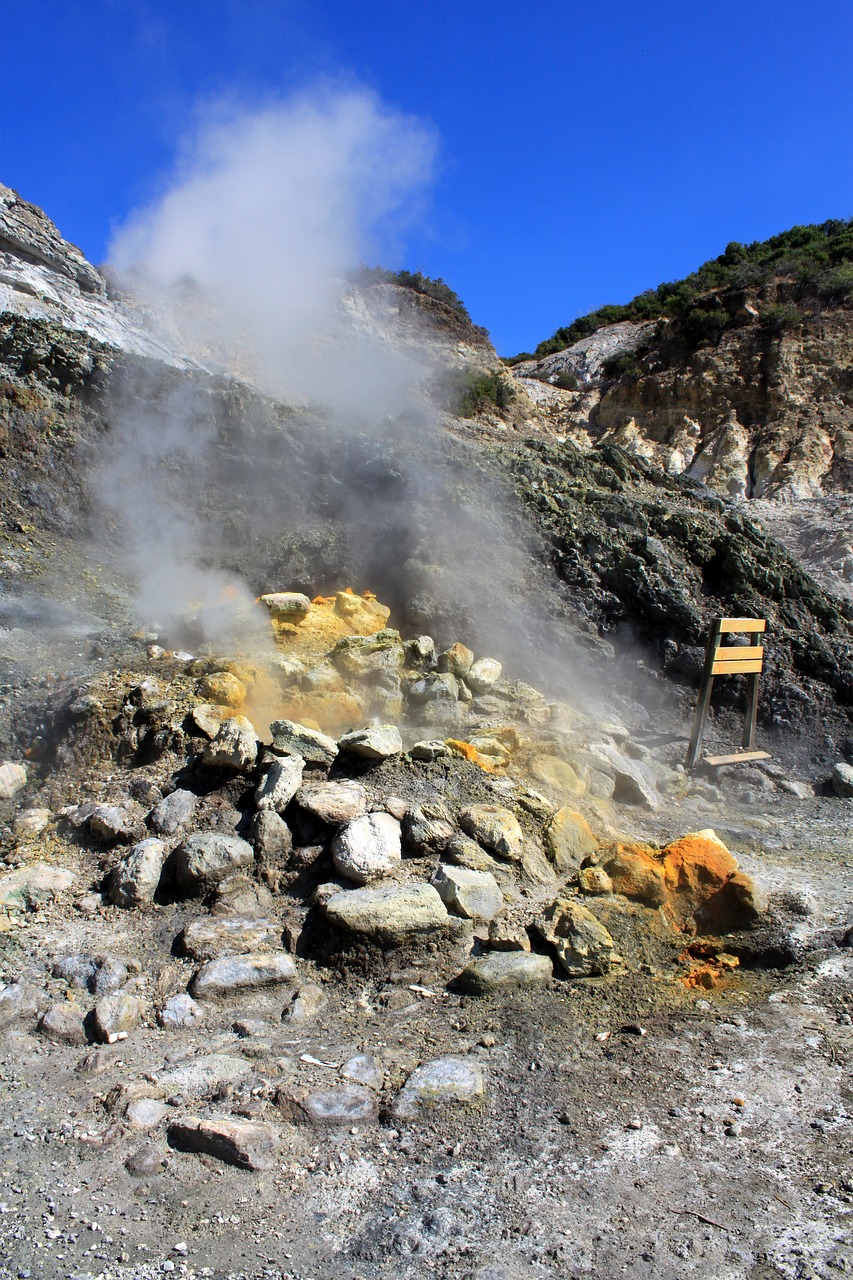
Every time we return to the Campi Flegrei we're amazed at how much fits into just a few kilometres: craters, lakes, Roman amphitheatres, sunken cities. It's a land the Greeks called "burning" and that still moves beneath your feet today. Here is our itinerary through Pozzuoli, Bacoli and Cumae, with the places we think you shouldn't miss.
An inhabited caldera
The name Campi Flegrei comes from the Greek and means "burning fields". It is a large volcanic caldera some 15–18 kilometres across, formed by gigantic eruptions such as the Campanian Ignimbrite, about 39,000 years ago, and the Neapolitan Yellow Tuff, about 15,000 years ago. The most recent eruption is the one that created Monte Nuovo in 1538.
The area's most distinctive phenomenon is bradyseism, the slow rising and sinking of the ground. You can read it clearly in the Roman monuments, now partly underwater, and it's the reason the area is constantly monitored. Before setting off, we recommend checking the latest updates from the Civil Protection department and the visitor sites. Since 2003 much of the area has been protected by the Campi Flegrei Regional Park.
Pozzuoli: the Flavian Amphitheatre and the Rione Terra
Start in Pozzuoli, ancient Puteoli, which in Roman times was one of the most important ports in the Mediterranean. The Flavian Amphitheatre is the third largest in Italy, after the Colosseum and the amphitheatre of Capua, and could hold up to 40,000 spectators. The part that struck us most is the underground area, where you can still see the remains of the devices that hoisted the wild animals' cages up into the arena.
A short walk away is the Macellum, the ancient market known as the Temple of Serapis, whose columns bear the marks left by the sea during phases when the ground sank. Then climb up to the Rione Terra, the city's acropolis, with its underground archaeological route through the streets and shops of the Roman colony.
A note on the Solfatara: the crater, for decades one of the most visited sites, has been closed to the public since 2017, and there is currently no official reopening date. If you want to see a crater up close, we suggest the Cratere degli Astroni nature reserve, managed by WWF.
Baia: the castle and the sunken city
Continuing along the coast you reach Baia, the holiday resort of the Roman aristocracy. The Aragonese Castle of Baia houses the Archaeological Museum of the Campi Flegrei, where the shrine of the Augustales of Misenum and the nymphaeum of Emperor Claudius, found underwater at Punta Epitaffio, have been reconstructed.
That nymphaeum is now one of the highlights of the Underwater Park of Baia, a marine protected area since 2002: just a few metres down lie villas, roads, mosaics and the remains of Portus Julius, which ended up underwater precisely because of bradyseism. You can explore it by diving, snorkelling or on glass-bottom boats. We chose snorkelling, and seeing a Roman mosaic among the fish is an experience we recommend to everyone.
Bacoli and Cumae: cisterns, lakes and the Sibyl
In Bacoli don't miss the Piscina Mirabilis, an Augustan-era cistern 70 metres long, supported by 48 pillars, which supplied water to the Roman fleet at Misenum. Stepping inside is like visiting an underground cathedral.
The final stop is Cumae, considered one of the oldest Greek colonies in the West, with its acropolis and the famous Sibyl's Cave, the long corridor carved into the tuff linked to the myth of the prophetess. On the way you'll pass Lake Avernus, which the ancients imagined as the entrance to the Underworld, and the lakes of Lucrino and Fusaro.
Getting there and when to go
From Naples, Pozzuoli can be reached on Metro Line 2 or on the Cumana railway, which continues towards Baia and Fusaro. A car is handy for getting around between Bacoli and Cumae, but there are also local buses. Check opening times and tickets on the official website of the Campi Flegrei Archaeological Park before you go: some sites only open on certain days.
Spring and autumn are the ideal seasons; for the Underwater Park, summer is best, with calm seas and clear water.
Nearby
We've devoted in-depth articles to the sites in this area: The Flavian Amphitheatre and the Rione Terra of Pozzuoli, The Archaeological Park of Baia and The archaeological area of Cumae. If you'd like to add a day at the beach, read The beaches of Naples and its surroundings, and for the local wine Campi Flegrei DOC. Ferries also leave from Pozzuoli for The Island of Procida: what to do and see. Everything else is in our guide Naples and its surroundings.
