Archaeological site
Roman Amphitheatre of Avella
Il monumento romano più importante dell'antica Abella: un anfiteatro in tufo, simile per dimensioni a quello di Pompei.
Archaeological site · Avella (AV)

The ancient town of Abella, ally of Nola and later a Roman colony, famous for its hazelnuts and the Cippus Abellanus in the Oscan language.
The origins of Abella are lost in myth: some credited its founding to a king named Muranus, others to Greek settlers from Chalcis. In the Samnite period it shared the fortunes of its ally Nola; in the Social War it sided with Rome and in 87 BC was sacked by the people of Nola. Before 73 BC it became a Roman colony, and under Vespasian a municipium. Even in antiquity it was known for its hazelnuts.On the border with Nola, in a sanctuary of Hercules, the Cippus Abellanus was found: a stone recording in the Oscan language an agreement between the two towns. Of the ancient town, what mainly survives today is the amphitheatre; sources also mention a theatre, an aqueduct and a basilica. We suggest imagining the complete urban landscape, with the necropolises that stretched to the east and west from the Iron Age to Roman times.
We are asking the authority for permission to publish photos of this place. Why there is an illustration
Archaeological site
Il monumento romano più importante dell'antica Abella: un anfiteatro in tufo, simile per dimensioni a quello di Pompei.
Museum
Raccolta dedicata all'antica Abella: reperti preistorici, corredi funerari, un'iscrizione osca e materiali da santuari.
Museum
Anfiteatro romano di Abella in opera reticolata, inserito nelle antiche mura: il monumento più noto di Avella.
Castle
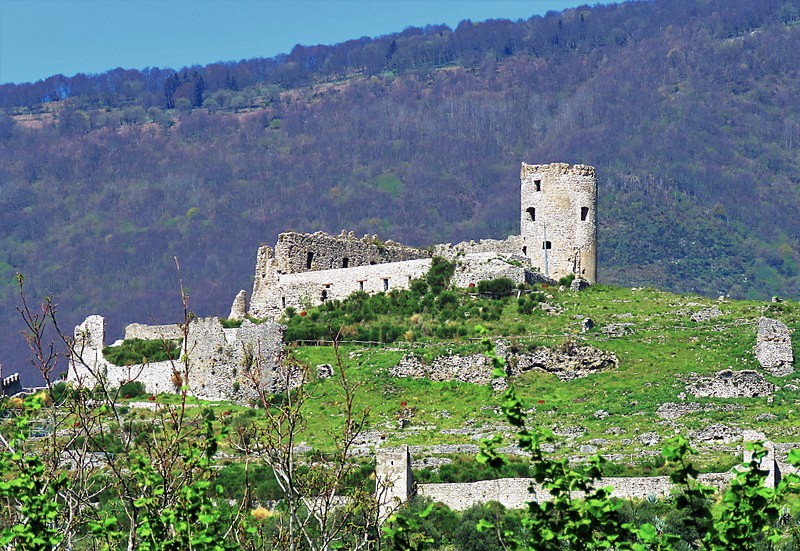
Il castello longobardo di Avella, detto di San Michele, con mastio cilindrico e due cinte murarie sulla collina sopra il Clanio.
Church
Chiesa settecentesca detta anche Cappella di San Ciro, con altari in marmo e volta decorata dalla cerchia di Michele Ricciardi.
Church
Chiesa a navata unica con cappelle laterali e altari in marmo, custode di un dipinto settecentesco della santa.
Church
Grotta di culto nascosta nel Vallone delle Fontanelle, sopra il Clanio e Avella, con tracce di pitture almeno duecentesche.
Archaeological site
Mausolei romani di età tardo-repubblicana e del I secolo d.C. lungo le antiche strade che uscivano da Abella.
Within a few kilometres, closest first.
Church · Sperone · 1,0 km
Chiesa del patrono di Sperone, ottocentesca, che ingloba un'antica cappella affrescata dedicata a Sant'Elia.
Church · Baiano · 1,8 km
Chiesa del centro storico di Baiano, probabilmente seicentesca, con porta rivestita in metallo del 1794 e campanile quadrato.
Church · Baiano · 1,8 km
Chiesa con facciata gotica e campanile a tre ordini, che custodisce una tavola del 1610 e stucchi del Seicento.
Church · Baiano · 1,9 km
Chiesa del patrono di Baiano, nata nel Cinquecento come cappella, sul cui piazzale si innalza il celebre Maio di Natale.
Church · Sirignano · 2,9 km
Chiesa parrocchiale di Sirignano, eretta all'inizio del Trecento e cuore delle feste per il patrono Sant'Andrea.
Church · Tufino · 3,1 km
Itineraries, events and flavours: an email now and then, no pushy advertising.