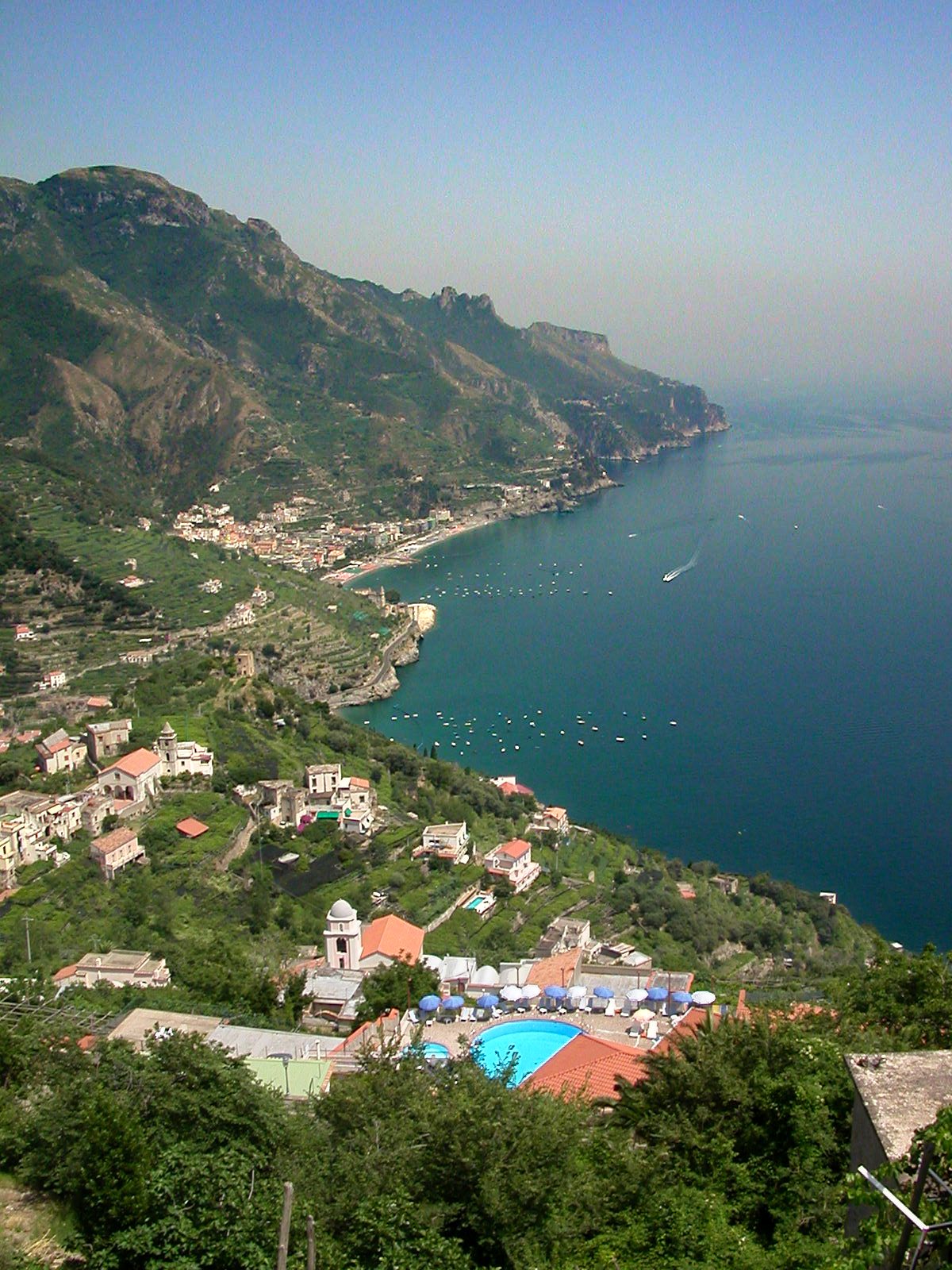
Climbing up to Ravello from the coast, bend after bend, is already part of the journey. Once in the square, with the car left behind, we found ourselves in a town suspended about 350 metres above the sea, quiet and beautifully kept. It is the terrace of the Amalfi Coast, famous for its gardens and its music: here we tell you what to see and which events come back every year.
The Cathedral and the square
The main square is dominated by the Cathedral, dedicated to Santa Maria Assunta and to San Pantaleone, whose construction began in 1086, when Ravello became a bishop's seat. Stop in front of the bronze door: it was made by Barisano da Trani in 1179, with 54 panels depicting saints and scenes from the Passion.
Inside, we were struck by the two mosaic-decorated pulpits. The most spectacular is the Gospel pulpit, made in 1272 by Nicola di Bartolomeo da Foggia, supported by columns resting on lions. A chapel holds an ampoule with the blood of San Pantaleone. The crypt houses the Cathedral Museum.
Villa Rufolo, Klingsor's garden
A few steps from the Cathedral you enter Villa Rufolo, built in the 13th century by the wealthy Rufolo merchant family. One of its members, Landolfo Rufolo, is the protagonist of a tale in Boccaccio's Decameron. In the mid-19th century the villa was bought and restored by the Scotsman Francis Nevile Reid, a keen botanist.
Today we recommend climbing the Torre Maggiore, about thirty metres high, and then going down into the terraced gardens. In 1880 Richard Wagner came here and, according to tradition, recognised in these gardens that of the magician Klingsor in his Parsifal. Looking out over the gulf, we understood why. Find out more in Villa Rufolo and Villa Cimbrone.
Villa Cimbrone and the Terrace of Infinity
From the centre, a walk through alleys and stone walls leads to Villa Cimbrone. In 1904 it was bought by the English banker Ernest William Beckett, Lord Grimthorpe, who transformed the villa and the surrounding land into a large park with statues, small temples, fountains and grottoes. Today the villa is a hotel, but the gardens are open to the public.
The main avenue leads to the Terrace of Infinity, a viewpoint adorned with marble busts that looks sheer down over the Gulf of Salerno. It is one of the most beautiful views we have seen in Campania: we recommend getting there in the late afternoon.
Ravello, city of music: the events that return every year
The most important event is the Ravello Festival. It was born in 1953 with Wagner concerts in the gardens of Villa Rufolo and today, every summer, it brings symphonic and chamber concerts, dance and talks to the town. Its symbol is the stage suspended over the villa's viewpoint, with the sea behind the orchestra. The programme changes every year: check the festival's official website.
Besides the festival, music is played in Ravello almost all year round, including at the Oscar Niemeyer Auditorium, designed by the Brazilian architect and inaugurated in 2010: a curved white shell that does not go unnoticed.
Among the religious traditions, the most heartfelt is the feast of San Pantaleone, the patron saint, celebrated every year on 27 July, the day on which the faithful await the liquefaction of the saint's blood.
How to get there and when to go
Ravello is reached by the road climbing up from Amalfi and Atrani, served by regular buses; the town is largely pedestrianised, so leave your car in the car parks at the entrance. For those who love walking, there are stepped paths going down towards Minori and Atrani. The ideal period runs from spring to autumn, with summer devoted to the festival. For the villas and concerts, check opening hours and tickets on the official website before you set off.
Nearby
Going down to Minori you can visit the Roman villa of Minori, while in Amalfi Amalfi: what to do and what to see awaits you. Right below Ravello is Atrani, the smallest village in Italy. For the rest of the province, start from Salerno and its surroundings.
Top photo (Ravello): Matt c j486 at English Wikipedia, CC BY-SA 3.0, via Wikimedia Commons.