Positano and Praiano are close to each other, but they seemed to us like two different worlds. Positano is a vertical town of colourful houses tumbling down to the sea, always lively; Praiano is quieter, suited to those looking for a slow pace and sunsets. Here we tell you what to visit in both, with a few practical tips for getting around.
Positano, the town of steps
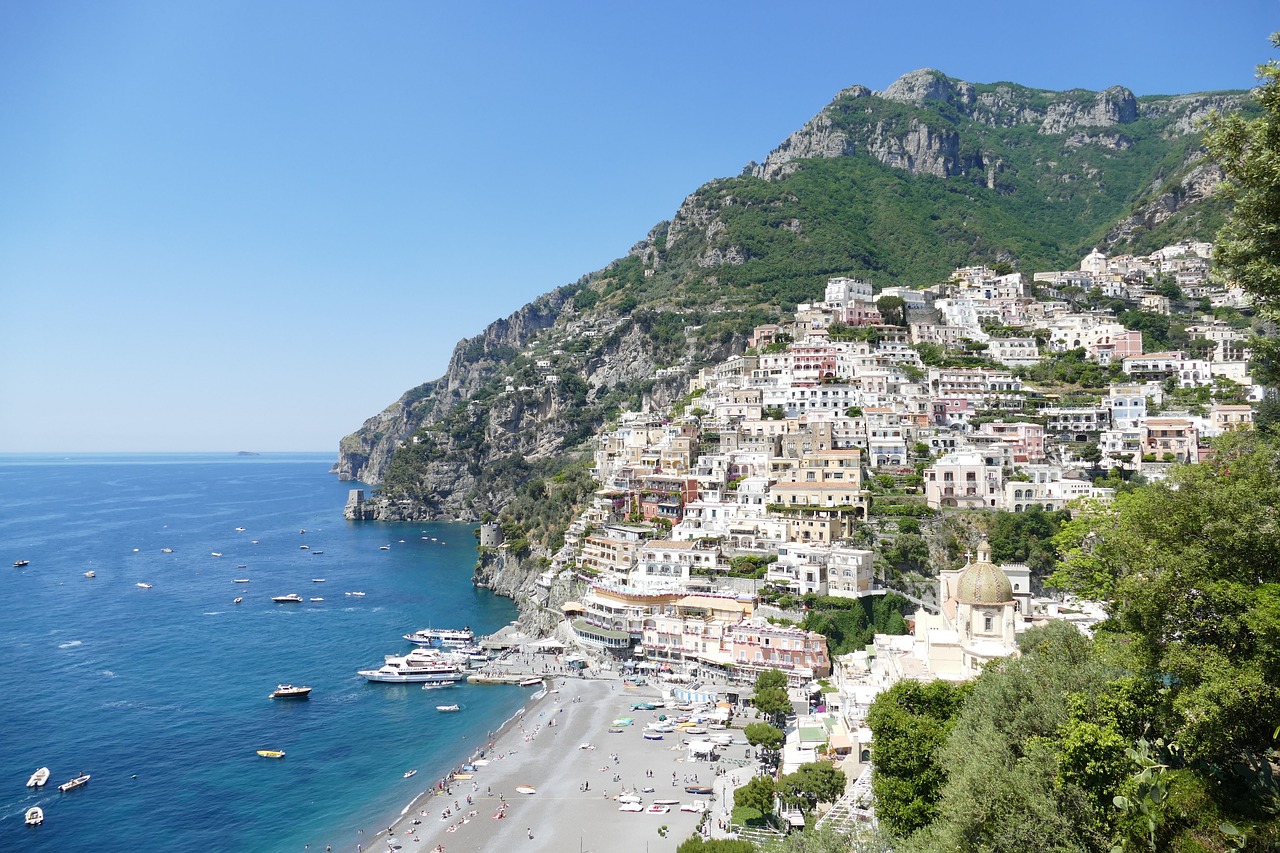
The first tip is also the most important: comfortable shoes. Positano is a tangle of stairways, alleys and terraces, and almost everything is visited on foot. The main road winds down in hairpin bends towards the sea, but the best way to get to know the town is to lose yourself among the steps, stopping to take in the view at every turn. Like the whole coast, since 1997 it has been part of the Amalfi Coast UNESCO site.
The Church of Santa Maria Assunta
The town's symbol is the dome covered in yellow, green and blue majolica tiles of the Church of Santa Maria Assunta, recognisable from every point of the bay. The church's origins probably date back to the 10th century, linked to a Benedictine abbey; its present appearance is due to 18th-century remodelling, and the bell tower dates from 1707.
On the high altar is the Byzantine icon of the Black Madonna with Child. Tradition tells that a ship coming from the East was stuck offshore until the sailors heard a voice saying «Posa, posa» ("put it down, put it down"): once the icon was brought ashore, the ship was able to set sail again. Many trace the town's name back to this story. Beneath the church are the remains of a Roman villa, a reminder that this stretch of coast was loved even in ancient times.
The beaches of Positano
The most famous is the Spiaggia Grande, right below the town, with boats coming and going and a view of the colourful houses. We do, however, recommend heading over to Fornillo too, reached by a short path along the cliff and usually quieter. From the sea, by boat, you can see the islets of Li Galli, linked to the myth of the sirens. You will find more ideas in the most beautiful beaches in the province of Salerno.
The Path of the Gods and Nocelle
If you love walking, the Path of the Gods is an experience to have at least once. It starts from Bomerano, a hamlet of Agerola, and ends at Nocelle, a small village above Positano, covering about 7.8 kilometres suspended between mountain and sea. From Nocelle you go down to the town by a long flight of steps. All the details are in the Path of the Gods.
Praiano, among domes and sunsets
Praiano has fewer than two thousand inhabitants and is divided between the village of Vettica Maggiore and the higher area. As we strolled around we noticed the many votive shrines decorated with majolica and the churches with colourful domes, such as that of San Gennaro, overlooking the sea. The patron saint is Saint Luke, celebrated every year in summer.
Its great strength is its position: facing west, Praiano offers sunsets that stretch across the sea as far as Positano and, on clear days, towards Capri. Going down to the Marina di Praia, a small inlet among the rocks, you will find fishing boats and a sheltered corner of sea.
Among the most heartfelt festivals is the Luminaria di San Domenico, which every year in early August lights up Vettica Maggiore with thousands of small lamps. A tasty curiosity: the sfogliatella Santa Rosa was not born here, as is often written, but in the nearby monastery of Conca dei Marini. Its story is in the sfogliatella Santa Rosa.
How to get there and when to go
Both towns lie along the Amalfitana coast road and are connected by regular buses; in summer ferries to Amalfi and Salerno also leave from Positano. By car, be prepared for scarce and expensive parking. The best months are May, June and September: mild weather and fewer crowds. For sea connections, check timetables and tickets on the official website before you set off.
Nearby
Heading east you come to the Fjord of Furore and then Amalfi: what to do and what to see. Higher up, above the coast, Ravello: what to see and major events awaits you. For the full picture of the province, read Salerno and its surroundings.